Liquid Glue by Material: Paper, Wood and Plastic
Elmer’s Glue-All wins as the one bottle most homes should stock, bonding paper, wood, cloth and ceramic. Fabric and felt hold better with Aleene’s Original Tacky Glue, which grabs in about a minute. Damp or outdoor repairs belong to Gorilla Clear Glue, since cured PVA softens in moisture.
Keep Elmer’s Glue-All on the shelf if you want one bottle for household repairs, because water-based PVA sticks to paper, wood, cloth and pottery alike. Moisture undoes it, so cured joints soften outdoors. Crafters working mostly in fabric and felt get cleaner seams from Aleene’s Original Tacky Glue.
Bottle labels rarely say which chemistry suits which material, and an adhesive that holds cardstock all year can peel off polypropylene in a day. We compared stated chemistry, bottle size, set and cure times, water resistance ratings and listed surface compatibility, then weighed what owners report about nozzle control and long term holding. Each pick below maps to a distinct job rather than one universal winner.
What we recommend

Elmer’s Glue-All Multi-Purpose Liquid Glue
Water-based PVA soaks into porous fibers and dries as the water leaves, so no stringing or foaming appears. Beads set in roughly 15 to 20 minutes and reach working strength overnight. Owners report enough flex for paper crafts plus enough grip for light wood joints such as drawer stops.
Pros
- One bottle covers paper, wood, cloth and pottery
- Non-toxic and wipes away with a damp cloth while wet
- Squeeze bottle meters a thin, even bead
Cons
- Cured film softens under prolonged moisture
- Slow set means taping or clamping parts

Aleene’s Original Tacky Glue
Higher solids and less water give this PVA a body thick enough to stay on a vertical seam. Grab happens within a minute or two, which helps when placing ribbon, felt or foam shapes by hand. Cured film stays flexible, so fabric projects bend without cracking along the glue line.
Pros
- Holds trim in place without clamps
- Flexible when dry, so seams survive folding
- Rinses out of brushes with warm water
Cons
- Too thick to spread thin on tissue paper
- Full cure still runs several hours
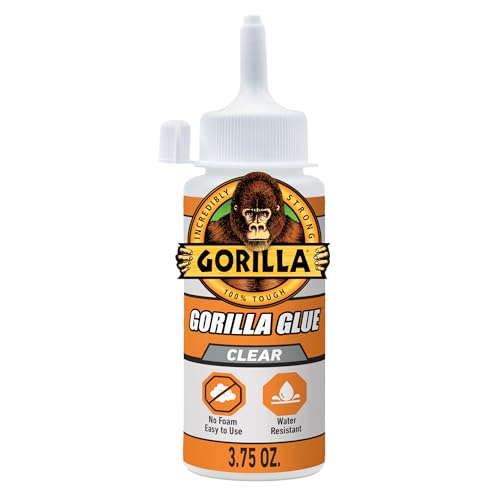
Gorilla Clear Glue
Transparent cure and water resistance make this the bottle for garden ornaments, window trim and anything facing a rainy week. Unlike the brown original Gorilla formula, it does not expand or foam, so the joint line stays tidy. Budget one to two hours of light clamping and a full day before loading the repair.
Pros
- Dries fully clear with no foaming
- Holds through damp and outdoor exposure
- Bonds wood, foam, glass, metal and ceramic
Cons
- Clamping is needed for a tight joint
- Nozzle plugs solid if the cap goes missing

Elmer’s Washable School Glue
Classrooms buy this by the case because spills rinse out of shirts and off desks with water. Bond strength sits below Glue-All, a deliberate trade for washability on porous paper and card. Borate activators turn it into slime, which explains why the 4 oz bottle empties fast in a house with kids.
Pros
- Washes out of fabric and off hands
- AP certified non-toxic for young children
- Reacts predictably with borate slime activators
Cons
- Weaker hold than multi-purpose PVA
- Porous surfaces only, so plastic is out

Titebond II Premium Wood Glue
Aliphatic resin carries an ANSI Type II water resistance rating, so outdoor benches and planters stay together through weather. Open time runs about five minutes, which rewards a dry fit before any glue leaves the bottle. Squeeze-out blocks stain once dry, making a wet rag part of the routine.
Pros
- Cured joint outlasts the wood fibers around it
- Rated for exterior projects, not just indoor
- Cleans up with water before curing
Cons
- Five minute open time rushes long panel glue-ups
- Dried squeeze-out shows through stain

Loctite Super Glue Liquid Professional
Rubber toughening sets this apart from basic cyanoacrylate, adding resistance to impact and vibration. Coverage is measured in drops, and a side squeeze bottle places them one at a time. Bonds form in seconds on metal, rubber, ceramic and rigid plastics such as ABS.
Pros
- Holds in seconds with no clamp required
- Survives vibration better than plain super glue
- Side squeeze bottle avoids flooding small parts
Cons
- Sticks skin instantly, so wear gloves
- Fills gaps poorly on loose or uneven joints

Beacon 3-in-1 Advanced Craft Glue
Mixed media work is where this small bottle earns its shelf space. Glass to metal and fabric to wood both hold, pairings where standard PVA slides apart once dry. Solvent chemistry means an open window during use, and a fine tip that suits beads, findings and small parts.
Pros
- Joins dissimilar materials that PVA cannot
- Dries clear and keeps some flex
- Fine tip suits jewelry and miniature work
Cons
- Solvent odor calls for ventilation
- 2 oz bottle runs dry on larger projects
How they compare
| # | Model | Type | Best for | Score | Price |
|---|---|---|---|---|---|
| 1 | Elmer’s Glue-All Multi-Purpose Liquid Glue | Water-based PVA | Best overall | 9.4 | Check price |
| 2 | Aleene’s Original Tacky Glue | Thick tacky PVA | Best for crafts | 9.2 | Check price |
| 3 | Gorilla Clear Glue | Water resistant clear adhesive | Best for outdoor repairs | 9.0 | Check price |
| 4 | Elmer’s Washable School Glue | Washable PVA | Best budget | 8.7 | Check price |
| 5 | Titebond II Premium Wood Glue | Aliphatic resin wood glue | Best for woodworking | 8.5 | Check price |
| 6 | Loctite Super Glue Liquid Professional | Cyanoacrylate, rubber toughened | Best for instant repairs | 8.2 | Check price |
| 7 | Beacon 3-in-1 Advanced Craft Glue | Solvent based craft adhesive | Best for mixed materials | 8.0 | Check price |
How to pick the right one
What to look for in a liquid glue Match chemistry to material before comparing anything else. PVA soaks into porous surfaces such as paper, wood and fabric, then hardens as water evaporates. Cyanoacrylate cures using surface moisture and grips non-porous items like metal, ceramic and rigid plastic. Solvent based craft adhesives bridge the two, which is how glass bonds to fabric. Check the bottle size against how much you actually use, because a 2 oz craft bottle and an 8 oz wood glue serve very different project volumes. Nozzle shape matters more than buyers expect, since a fine tip places single drops that a wide cap floods.
Working time, clamp time and full cure Three numbers shape how a glue-up feels. Working time is how long parts can shift, clamp time is how long pressure must stay on, and cure time is when full strength arrives. Titebond II allows about five minutes of open time, comfortable on a small joint and tight across a long panel. Gorilla Clear Glue wants one to two hours under clamps and a day to finish curing. Super glue skips clamping entirely, which also means no second chance at alignment. Slower PVA rewards patience with squarer assemblies, so pick your pace to match the part.
Best liquid glue for paper, cardstock and school projects Washability outranks raw strength for anything children handle. Elmer’s Washable School Glue rinses out of clothing, keeping classroom spills minor. Thin paper wrinkles when a glue carries too much water, so spread a light film and press flat under a book until dry. Cardstock, ribbon and three dimensional paper builds favour Aleene’s, whose thicker body grabs before gravity pulls a piece loose. Avoid super glue on paper entirely, because it soaks through and leaves a stiff dark patch.
Outdoor, wood and mixed material repairs Moisture ends most household repairs. Gorilla Clear Glue resists water and dries invisible, a useful combination on garden ornaments and exterior trim. Structural wood joints belong to Titebond II, whose Type II rating covers outdoor furniture. Repairs joining glass to metal or plastic to fabric call for Beacon 3-in-1 instead of any PVA. Scuff slick plastic and glazed ceramic with fine sandpaper first, giving the adhesive a surface to key into. Polyethylene and polypropylene remain the exception, since almost nothing holds on them without a primer.
Common questions
What is the strongest liquid glue for household repairs?
Strength depends entirely on the material pair. Loctite Super Glue Liquid Professional wins on small non-porous parts like metal and rigid plastic. On wood, Titebond II builds a joint stronger than the fibers beside it.
Is liquid glue waterproof once it dries?
Most PVA is not. Elmer’s Glue-All softens under sustained moisture, while Gorilla Clear Glue and Titebond II are built to resist it. Look for a stated rating such as ANSI Type II rather than assuming.
Which glue works best on fabric without stiffening it?
Aleene’s Original Tacky Glue stays flexible after curing, so seams bend instead of cracking. Spread it thin and press, because a heavy bead dries stiff even in a flexible formula.
How long does liquid glue take to dry?
Thin PVA films feel dry in 15 to 30 minutes and reach full strength near 24 hours. Cyanoacrylate sets in seconds. Wood glue wants roughly 30 minutes under clamps before handling.
Can liquid glue bond plastic?
Some can. Cyanoacrylate grips ABS, PVC and most rigid plastics, while PVA beads up and peels off. Polyethylene and polypropylene resist nearly every adhesive unless primed first.
Does school glue work for slime?
Yes. Elmer’s Washable School Glue reacts with borate activators to form the polymer network slime needs. Clear PVA versions produce a glassier result than the white formula.
What is the difference between tacky glue and regular white glue?
Tacky glue holds more solids and less water. That thicker body grabs faster and stays put on vertical seams, where thin white glue runs downhill before it sets.
How do you unclog a dried glue nozzle?
Remove the cap, then push a pin or straightened paperclip through the tip. Warm water softens a PVA plug after a few minutes of soaking. Cyanoacrylate tips usually need the plug picked out dry.
Is white glue or wood glue better for furniture repair?
Wood glue, every time. Titebond II grips end grain and edge joints under load, while multi-purpose PVA creeps when a chair rail or leg carries weight.
How should liquid glue be stored?
Cap tightly and keep bottles above freezing, since frozen PVA can separate and never recover. Store cyanoacrylate upright in a cool spot, and wipe the tip before recapping so the nozzle stays open.
Final word
Elmer’s Glue-All earns the top spot because a single 7.625 oz bottle handles the paper, wood, cloth and ceramic jobs that fill most households. Switch to Aleene’s Original Tacky Glue if your projects mean fabric, felt and vertical seams that need to grab fast. Outdoor fixes and structural wood joints should skip both, going to Gorilla Clear Glue or Titebond II for real water resistance.
Marcus Chen
Marcus covered consumer electronics for enthusiast tech publications for six years before joining ChoiceCrest. He specializes in translating manufacturer spec sheets into plain-language buying advice, with a focus on audio, computing accessories and smart-home gear.
You might also need
Nintendo Game & Watch: Super Mario Bros Review: Still Worth It as a Collectible?

Ray-Ban Meta (Gen 2) Wayfarer Smart Glasses: Worth $379 for Clear Lenses?
AlyKets Nikon UC-E6 Replacement USB Cable: Does a $7.95 Cord Work as Well as the Original?
