9 Card Games Worth Adding to Family Game Night
UNO wins on reach: it plays with almost any group and needs no rulebook. Exploding Kittens suits new players who want fast, silly rounds. Sushi Go Party! adds real strategy through card drafting without losing the light, family-friendly feel that makes it easy to bring to the table.
UNO tops this list because it works with nearly any group and teaches itself in under a minute. Exploding Kittens gets a fun round going fastest with people who don’t normally play games, since the theme does the explaining. Sushi Go Party! is the step up for players ready for light strategy, using a drafting system that stays simple but still rewards planning.
Choosing a card game is trickier than it looks, since the box lists a maximum player count, not the count where the game is actually good. A design that shines with four can drag at seven, and stated playing times usually assume everyone already knows the rules. We compared player counts, playing times, rules complexity, and age guidance, then weighed those against what owners report about mixed-age groups and whether a game survives its second month on the shelf.
Our top picks

UNO Card Game
Matching colors or numbers keeps the rules simple enough for a first game night. Action cards add just enough friction to keep every player alert. Two players work as well as a full table of ten, and grandparents pick it up as fast as kids do.
Pros
- Explains itself in under a minute
- Works from two players up to ten
- Handles mixed ages at the same table
Cons
- Repeated draw cards slow a round down
- Offers little challenge for strategy-minded adults

Exploding Kittens Card Game
The premise takes ten seconds to explain: avoid the exploding card, or make someone else draw it. Rounds run about fifteen minutes, so a bad hand costs little. Losing players sit out until the round ends, and the artwork skews older than the stated age guidance.
Pros
- Rules understood before the box is opened
- Short rounds invite an immediate replay
- Artwork carries the fun for reluctant players
Cons
- Eliminated players wait for the round to finish
- Humor sits above the seven-and-up age guidance

Sushi Go Party!
Every player drafts simultaneously from a passed hand, so nobody waits for a turn. Set collection scoring rewards planning without punishing one bad round. The party edition swaps in new card menus each game, which drives most of the replay value.
Pros
- Simultaneous play removes turn-taking downtime
- Rotating menus keep repeat games fresh
- Comfortably seats up to eight players
Cons
- Scoring adds more arithmetic than young kids enjoy
- Menu variety means re-explaining rules at each setup
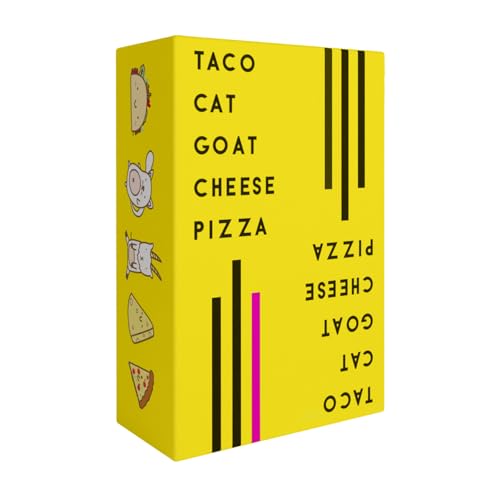
Taco Cat Goat Cheese Pizza
Say the word sequence while flipping cards, then slap the pile the instant it matches. Thirty seconds covers the whole explanation, and the box fits a coat pocket for restaurants and holidays. Reflexes decide every round, so fast adult hands tend to beat small children.
Pros
- Explains in half a minute to anyone
- Pocket-sized box travels easily
- Produces laughter almost every round
Cons
- No strategy involved, purely reflex
- Adults out-slap children in mixed groups

The Crew: Mission Deep Sea
Trick-taking usually pits players against each other; here the whole table wins or loses together. Restricted communication creates the tension across a long mission campaign. It assumes players already understand trick-taking, so it isn’t a first card game.
Pros
- Whole table wins or loses as one team
- Long campaign adds lasting replay value
- Difficulty increases gradually across missions
Cons
- Requires prior familiarity with trick-taking games
- Awkward for a group whose size keeps changing

Phase 10 Card Game
Ten set-collection objectives, cleared in order, give the game the shape of a mini campaign. Each player advances at their own pace, keeping everyone invested. Sessions run 45 minutes or longer, well past most fillers on this list.
Pros
- Structured phases keep players motivated
- Familiar rummy mechanics are easy to pick up
- Suits a full evening rather than a quick filler
Cons
- Runs noticeably longer than a typical card game
- Getting stuck on one phase frustrates for rounds

SET Card Game
Spot three cards where four attributes are all the same or all different: that single rule produces real depth. Everyone plays simultaneously, so no one waits through a turn. It works solo just as well as with a full group.
Pros
- One elegant rule covers the entire game
- No turn order, everyone plays at once
- Works equally well solo or in groups
Cons
- Fast pattern spotters dominate every round
- Visual search style doesn’t suit every player
How they stack up
| # | Model | Players | Best for | Score | Price |
|---|---|---|---|---|---|
| 1 | UNO Card Game | 2 to 10 | Best overall | 9.4 | Check price |
| 2 | Exploding Kittens Card Game | 2 to 5, expandable | Best for new players | 9.2 | Check price |
| 3 | Sushi Go Party! | 2 to 8 | Best family strategy | 9.0 | Check price |
| 4 | Taco Cat Goat Cheese Pizza | 2 to 8 | Best quick filler | 8.7 | Check price |
| 5 | The Crew: Mission Deep Sea | 2 to 5 | Best cooperative game | 8.5 | Check price |
| 6 | Phase 10 Card Game | 2 to 6 | Best longer session | 8.2 | Check price |
| 7 | SET Card Game | 1 to 20 | Best for pattern thinkers | 8.0 | Check price |
What matters most
Match the game to the group you actually host Player count on the box is the range a game supports, not the range where it plays best. Many designs peak at three or four players and slow down at their stated maximum, since more players means longer waits between turns. A regular group of two should look for games with dedicated two-player rules rather than ones that merely allow it. Hosting six or more often works better with simultaneous-play designs, where nobody sits idle.
Rules weight decides whether it gets replayed A twenty-minute rules explanation has to earn its place every single time the box comes out. In most households, that barrier means the game stops getting chosen. Titles that teach in under a minute get played on an ordinary weeknight, which is when most families actually reach for a card game. Save the heavier titles for evenings when everyone already has time to spare.
Check how elimination affects younger players Elimination works fine when a round lasts ten minutes and the group deals in again right away. It becomes a problem when the last two players grind on for twenty more minutes while a child watches. Groups with younger or easily distracted players do better with games that score at the end instead of knocking people out. Where elimination is unavoidable, favor short rounds with a fast redeal.
Age guidance tracks reading and math, not content Published age guidance usually reflects reading level and the arithmetic required for scoring, not any content concern. A child comfortable with basic addition and short card text often plays a year or two below the stated age with light help. A game rated for eight can still frustrate an eight-year-old if scoring runs through several categories at once. Look at what a game actually asks a player to calculate, not just the number on the box.
Questions worth asking
What card game is best for two players?
Look for games with dedicated two-player rules, since many designs remove the interaction that makes them work at higher counts. Trick-taking and drafting games in particular scale poorly to two without adjustments built in.
Which card game travels best?
The smallest boxes travel easiest, and quick reflex games in tiny packaging fit a coat pocket for flights and restaurants. Games with score pads or a large table spread need room, so save those for home.
How do you get reluctant players to join a card game?
Start with something that explains in under a minute and runs short rounds, so a hesitant player only commits to five minutes. Humor helps too, since laughing together feels social rather than competitive. Save the strategic titles for later in the evening.
Are cooperative card games good for mixed-skill families?
Yes, since a stronger player can help rather than simply beat everyone else. The risk is one person directing every decision, which some cooperative designs limit by restricting communication. That restriction is exactly what keeps the format interesting.
Do card games need sleeves?
Sleeves help games handled often by kids or shuffled hard, adding some bulk and cost. Adult game nights rarely need them, but a favorite family title destined for hundreds of plays lasts much longer sleeved.
What is card drafting?
Players receive a hand, keep one card, then pass the rest along, repeating until the hand runs out. Everyone chooses at the same time, so there’s no waiting, and picks involve both what helps you and what you hand a neighbor.
How many card games does a household actually need?
Three usually covers it: one light filler for short gaps, one family game with real decisions, and one longer title for evenings everyone commits to. Buying more at the same weight tends to mean the favorites still get played and the rest sit unopened.
Can these games be played with a standard deck instead?
Rummy and trick-taking mechanics can, but games like Sushi Go Party! or Exploding Kittens rely on bespoke cards and abilities a standard deck can’t reproduce. A standard deck remains great value for classic formats, while dedicated games buy pre-balanced rules and components.
UNO vs Exploding Kittens: which is the better first game?
UNO teaches in under a minute and scales from two players to a full table, making it the safer default. Exploding Kittens edges it out for groups who claim not to like games, since the theme carries the explanation and rounds run shorter.
Is Phase 10 good for kids?
The rummy mechanics suit kids from around age seven, but the forty-five-minute-plus sessions run long for short attention spans. It fits better as a family evening game than a quick weeknight filler.
Our take
UNO remains the game most likely to get opened, since it fits almost any group and any age. Exploding Kittens works better as a first move with people who don’t usually play games, thanks to its short rounds and self-explaining theme. Once a group is ready for real decisions without a heavy rulebook, Sushi Go Party! is the natural next step.
Rachel Simmons
Rachel previously worked in child-product retail and brings a practical, detail-first eye to gear reviews, focusing on safety standards, ease of use and the fine print that matters most for new caregivers.