9 Memory and Matching Games Kids Actually Want to Replay
Ravensburger Disney Classics Memory is the top pick for thick tiles and images young children recognise instantly. Wonder Forge I Never Forget a Face adds real world faces that hold attention longer, and Blue Orange Spot It is the fast paced matching game that travels best.
For a first memory game, Ravensburger Disney Classics Memory is the safest choice thanks to sturdy tiles and instantly familiar images. Wonder Forge I Never Forget a Face keeps older preschoolers engaged with photographs of children around the world, and Blue Orange Spot It is the pocket sized matching game families actually keep playing.
Picking a matching game is harder than it looks because the differences that matter are physical, not thematic. Thin cards curl within a fortnight, glossy printing throws glare, and an oversized grid turns a five minute game into a frustrating twenty. We compared card stock and tile thickness, recommended ages, pairs per round and image legibility, then weighed those against what parents report about repeat play.
How to pick the right one
Memory games vs speed matching games: what is the difference? Classic memory games hide cards face down and test recall, which suits a single child working at their own pace. Speed matching games such as symbol spotting leave everything visible and reward fast scanning instead. That format levels the field between generations, since a five year old often beats a parent at spotting symbols. A family with a wide age range gets more mileage from a speed game, while one toddler benefits more from classic memory.
What makes a matching game durable enough for daily play? Board thickness is the biggest quality gap between sets. Thick tiles stay flat under sticky hands and resist bending in a warm room, while thin card develops a bow within weeks. A bowed card becomes a marked card, since it stands out in the grid and ruins the challenge. Matte finishes also beat glossy printing under a ceiling light, because glare hides the image from a child sitting low at the table.
How many pairs should a first game include? Most boxes ship with more pairs than a young child should face at once. Six to eight pairs gives a toddler a round they can finish and win, while a full 36 pair layout usually ends with someone wandering off. Treat the printed pair count as a ceiling for later, not an instruction for day one. Add pairs gradually as recall improves.
Which art style helps kids match faster? Bold, high contrast illustrations of familiar animals and objects beat busy, detailed scenes for young matchers. A child who can name what they see finds the game easier and stays interested longer. Photographic sets add a fresh challenge once cartoon icons feel too easy for older preschoolers. Whatever the style, check that pairs look visibly distinct, since near identical images turn matching into guesswork.
The best picks, ranked

Ravensburger Disney Classics Memory Game
Ravensburger has produced this style of memory game for decades, and the tile stock shows it, staying flat under sticky toddler hands instead of warping. Familiar Disney artwork gives three year olds an instant hook, and each pair stays visually distinct enough to avoid guesswork. A matte coating keeps overhead light from washing out the images.
Pros
- Tiles stay flat with heavy use
- Matte finish cuts glare
- Characters are easy for toddlers to name
Cons
- Full 36 pair grid overwhelms first time players
- Character appeal fades as kids age out

Wonder Forge I Never Forget a Face Matching Game
Photographs of real children replace cartoon icons here, and that extra detail holds attention longer than most illustrated sets. Each card names the country on the back, turning a match into a quick geography chat. Thick coated stock survives repeated shuffling without denting.
Pros
- Photographs sustain interest longer
- Country names spark conversation
- Coated card resists shuffling wear
Cons
- Faces are harder to match than icons
- Too subtle for the youngest players
Blue Orange Spot It Card Game
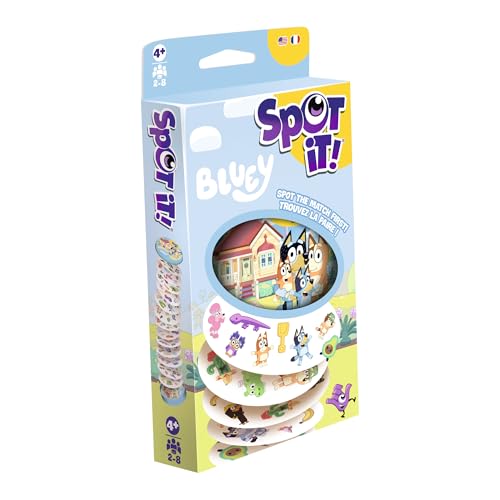
Spot It swaps recall for speed: every pair of cards shares exactly one symbol, and players race to name it first. A metal tin keeps 55 round cards intact inside a glovebox or backpack. Because the game rewards fast scanning over memory, adults and kids compete on genuinely equal footing.
Pros
- Adults and children compete fairly
- Tin survives a bag or glovebox
- Several game modes in one deck
Cons
- Fast pace frustrates some younger kids
- Not a memory game in the classic sense
Melissa and Doug Flip to Win Memory Game
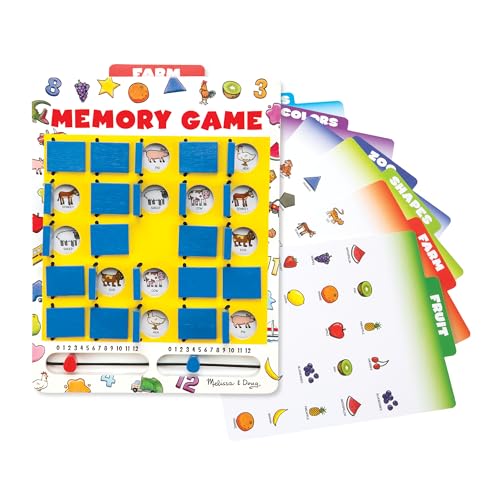
Wooden flippers sit inside a hinged board here, so nothing slides under the couch and setup takes seconds. Interchangeable cards slot behind the flippers, which stretches the game well past one theme. That closed format survives being tossed in a car boot repeatedly.
Pros
- Nothing to lose or scatter
- Instant setup and pack away
- Swappable card sets add variety
Cons
- Limited to two players
- Bulkier than a card box

eeBoo Little Hands Memory and Matching Game
eeBoo scales this set to small hands, with oversized cards a two year old can grip without fumbling. Twelve pairs keep a round short enough to finish before attention drifts. Illustrations sit on recycled board with a soft matte coating that avoids glare.
Pros
- Card size suits toddler grip
- Short rounds match short attention
- Clear, nameable illustrations
Cons
- Outgrown within a couple of years
- Few pairs limits challenge

Briarpatch The World of Eric Carle Matching Game
Bold, high contrast Eric Carle illustrations make pairs easy to tell apart at a glance. Eighteen pairs cover animals and shapes drawn from picture books many families already own. Card stock is respectable for the price, though it falls short of premium board tiles.
Pros
- High contrast art is easy to match
- Ties into familiar picture books
- Good value for the pair count
Cons
- Card stock thinner than premium sets
- Glossy coating shows fingerprints

Mudpuppy Memory Matching Game
Mudpuppy commissions original illustrators instead of licensing characters, so the cards look at home on a coffee table. A sturdier than average box keeps the set organized between uses. Uniform card backs stop anyone from spotting a printing tell and cheating.
Pros
- Distinctive commissioned artwork
- Sturdy storage box
- Consistent card backs
Cons
- Detailed art is harder for toddlers
- Fewer pairs than large sets
Compared at a glance
| # | Model | Ages | Best for | Score | Price |
|---|---|---|---|---|---|
| 1 | Ravensburger Disney Classics Memory Game | 3 and up | Best overall | 9.4 | Check price |
| 2 | Wonder Forge I Never Forget a Face Matching Game | 4 and up | Best for older preschoolers | 9.2 | Check price |
| 3 | Blue Orange Spot It Card Game | 6 and up | Best for travel | 9.0 | Check price |
| 4 | Melissa and Doug Flip to Win Memory Game | 5 and up | Best self contained | 8.8 | Check price |
| 5 | eeBoo Little Hands Memory and Matching Game | 2 and up | Best for toddlers | 8.6 | Check price |
| 6 | Briarpatch The World of Eric Carle Matching Game | 3 and up | Best value | 8.3 | Check price |
| 7 | Mudpuppy Memory Matching Game | 3 and up | Best design | 8.0 | Check price |
Good to know
What age can kids start playing memory games?
Around two with oversized cards and a small grid, and more reliably from age three. Begin with six to eight pairs and expand gradually. Attention span limits early play more than actual recall ability does.
How many pairs should I lay out for a first game?
Six to eight pairs suits a toddler or young preschooler. That grid produces a round lasting a few minutes and ending in a win, which matters more for repeat play than difficulty does.
Do memory games actually help child development?
They build short term recall, turn taking and naming skills inside play kids already enjoy. Treat them as useful repetition rather than a training program, since relaxed, repeated exposure drives the benefit.
What is the difference between a memory game and a matching game?
Memory games hide cards face down, so players must recall where a pair sits. Matching games leave images visible and reward spotting a connection fast. Many families end up owning one of each, since the two exercise different skills.
Are wooden memory games better than card ones?
Wood and board tiles resist bending longer than standard card stock. Card sets pack more pairs and more variety into the same price. A self contained board is the most practical option for travel, since nothing can fall out and get lost.
How do I stop memory game cards from getting lost?
Pick a set with a sturdy box or a self contained flip board, and count pairs back in after each round. A rubber band around loose decks helps too, since original boxes tend to split at the corners first.
Can adults play memory games fairly against kids?
Adults usually win classic memory games outright. Speed matching games close that gap, because visual scanning speed does not favor adults nearly as much. Giving an adult fewer turns is another simple way to even the odds.
Which memory game works best for a mixed age group?
Symbol spotting games scale best, since every player competes in the same round. For classic memory, deal a larger grid to older kids and a smaller sub grid to the youngest so everyone has a game they can win.
Ravensburger or Wonder Forge for a first memory game?
Ravensburger Disney Classics suits a first purchase, since thick tiles and familiar characters keep three year olds engaged from the start. Wonder Forge I Never Forget a Face fits better once a child nears five and is ready for subtler photographic pairs.
Final word
Ravensburger Disney Classics Memory is the set most families should start with, because thick tiles and clear images survive the enthusiasm of a three year old. Wonder Forge I Never Forget a Face is the better next step once cartoon icons feel too easy. If the game needs to travel and cover a range of ages, Blue Orange Spot It earns its place in a bag.
Rachel Simmons
Rachel previously worked in child-product retail and brings a practical, detail-first eye to gear reviews, focusing on safety standards, ease of use and the fine print that matters most for new caregivers.