Which Cabinet Latches Actually Keep Toddlers Out?
The Sugatsune Magnetic Touch Latch tops this list for handleless doors that need a clean push to open. National Hardware’s Double Roller Catch is the dependable fix for doors that drift open on their own. Safety 1st’s Adhesive Magnetic Lock System offers the strongest option built for keeping toddlers out.
Handleless cabinet doors work best with the Sugatsune Magnetic Touch Latch, which pushes the door back out with a firm spring loaded magnet. Doors that will not stay closed on their own need the National Hardware Double Roller Catch instead. Anyone focused on keeping a toddler out should reach for the Safety 1st Adhesive Magnetic Lock System.
Cabinet latches look interchangeable in a listing photo, yet they solve entirely different problems. Some hold a warped door shut, some replace a handle entirely, and some exist purely to block small hands. We compared mounting styles, adjustability, published holding force where manufacturers state it, and whether installation means screws, adhesive or drilling. Owner reports on long term grip and adhesive failure shaped the final ranking.
The top picks, ranked

Sugatsune Magnetic Touch Latch
Sugatsune, a Japanese hardware maker with decades in cabinet fittings, built this touch latch to make handleless doors work properly. Press the door and a spring loaded magnet pushes it back out, then grips it firmly once closed. Owners report the mechanism keeps its snap far longer than generic push catches do.
Pros
- Genuinely handleless operation
- Firm magnetic hold when closed
- Long lasting spring mechanism
Cons
- Needs accurate alignment to work well
- Not a child deterrent

National Hardware Double Roller Catch
This classic spring loaded roller catch remains the most practical fix for a door that no longer sits flush. Two sprung rollers grip a strike plate, and mounting slots let tension creep in or out until the door closes with a positive click. Inexpensive hardware like this solves a problem most magnets cannot.
Pros
- Copes well with slightly warped doors
- Tension is adjustable after fitting
- Cheap and widely stocked
Cons
- Audible click every time
- Rollers can squeak over time

Safety 1st Adhesive Magnetic Lock System
Adhesive mounting keeps this system entirely inside the cabinet, so no latch shows and no drilling touches the cabinet face. A magnetic key releases the lock and parks out of reach on a fridge door. Owners report the adhesive holds well on smooth painted or laminate surfaces given a proper clean and cure time first.
Pros
- Invisible from outside the cabinet
- No drilling needed on most doors
- Adults can bypass instantly with the key
Cons
- Lose the key and it is a problem
- Adhesive struggles on textured wood
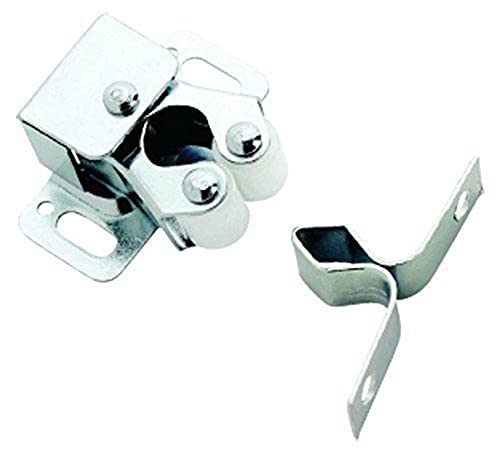
Amerock Double Roller Catch
Amerock has supplied cabinet hardware for decades, and this compact roller catch fits tight face frame installations where a full sized catch will not clear. A small body sits behind the stile without fouling the hinge, and the strike uses a simple two screw fit. Limited space inside the cabinet makes this the sensible pick.
Pros
- Fits tight face frame openings
- Simple two screw installation
- Consistent closing tension
Cons
- Less adjustment range than larger catches
- Small parts are fiddly to align

Munchkin Xtraguard Dual Action Multi Use Latch
Instead of a fixed latch, this is a flexible strap with a two step release that spans doors, drawers, appliances and awkward pairings a rigid latch cannot handle. Adhesive backing means zero drilling. Owners report the two step release genuinely stumps toddlers while staying fast enough for adults carrying groceries.
Pros
- Works on shapes rigid latches cannot
- No tools or drilling required
- Repositionable during setup
Cons
- Visible on the cabinet front
- Adhesive weakens near heat sources

Liberty Magnetic Cabinet Catch
A plain magnetic catch with a steel strike plate ships in multipacks that make outfitting a full kitchen straightforward. Nothing complicated happens here, which is the appeal. It closes quietly, carries no moving parts to wear out, and mounts with two screws into the cabinet frame in under a minute per door.
Pros
- Silent compared with roller catches
- No moving parts to fail
- Cheap in multipacks
Cons
- Weaker hold on warped doors
- Strike plate alignment is unforgiving

Jool Baby Cabinet Locks
These adjustable strap locks cover a lot of ground for very little outlay, wrapping around handles, knobs or paired doors that would otherwise need custom hardware. A sliding strap length lets one design fit several cabinet styles. Owners report the plastic release button wears first, so a slightly larger pack than needed is a sensible buy.
Pros
- Fits knobs, handles and paired doors
- Length adjusts to the cabinet
- Lowest cost per door here
Cons
- Plastic release wears with heavy use
- Clearly visible on cabinet fronts
How to pick the right one
What problem is your cabinet door actually having? Get clear on what is failing before buying hardware. A door swinging open on its own needs holding force, pointing to a roller or magnetic catch. A door with no handle needs a touch latch that pushes it back out. A door a toddler can open needs a child lock, and no amount of magnetic hold substitutes for a proper two step release. Buying the wrong category is the most common mistake here.
Roller catch or magnetic catch: which holds better? Roller catches grip mechanically and tolerate doors that no longer sit perfectly flush, making them the better repair for older cabinets that have moved with humidity. That mechanical grip comes with an audible click and rollers that can squeak. Magnetic catches close silently with nothing to wear out, but they need close contact with the strike plate, so a warped door defeats them. Cabinets that have settled call for rollers.
Does adhesive or screw mounting damage cabinets? Adhesive mounted latches leave no holes, useful on rented kitchens and finished interiors, but they need a clean, smooth, non greasy surface and a full cure before use. Cabinets near a stove collect a film over time that defeats adhesive. Screw mounted hardware stays permanent and dependable but leaves marks if removed later. Interior mounted options avoid marking the visible face either way.
Why does most cabinet latch installation come down to alignment? Nearly every complaint about cabinet latches traces back to alignment rather than the hardware itself. Touch latches need the door at a specific depth to trigger. Magnetic catches lose most grip with a small gap. Roller catches need the strike centered. Fit the door side component first, close the door gently to mark the frame position, then use slotted holes to fine tune before driving screws home.
How they stack up
| # | Model | Type | Best for | Score | Price |
|---|---|---|---|---|---|
| 1 | Sugatsune Magnetic Touch Latch | Magnetic touch latch | Best overall | 9.4 | Check price |
| 2 | National Hardware Double Roller Catch | Double roller catch | Best for drifting doors | 9.2 | Check price |
| 3 | Safety 1st Adhesive Magnetic Lock System | Magnetic child lock | Best for child safety | 9.0 | Check price |
| 4 | Amerock Double Roller Catch | Double roller catch | Best for face frame cabinets | 8.8 | Check price |
| 5 | Munchkin Xtraguard Dual Action Multi Use Latch | Flexible strap latch | Best for mixed cabinet types | 8.6 | Check price |
| 6 | Liberty Magnetic Cabinet Catch | Magnetic catch | Best value | 8.3 | Check price |
| 7 | Jool Baby Cabinet Locks | Adjustable strap lock | Best budget child lock | 8.0 | Check price |
Questions worth asking
What is the difference between a cabinet catch and a latch?
The terms overlap in practice. A catch usually holds a door closed by friction or magnetism and releases when pulled. A latch often implies a mechanism that must be operated, like a touch release or child lock. Listings use both terms loosely, so read the description rather than the name.
Will magnetic child locks damage cabinets?
Adhesive versions mount inside the cabinet and are designed to remove without pulling finish, though heat and time make removal harder. Screw mounted versions leave small holes inside the door, invisible when closed. Neither affects the visible cabinet face.
How do you fix a cabinet door that keeps swinging open?
Check the hinges first, since a loose or worn hinge is often the real cause. If hinges are sound, an adjustable double roller catch usually fixes it because it grips even when the door no longer sits perfectly flush. Adjust tension using the slotted mounting holes.
Do touch latches work on heavy cabinet doors?
They work best on light to medium doors. A heavy solid timber door can overwhelm the spring, so it never pushes out far enough to grab. Manufacturers usually state a suitable door weight range, and doubling up two latches helps on a wide door.
Can cabinet locks be installed without drilling?
Yes, with adhesive strap locks or adhesive mounted magnetic systems. Traditional roller and magnetic catches need screws, though those screws go inside the cabinet where they stay hidden.
Are magnetic child locks safe around kitchen appliances?
The magnets are small and the key is a household magnet, so keep it away from anything magnetically sensitive and off the front of appliances with digital displays. Storing the key high on a fridge side is the common approach.
How many latches does one cabinet door need?
One is normally enough for a standard door. Tall pantry doors and wide doors benefit from two, one high and one low, to stop the free edge flexing away from the frame.
Which holds better on a warped door, magnetic or roller?
Roller catches, comfortably. They tolerate a small gap because the rollers still grip the strike as the door pushes past. Magnetic catches lose holding force sharply as the gap grows, so a door that no longer sits flat keeps popping open.
Our pick
Handleless doors get their cleanest fix from the Sugatsune Magnetic Touch Latch, which keeps working reliably for years. The far more common problem, a door that drifts open, calls for the National Hardware Double Roller Catch and its adjustable, dependable grip. When child safety is the actual goal, the Safety 1st Adhesive Magnetic Lock System keeps cabinet fronts clean while genuinely stopping small hands.
Jake Monroe
Jake worked as a residential contractor for over a decade before shifting to full-time writing. He evaluates power tools, hand tools and workshop gear through the lens of someone who has actually used them on job sites, not just read the box.


