Which Utility Knife Actually Survives a Full Workday?
Milwaukee’s 48-22-1502 Fastback wins overall for one-handed flip opening and built-in blade storage. DEWALT’s DWHT10295 leads retractable designs with the fastest blade swap here. OLFA’s LA-X takes snap-off duty, since a fresh edge is always one snap away.
Milwaukee’s 48-22-1502 Fastback suits most trades and DIY jobs best, flipping open one-handed and storing a spare blade inside the handle. Retractable fans should look at the DEWALT DWHT10295 instead. Anyone cutting foam, insulation or thick cardboard gets more from the OLFA LA-X snap-off design.
A cheap lock or a stripped blade screw ruins a utility knife fast, even though most models look interchangeable in a photo. We compared opening mechanisms, blade-change speed, onboard storage capacity, grip material and owner feedback on long-term wear to separate working tools from shelf fillers.
The best picks, ranked

Milwaukee 48-22-1502 Fastback Folding Utility Knife
One button flips this knife open with a single hand, useful when the other hand is holding material steady. Blade changes need no tools, and a spare blade rides inside the steel handle. A wire-stripping notch and gut hook add function beyond straight cutting.
Pros
- Flips open one-handed with a button press
- Steel body tolerates drops and light prying
- Spare blade stores inside the handle
Cons
- Folding hinge collects drywall dust over time
- Heavier in the pocket than compact retractables

DEWALT DWHT10295 Premium Retractable Utility Knife
A push-button on the nose releases blades in seconds, without opening the knife body. Rubber overmold on the aluminum handle holds steady even with sweaty or gloved hands. Internal storage carries spare blades, so a dropped pouch does not stop a scoring job midway.
Pros
- Fastest blade swap of any knife tested here
- Three-position blade depth adjustment
- Rubber overmold grips well through long sessions
Cons
- Slider can loosen after years of daily use
- Ships without a belt clip

Stanley FatMax 10-778 Retractable Utility Knife
Decades of jobsite use back this shape, and the current FatMax version adds a bi-material grip. Its cast body absorbs drops from a ladder or scaffold without cracking. Interior storage holds up to five spare blades for a full day of flooring or roofing work.
Pros
- Cast body survives drops and light prying
- Stores up to five spare blades onboard
- Accepts standard blades from any brand
Cons
- Bulkier in a pocket than folding designs
- Blade wiggle develops sooner than on the Milwaukee
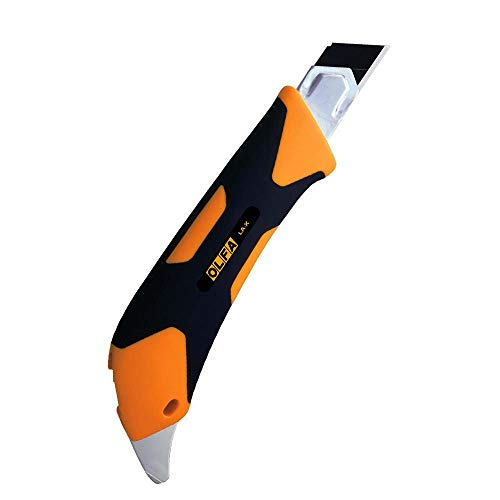
OLFA LA-X 18mm Fiberglass Utility Knife
Snapping off a dull segment produces a fresh edge in seconds, with no spare blades to dig for. A fiberglass-reinforced handle wraps around OLFA’s 18mm heavy-duty blade, locked by a positive auto-lock slider. Long blade extension suits insulation, foam board and thick cardboard.
Pros
- Fresh edge in seconds by snapping a segment
- Extends far enough for thick foam and insulation
- Rubber grip holds even in wet gloves
Cons
- Extended segments flex under heavy prying
- Used segments need a bin for safe disposal

Klein Tools 44133 Auto-Loading Utility Knife
An internal magazine feeds a fresh blade forward the moment one dulls, without opening the handle. Klein built this for electricians cutting jacketing, shrink wrap and boxes throughout a shift. A squeeze-style release keeps swaps fast even from the top of a ladder.
Pros
- Magazine reloads blades without disassembly
- Light enough for an electrician’s tool pouch
- Blade locks solidly at full extension
Cons
- Magazine only accepts standard-shape blades
- Plastic body feels less rugged than metal rivals

Slice 10558 Smart-Retracting Utility Knife
A ceramic blade cuts cardboard and shrink wrap while resisting casual skin contact, unlike steel edges. Its smart-retract slider pulls the blade inward the instant it clears the material, even with a thumb still on the slider. Warehouses adopt this design specifically to cut unboxing injuries.
Pros
- Retracts automatically the moment it exits a cut
- Ceramic edge resists rust and rarely needs changing
- Suited to shared warehouse tool bins
Cons
- Ceramic chips if used for prying
- Not built for deep cuts in dense material

Gerber EAB Lite Pocket Utility Knife
Folded, this stainless steel knife measures under three inches and doubles as a money clip. Standard utility blades keep replacement cost low at any hardware store. Everyday carry users reach for it on packages and tape rather than jobsite tasks.
Pros
- Fits easily in a pocket or wallet
- Cheap standard blades cost far less than pocket-knife sharpening
- Liner lock holds firm for its size
Cons
- Small handle tires the hand on long cuts
- No onboard spare blade storage
How to pick the right one
What type of utility knife fits your work? Four designs dominate this category. Retractable knives like the DEWALT DWHT10295 slide the blade into a rigid body, suited to constant jobsite use. Folding models such as the Milwaukee Fastback carry flatter and open with one hand. Snap-off knives trade some rigidity for an edge that is always fresh, while smart-retracting safety knives protect hands in shared workplaces. Base the choice on where the knife actually lives: a tool belt, a pocket, or a warehouse bench.
How much does the blade-change system matter? Tool-free blade changes are standard now, but speed still varies widely. DEWALT’s nose-button release takes seconds, while budget knives use slower slide-out trays. Onboard storage matters just as much, since a knife holding five spares keeps a flooring job moving without a supply run. Klein’s auto-loading magazine removes the swap step entirely, feeding blades forward on its own.
Which utility knife works best for drywall and flooring? Scoring drywall rewards a rigid, full-extension blade and a handle that will not slip in dusty hands, which favors the Stanley FatMax or Milwaukee Fastback. Flooring installers cutting underlayment and vinyl lean on snap-off blades instead, since laminate glue and abrasive backing dull edges fast. An 18mm snap-off like the OLFA LA-X keeps a sharp segment ready every few cuts.
When should you choose a safety or compact knife? Warehouses and shipping rooms should standardize on smart-retracting ceramic knives, since box cutting causes a large share of hand injuries on the floor. Slice’s finger-friendly grind cuts material aggressively while staying hard to cut skin with. Everyday carry calls for something smaller instead: a compact folder like the Gerber EAB Lite handles packages without the bulk of a full-size knife. Neither design replaces a full-size knife for construction work.
Compared at a glance
| # | Model | Type | Best for | Score | Price |
|---|---|---|---|---|---|
| 1 | Milwaukee 48-22-1502 Fastback Folding Utility Knife | Folding | Best overall | 9.4 | Check price |
| 2 | DEWALT DWHT10295 Premium Retractable Utility Knife | Retractable | Best retractable | 9.2 | Check price |
| 3 | Stanley FatMax 10-778 Retractable Utility Knife | Retractable | Best for jobsite abuse | 9.0 | Check price |
| 4 | OLFA LA-X 18mm Fiberglass Utility Knife | Snap-off, 18mm | Best snap-off | 8.7 | Check price |
| 5 | Klein Tools 44133 Auto-Loading Utility Knife | Retractable, auto-loading | Best for electricians | 8.5 | Check price |
| 6 | Slice 10558 Smart-Retracting Utility Knife | Smart-retracting | Best for safety | 8.2 | Check price |
| 7 | Gerber EAB Lite Pocket Utility Knife | Folding, compact | Best compact carry | 8.0 | Check price |
Frequently asked questions
What is the difference between a utility knife and a box cutter?
Box cutter usually means a lightweight snap-blade or razor holder built for cardboard. Utility knives run sturdier trapezoid blades and handle drywall, roofing felt, carpet and rope in addition to boxes.
Which utility knife blades last the longest?
Carbide-edged steel blades outlast standard carbon steel several times over. Ceramic blades, like the one in the Slice 10558, last even longer on cardboard, though they chip if twisted or pried.
Are snap-off blades as strong as standard blades?
No. A long, extended snap-off segment flexes more than a trapezoid blade locked in a rigid body. Keep the extension short for tough cuts, and pick 18mm or 25mm segments over 9mm for heavy material.
Can utility knife blades be swapped between brands?
Standard trapezoid blades fit almost every retractable and folding knife, including the Milwaukee, DEWALT, Stanley and Gerber models here. Snap-off blades are sized by width, so an 18mm blade fits any 18mm handle.
How do you change a utility knife blade safely?
Retract or close the knife first, then press the release and grip the old blade by its flat sides, never the edge. Insert the new blade until the notch seats on the post, then test the lock before cutting.
Is a folding or retractable utility knife better?
Folding knives carry flatter and open faster with one hand, which suits belt and pocket carry. Retractable bodies keep dust out of the mechanism and adjust blade depth, which suits benches and jobsites. Trades split roughly evenly between the two.
What utility knife do electricians prefer?
Electricians favor light knives with fast blade access, such as the Klein Tools 44133 and its auto-loading magazine. A wire-stripping notch, built into the Milwaukee Fastback, adds value for cable jacket work too.
Do I need a safety knife for warehouse work?
If multiple people share knives or unboxing volume runs high, yes. Smart-retracting models pull the blade in the moment it leaves material, and a finger-friendly ceramic edge sharply cuts laceration risk.
How many utility knife blades should I keep on hand?
A box of 100 standard blades covers most trades for months, since a dull blade slows work more than it costs to replace. Snap-off users need fewer boxes, since one blade yields eight or more fresh edges.
The bottom line
Buy the Milwaukee 48-22-1502 Fastback for one knife that covers nearly every task, from its flip opening to its built-in blade storage. Retractable loyalists get equal cutting performance from the DEWALT DWHT10295. Add an OLFA LA-X if your work dulls blades quickly, since snapping to a fresh edge beats stopping to swap one.
Jake Monroe
Jake worked as a residential contractor for over a decade before shifting to full-time writing. He evaluates power tools, hand tools and workshop gear through the lens of someone who has actually used them on job sites, not just read the box.


