Accurate Reptile Thermometers That Won’t Break the Bank
Zoo Med ReptiTemp Digital Infrared Thermometer is the top overall pick because it reads actual basking surface temperature instantly. Exo Terra Digital Thermometer with a remote probe is best value for ambient and cool side monitoring, and Etekcity Lasergrip 774 is the best budget infrared option.
Zoo Med ReptiTemp measures the basking surface a reptile actually lies on, which makes it the cheap tool that most improves husbandry. Exo Terra’s probe thermometer covers continuous ambient monitoring, and Etekcity Lasergrip 774 does the infrared job for less.
Stick on dial gauges bundled with starter kits are frequently inaccurate by several degrees and only read the glass they are attached to, so a keeper following one can cook or chill an animal without ever knowing. We compared measurement method, stated accuracy, sensor placement and humidity capability based on specifications, weighing what long term keepers report about drift and reliability.
The top picks, ranked

Zoo Med ReptiTemp Digital Infrared Thermometer
Point and shoot infrared measurement is the only practical way to know how hot a basking rock actually gets, which is the number that matters for thermoregulating species. A laser pointer aims the reading, so mapping hot spots across an entire enclosure takes seconds. Surfaces, not air, are what it reads, so it complements rather than replaces a probe for ambient monitoring.
Pros
- Reads the actual basking surface temperature
- Maps hot and cool zones across an enclosure quickly
- No wires or sensor placement to get wrong
Cons
- Cannot monitor continuously or log overnight
- Reads surfaces, not ambient air temperature

Exo Terra Digital Thermometer with Remote Probe
A wired probe positions exactly where a reading matters, whether that is the cool end floor or just above the basking area. The display sits outside the enclosure, so checking it does not mean opening the lid and disturbing the animal. Minimum and maximum memory catches overnight lows, which is where many setups quietly fail.
Pros
- Probe can be placed exactly where it matters
- Records overnight minimum temperatures
- Readable without opening the enclosure
Cons
- Only measures one point at a time
- Cable routing needs a gap or notch in the lid

Etekcity Lasergrip 774 Infrared Thermometer
This general purpose infrared gun costs less than most reptile branded equivalents while doing the identical job. A wide temperature range makes it equally useful for checking cooking surfaces or car components elsewhere in the house. Reptile specific presets are missing, but none matter since reading the surface number is all that is required.
Pros
- Cheapest reliable route to surface readings
- Wide temperature range for household use too
- Fast readings with clear backlit display
Cons
- Not calibrated specifically for reptile surfaces
- Reflective surfaces such as glass read inaccurately
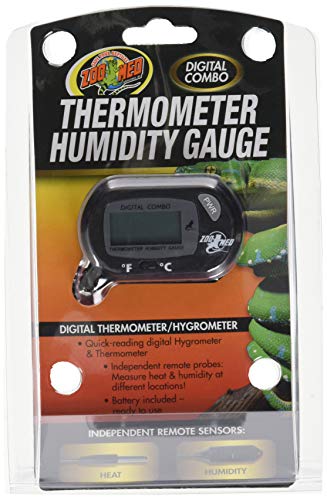
Zoo Med Digital Thermometer Humidity Gauge
One probe reports both temperature and relative humidity here, which suits tropical setups where humidity control matters as much as heat. The display mounts outside the enclosure while the probe reaches into the zone that counts. Humidity sensors on inexpensive units drift over time, so treat readings as a trend rather than a lab grade figure.
Pros
- Covers humidity as well as temperature
- Single probe simplifies setup
- Inexpensive way to monitor tropical enclosures
Cons
- Humidity accuracy drifts over months
- Only one measurement point per unit

Zilla Temperature Humidity Digital Gauge
A straightforward combined display mounts inside or on the side of a terrarium with minimal fuss. Keepers who want a quick at a glance check rather than zone by zone data benefit most. Since the sensor is built into the unit, placement flexibility stays limited to wherever the display goes.
Pros
- Very simple to set up with no cables
- Combined temperature and humidity display
- Low cost for a second monitoring point
Cons
- Sensor location is tied to display location
- Reads air near the wall rather than the basking zone

ThermoPro TP49 Digital Hygrometer Thermometer
Tracking the room conditions around an enclosure, which drive how hard a heater has to work, is where this small household hygrometer earns its keep. Trend arrows and a comfort indicator make changes easy to spot at a glance. It is not enclosure specific, so pair it with a probe or infrared thermometer rather than relying on it alone.
Pros
- Very cheap and readable at a distance
- Fast refresh with trend indication
- Useful for tracking the room around the enclosure
Cons
- Not designed for inside enclosure use
- No remote probe option
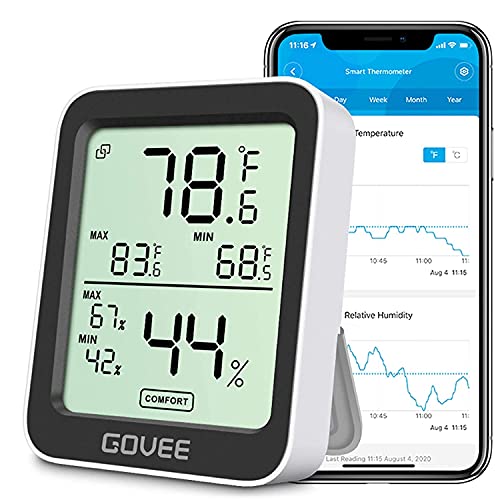
Govee H5075 Bluetooth Hygrometer Thermometer
Continuous logging sends temperature and humidity data to a phone app, with configurable alerts when readings leave a set range. Catching an overnight drop or a failed thermostat before an animal suffers is genuinely valuable. As a household sensor rather than a reptile product, it should stay out of direct heat and away from misting, paired with a surface thermometer for basking checks.
Pros
- Continuous logging catches overnight failures
- Phone alerts when readings drift out of range
- Exportable history helps diagnose problems
Cons
- Bluetooth range limits remote monitoring
- Not built to tolerate misting or direct heat
The lineup, side by side
| # | Model | Measurement | Best for | Score | Price |
|---|---|---|---|---|---|
| 1 | Zoo Med ReptiTemp Digital Infrared Thermometer | Infrared surface temperature | Best overall | 9.4 | Check price |
| 2 | Exo Terra Digital Thermometer with Remote Probe | Wired probe, air or surface | Best value | 9.2 | Check price |
| 3 | Etekcity Lasergrip 774 Infrared Thermometer | Infrared surface temperature | Best budget infrared | 9.0 | Check price |
| 4 | Zoo Med Digital Thermometer Humidity Gauge | Temperature and relative humidity | Best combined temperature and humidity | 8.8 | Check price |
| 5 | Zilla Temperature Humidity Digital Gauge | Temperature and humidity | Best for simple setups | 8.6 | Check price |
| 6 | ThermoPro TP49 Digital Hygrometer Thermometer | Temperature and humidity | Best for ambient room monitoring | 8.3 | Check price |
| 7 | Govee H5075 Bluetooth Hygrometer Thermometer | Temperature and humidity with logging | Best for phone alerts | 8.0 | Check price |
What matters most
Why stick on dial gauges cause real harm Round analogue gauges bundled with many starter kits measure the glass they are stuck to, not the air or basking surface, and their stated accuracy is often several degrees at best. A keeper who trusts one can run a basking spot far hotter or cooler than intended without ever seeing a warning. Replacing that gauge with even the cheapest digital probe or infrared gun is the single most valuable inexpensive upgrade in reptile keeping.
Surface temperature and air temperature are different numbers Basking species regulate body temperature by lying on a warm surface and absorbing radiant heat, so the surface reading under a lamp determines whether they can thermoregulate properly. Air temperature governs the ambient gradient across the enclosure and the cool end refuge, and both numbers matter. Infrared units like the ReptiTemp and Lasergrip 774 give instant surface readings, while probe units like the Exo Terra provide continuous ambient monitoring, which is why many keepers own one of each.
Building a proper temperature gradient across the enclosure A reptile enclosure should offer a warm end, a cool end and a basking spot, letting the animal choose. Measure at three points: the basking surface, the warm end floor and the cool end floor, checking the overnight low as well as daytime highs. Species specific target ranges vary widely, so a reputable care sheet beats a generic figure. Heat sources must run through a thermostat, since an uncontrolled bulb or mat can reach dangerous temperatures within minutes.
Placement, calibration and knowing when a unit has failed Position probes where the animal actually spends time, not tucked in a corner near a vent. Infrared readings should stay perpendicular to the surface, close enough that the measured spot is smaller than the target, since reflective glass and water give false readings. Cheap humidity sensors drift, so compare two units against each other periodically and replace one when they disagree by more than a few percent.
Good to know
Are stick on dial thermometers accurate enough for reptiles?
No. They measure the glass surface they are attached to and are commonly several degrees out. A digital probe or infrared thermometer costs very little and replaces them easily.
Do I need both an infrared and a probe thermometer?
Ideally yes. Infrared reads the basking surface instantly, while a probe monitors ambient air continuously and records overnight lows. Together they cost less than most heat lamps.
Where should I place a reptile thermometer probe?
Place it where the animal spends time, typically at floor level on the cool end for ambient readings, with a second one at the warm end. Avoid vents, glass walls and direct lamp light.
Why does my infrared thermometer read strangely on glass or water?
Reflective and transparent surfaces confuse infrared sensors because they reflect the temperature of other objects. Read matte surfaces such as substrate, wood or basking rock instead.
Can I use a household hygrometer for a reptile enclosure?
Yes for a rough humidity trend, and units like the ThermoPro TP49 or Govee H5075 work well for room and enclosure air. Keep them away from misting and direct heat, which damages the sensor.
Does a thermometer replace a thermostat?
No. A thermometer tells you what the temperature is, while a thermostat controls the heat source. Every heat mat, ceramic emitter or basking bulb should run through a thermostat.
How often should enclosure temperatures be checked?
Check daily at a glance and take a full gradient measurement weekly, plus after any change to lighting, heating, room position or seasonal weather.
Do cheap humidity sensors stay accurate over time?
They drift over months. Comparing two sensors against each other periodically, and replacing whichever one disagrees, matters more for most enclosures than exact precision.
What is the best budget thermometer for a bearded dragon basking spot?
An infrared unit like the Zoo Med ReptiTemp or Etekcity Lasergrip 774 gives the surface reading that matters most for a basking dragon, since it shows what the animal’s skin actually contacts.
Is a digital probe better than an infrared gun for daily use?
They answer different questions. A probe left in place tracks ambient temperature continuously, while an infrared gun spot checks surfaces on demand, so most setups benefit from having both.
The bottom line
Zoo Med ReptiTemp is the small purchase that most improves husbandry, because it finally shows what the basking surface is doing rather than what a piece of glass is doing. Continuous ambient and overnight monitoring comes from pairing it with the Exo Terra probe thermometer. Tight budgets still get the same infrared capability from Etekcity Lasergrip 774, just for less money.
Olivia Hartley
Olivia spent several years working at an animal shelter and a pet-supply retailer before joining the editorial team. She researches pet gear with an emphasis on safety, comfort and the fine print that owners often miss.