Which Dice Game Should Total Beginners Buy First
Yahtzee suits mixed-age groups learning together, since scoring stays simple enough to explain in one demonstration round. Farkle adds push-your-luck risk that keeps family game night lively. Tenzi wins for kids and large groups, since matching rounds finish in under a minute each.
Yahtzee remains the most familiar starting point for a mixed-age group. Farkle raises the stakes with push-your-luck scoring for family night, and Tenzi strips rules down to fast matching rounds for kids. LCR, Zombie Dice, Qwixx, and Pass the Pigs each solve a narrower need, from large tables to travel.
Picking a first dice game gets tricky once player count, age range, and round length pull in different directions. We compared official player counts, dice included, and age recommendations printed on each box to match these seven titles against real group sizes.
What to look for
What makes a dice game easy for beginners to learn Short rulebooks, dice included in the box, and rounds under 30 minutes define an easy dice game. Standard six-sided dice, like those in Yahtzee and Farkle, feel familiar even to first-timers. Special dice, such as the pig-shaped pieces in Pass the Pigs, need a little more explanation up front. Age labels on the box usually reflect the reading level needed for scorecards, not raw game difficulty.
Which dice games work best for family game night Family night favors games that blend light strategy with luck, so no single player dominates every round. Yahtzee’s scoring categories reward planning without punishing one bad roll too harshly. Farkle raises the stakes further, since banking points too late can wipe out a turn. Both scale up to 10 players, useful for larger gatherings.
Fast dice games for young kids and large groups Younger kids do better with games that skip scorecards entirely. Tenzi hands each player 10 dice and a simple matching goal, finishing rounds in under a minute. LCR swaps points for chips, so no one adds up a score sheet. Both explain in under a minute, keeping kids engaged instead of waiting.
Dice games for teens, strategy fans, and travel Older kids and adults looking for theme or strategy have other options. Zombie Dice adds a horror push-your-luck twist suited to age 10 and up. Qwixx introduces light probability strategy through simultaneous scorecards. Pass the Pigs packs into a tin small enough for a glove box, better suited to road trips than a boxed game.
The shortlist, ranked

Hasbro Yahtzee Classic Dice Game
Yahtzee scores combinations such as three of a kind, full house, and straights across 13 rounds. A rolling cup and score cards come standard in the box. Most first-time players grasp the rules after a single demonstration round.
Pros
- Scoring system explained in one demo round
- Supports large groups up to 10 players
- Score pads are cheap and easy to replace
Cons
- Games run long once more than 6 players join
- Repeated play reveals limited strategic depth

Pressman Farkle Dice Game
Farkle rewards banking points early or re-rolling dice for a higher score later. A single bad roll can erase an entire turn, a mechanic that teaches risk assessment fast. A scoring reference card ships with the set for new players.
Pros
- Push-your-luck mechanic teaches risk assessment quickly
- Reference card speeds up learning the rules
- Fast rounds keep large groups engaged between turns
Cons
- Scoring combinations take a session or two to memorize
- Luck can outweigh strategy in shorter games

LCR Left Center Right Dice Game
Three dice marked Left, Center, Right, or dot decide how chips pass around the table. Rounds finish in under 15 minutes, so replay comes easy at a family gathering. Chips determine the winner directly, with no score sheet needed.
Pros
- No score tracking required, chips decide the winner
- Rounds finish in under 15 minutes for quick replay
- Rules explain in under a minute for new players
Cons
- Outcome depends entirely on luck with no strategy
- Needs chips or tokens that can go missing between plays

Tenzi Dice Party Game
Each player gets 10 dice with one goal: roll matching numbers as fast as possible. Rounds finish in under a minute, so a session covers dozens of quick replays. Forty dice ship in the box, enough for four players at once.
Pros
- Rounds finish in under a minute for constant replay
- Forty included dice support four simultaneous players
- Simple matching goal works for younger kids too
Cons
- Limited depth once the core matching mechanic is learned
- Fast dice rolling can get loud in shared spaces

Zombie Dice by Steve Jackson Games
Players draw custom dice from a cup to collect brains while dodging shotgun blasts. Push-your-luck decisions happen every turn, similar to Farkle but wrapped in a horror theme. Color-coded dice signal risk level, which speeds up decisions for new players.
Pros
- Color-coded dice signal risk level at a glance
- Cup mechanic keeps rounds under 15 minutes
- Push-your-luck decisions repeat every turn for engagement
Cons
- Theme may not suit younger children in mixed groups
- Custom dice cannot be swapped for standard six-siders
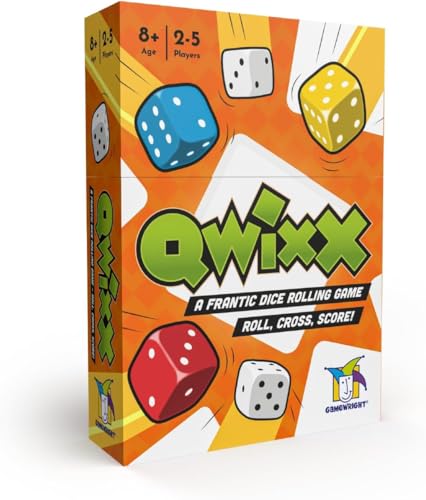
Qwixx Dice Game by Gamewright
Every player marks numbers on a personal scorecard at the same time, so no one waits through long turns. Locking a row early scores bonus points but closes off future options. The simultaneous format teaches basic probability without a thick rulebook.
Pros
- Simultaneous play means no downtime between turns
- Simple scorecards teach basic probability concepts
- Compact box travels well for beginners on the go
Cons
- Scorecards run out and need reprinting or a notepad
- Strategy depth is lighter than combination-based dice games

Pass the Pigs by Winning Moves
Two pig-shaped tokens replace dice, landing in different positions worth different points. A compact tin case fits a glove box or backpack side pocket for travel. Scoring stays simple enough for a 7-year-old to track on paper.
Pros
- Compact tin case is easy to pack for travel
- Pig-shaped pieces make scoring positions easy to remember
- Simple enough for a 7-year-old to play unsupervised
Cons
- Pigs can land on edges, causing occasional scoring disputes
- Fewer strategic choices than card-assisted dice games
How they stack up
| # | Model | Players | Best for | Score | Price |
|---|---|---|---|---|---|
| 1 | Hasbro Yahtzee Classic Dice Game | 2 to 10 | Best overall | 9.4 | Check price |
| 2 | Pressman Farkle Dice Game | 2 to 10 | Best for family game night | 9.2 | Check price |
| 3 | LCR Left Center Right Dice Game | 3 to 8 | Best budget | 9.0 | Check price |
| 4 | Tenzi Dice Party Game | 2 to 8 or more | Best for large groups and kids | 8.8 | Check price |
| 5 | Zombie Dice by Steve Jackson Games | 2 to 8 | Best for teens and adults | 8.6 | Check price |
| 6 | Qwixx Dice Game by Gamewright | 2 to 5 | Best for strategy-minded beginners | 8.3 | Check price |
| 7 | Pass the Pigs by Winning Moves | 2 to 6 | Best for travel | 8.0 | Check price |
Questions worth asking
What is the easiest dice game to learn?
LCR and Tenzi explain in under a minute since neither needs score tracking. Yahtzee takes slightly longer but still needs only one demonstration round for most players.
What age can kids start playing dice games?
Tenzi and Pass the Pigs list a recommended age of 7 and up, the youngest range among common beginner titles. Games with more scoring categories, like Yahtzee and Farkle, list 8 and up since they involve basic addition.
Farkle vs Yahtzee, which is easier for a first-time player?
Yahtzee uses a fixed scorecard with named categories, which some new players find easier to follow visually. Farkle has fewer categories to memorize but requires tracking a running total by hand.
Can beginner dice games be played with just two people?
Yahtzee, Farkle, Qwixx, and Pass the Pigs all list a minimum of two players on the box. LCR needs at least three, since chips pass around a circle.
Which dice game works best for large family groups?
Yahtzee and Farkle both support up to 10 players, the highest count among the games compared here. Larger groups should expect longer total game time, since players take turns one at a time.
Are push-your-luck dice games good for young children?
Farkle and Zombie Dice both use push-your-luck mechanics that reward patience, which can frustrate very young kids. Tenzi or LCR fit younger children better, since outcomes resolve almost instantly.
Do beginner dice games need extra equipment like pens or chips?
Yahtzee and Farkle need a pen and scorecard, though blank paper works once the pads run out. LCR needs chips or tokens, while Tenzi, Zombie Dice, Qwixx, and Pass the Pigs include everything needed in the box.
Which dice game travels best for road trips?
Pass the Pigs packs into a small tin that fits a glove box or backpack pocket. Qwixx also travels well thanks to a compact box, though it needs a flat surface for scorecards.
Is Tenzi only for kids, or do adults enjoy it too?
Adults often use Tenzi as a quick warm-up game before a longer session, since rounds take under a minute. Its speed appeals to competitive players as much as young kids.
How many dice come in a Farkle set?
Pressman’s Farkle set ships with 6 six-sided dice plus a scoring reference card. That is one more die than Yahtzee’s standard set of 5.
Final word
Yahtzee and Farkle cover the widest range of ages and group sizes for a first dice game purchase. LCR and Tenzi trade strategy for speed, better suited to younger kids or large families. Save Zombie Dice, Qwixx, or Pass the Pigs for groups wanting a narrower fit, like teens, strategy fans, or travelers.
Rachel Simmons
Rachel previously worked in child-product retail and brings a practical, detail-first eye to gear reviews, focusing on safety standards, ease of use and the fine print that matters most for new caregivers.