4K Projectors That Make a Home Theater Feel Bigger
Epson’s Home Cinema 4010 4K PRO-UHD wins overall on brightness and color in a darkened room. Hisense PX1-PRO TriChroma Laser Cinema is the ultra short throw pick, sitting about a foot from the wall. Optoma UHD55 covers true 4K value at 3600 lumens.
Epson Home Cinema 4010 4K PRO-UHD leads this group for movie nights in a room you can darken. Pixel shifting puts 8.3 million pixels on screen at 2400 lumens. Want the projector against the wall instead? Hisense PX1-PRO TriChroma Laser Cinema throws a huge image from about a foot away, while Optoma UHD55 covers true 4K on a smaller outlay.
Spec sheets hide the two things that actually decide picture quality: how the chip builds a 4K frame, and how much light reaches your screen. Some models use a native 4K panel. Others shift a smaller chip several times per frame to reach 8.3 million pixels. We compared published resolution methods, lumen ratings, light-source type and throw ratios, then weighed what owners report about fan noise, placement and setup time.
The best picks, ranked

Epson Home Cinema 4010 4K PRO-UHD
PRO-UHD pixel shifting places 8.3 million pixels on screen from a 1080p chip, and 2400 lumens keeps HDR10 highlights alive. Motorized zoom, focus and lens shift store screen presets, so switching between 16:9 and wider scope framing takes one button. Owners report film-like color out of the box once the room is dark.
Pros
- 2400 lumens carries HDR in a dark room
- Motorized lens memory saves screen presets
- Wide color coverage without calibration work
Cons
- Cabinet is too big for a small shelf
- Lamp dims and needs replacing eventually

Hisense PX1-PRO TriChroma Laser Cinema
Three separate lasers generate red, green and blue light, which widens color range well past any lamp projector here. Sitting roughly a foot from the wall, it still fills a screen in the 90 to 130 inch range. Owners treat it as a television replacement because 2200 lumens holds up under normal evening lighting.
Pros
- Triple laser covers a very wide color gamut
- Fills up to 130 inches from about a foot away
- Laser light source skips lamp replacement
Cons
- Wants a flat ambient-light-rejecting screen
- Alignment is fussy down to a fraction of an inch

Optoma UHD55 4K UHD Projector
3600 lumens is the headline, enough to keep a 120 inch image watchable with a lamp on in the room. Vertical lens shift and a wide zoom range make ceiling mounting far easier than rivals in this bracket. Both HDR10 and HLG decode, so broadcast HDR sport plays without an external workaround.
Pros
- 3600 lumens handles rooms you cannot fully darken
- Vertical lens shift eases ceiling mounting
- Decodes broadcast HLG as well as HDR10
Cons
- Black levels trail the laser models here
- Built-in smart platform stays basic

LG CineBeam HU810PW 4K Laser Projector
Two lasers, one blue and one green, drive a 2700 lumen image with a service life measured in tens of thousands of hours. Iris control reads each scene and adjusts output frame by frame, which protects shadow detail in HDR films. webOS handles the streaming apps, so a separate media box becomes optional.
Pros
- Dual laser removes lamp replacement entirely
- Dynamic tone mapping lifts HDR shadow detail
- webOS streaming apps are built in
Cons
- Higher outlay than lamp-based rivals
- Contrast still rewards a dim room

BenQ TK700STi 4K HDR Projector
Short throw optics fill roughly 100 inches from about eight feet, which suits a living room with no long throw path. Game mode drops latency for 1080p at 120Hz and 4K at 60Hz, covering current consoles and PCs. An Android TV dongle ships in the box, so streaming and console play share one setup.
Pros
- Low-latency mode supports 1080p at 120Hz
- Short throw reaches 100 inches from eight feet
- 3000 lumens copes with some ambient light
Cons
- Color gamut narrower than the laser models
- Fan is audible during quiet dialogue scenes
XGIMI Horizon Pro 4K Projector
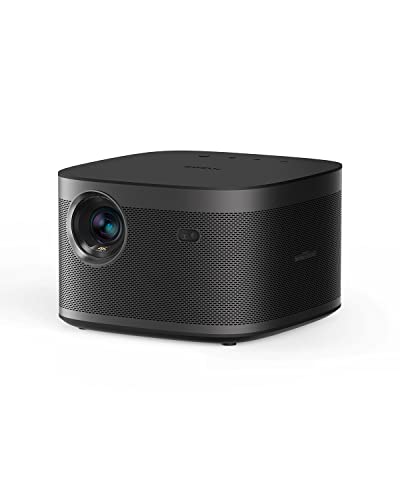
Everything lives in one box under seven pounds: LED light engine, Android TV and a pair of Harman Kardon drivers. Autofocus and keystone correction square the image within seconds of moving it to a new spot. Rated at 1500 ISO lumens, it asks for curtains rather than daylight.
Pros
- Android TV and Harman Kardon audio included
- Autofocus and keystone square the image fast
- Light enough to carry between rooms
Cons
- 1500 ISO lumens needs controlled lighting
- LED color falls short of triple-laser units

ViewSonic PX748-4K Projector
4000 lumens is the brightest rating in this roundup, which is what keeps the image usable with curtains open. A shortish throw ratio reaches around 100 inches from roughly eight feet, so no long room is required. Two HDMI 2.0 inputs plus a high-refresh 1080p mode cover console gaming on a plain build.
Pros
- 4000 lumens works in a lit living room
- Lowest outlay for a true 8.3M pixel image
- Sets up in minutes with no lens memory to learn
Cons
- Contrast is modest against laser units
- Feature set is deliberately plain
How they compare
| # | Model | Resolution | Best for | Score | Price |
|---|---|---|---|---|---|
| 1 | Epson Home Cinema 4010 4K PRO-UHD | 4K PRO-UHD pixel shift | Best overall | 9.4 | Check price |
| 2 | Hisense PX1-PRO TriChroma Laser Cinema | 4K UHD | Best ultra short throw | 9.2 | Check price |
| 3 | Optoma UHD55 4K UHD Projector | 4K UHD, 8.3M pixels | Best value | 9.0 | Check price |
| 4 | LG CineBeam HU810PW 4K Laser Projector | 4K UHD | Best laser home theater | 8.8 | Check price |
| 5 | BenQ TK700STi 4K HDR Projector | 4K UHD, 8.3M pixels | Best for gaming | 8.6 | Check price |
| 6 | XGIMI Horizon Pro 4K Projector | 4K UHD | Best all-in-one smart projector | 8.3 | Check price |
| 7 | ViewSonic PX748-4K Projector | 4K UHD, 8.3M pixels | Best budget 4K | 8.0 | Check price |
What matters most
What does 4K actually mean on a projector? Two engineering routes reach the same 8.3 million pixel count. Native panels carry that many mirrors or pixels physically. Pixel-shift designs move a 1080p or 2716×1528 chip several times per frame to fill the gaps. Both look sharp from a normal seating distance of ten feet or more. Native panels hold a small edge on fine text and grille patterns, which matters mostly if you sit close to a 120 inch screen.
How many lumens do you need for your room? Light control decides this more than screen size does. A blacked-out basement is well served by 2000 to 2500 lumens, and extra output there just crushes shadow detail. Living rooms with windows want 3000 lumens and up. HDR sits on top of that number: projectors cannot reach television peak brightness, so tone mapping decides whether highlights survive. Judge your curtains honestly before paying for HDR features.
Laser vs lamp: which light source lasts longer? Lasers switch on at full output instantly, hold brightness for tens of thousands of hours and never need a bulb swap. Lamps cost less up front and can push higher raw lumens, as the 4000 lumen ViewSonic shows. Bulbs fade gradually, though, and replacement is a recurring job. Frequency of use is the deciding factor. Watch nightly and laser pays back; watch weekends only and a lamp is fine.
How to plan throw distance and screen size Every projector publishes a throw ratio, which is distance divided by image width. Multiply your available distance by that ratio to get the width you can fill. Standard lenses need eight to fifteen feet for 100 inches. Short throw units like the BenQ cut that roughly in half. Ultra short throw lasers sit on a credenza against the wall, but they demand a flat matched screen to stay evenly focused corner to corner.
Frequently asked questions
Is a pixel-shifting projector real 4K?
It puts a genuine 8.3 million pixels on the screen, just not from 8.3 million physical mirrors. Viewers sitting ten feet from a 100 inch image rarely see the difference. Native panels pull ahead only on very fine detail at close range.
How many lumens is enough for a 4K projector?
Around 2000 to 2500 lumens covers a fully darkened room. Rooms with lamps on or curtains open want 3000 or more. Screen size raises the requirement too, since the same light spread over a bigger area looks dimmer.
Which is better, a laser projector or a lamp projector?
Lasers win on lifespan, instant startup and zero maintenance. Lamps win on up-front outlay and often on peak lumens. Heavy viewers benefit from laser; occasional viewers usually do not recoup the difference.
What is an ultra short throw projector?
Ultra short throw units sit inches from the wall and still project a large image, using a curved mirror instead of a long light path. The Hisense PX1-PRO is the example here. Placement tolerance is tight, so a stand that cannot be nudged helps.
Can you use a 4K projector for gaming?
Yes, provided it lists a game mode and a stated input lag figure. The BenQ TK700STi handles 1080p at 120Hz and 4K at 60Hz. Anything without a documented low-latency mode will feel sluggish for shooters.
Do you need a special screen for a 4K projector?
A matte white screen preserves sharpness better than painted drywall, which scatters light and softens edges. Bright rooms benefit from ambient light rejecting material. Ultra short throw models specifically require a screen designed for their steep light angle.
How far should a projector sit from the screen?
Check the throw ratio, then multiply by your target image width. A 1.5 ratio needs about eleven feet for a 100 inch wide image. Ultra short throw models need under two feet.
Is HDR on a projector worth it?
HDR helps when a projector is bright and tone maps well, as the LG CineBeam does with its dynamic iris. On dim units the effect can flatten shadows instead. Treat HDR as a bonus on top of brightness, not a substitute for it.
How long does a projector lamp last?
Manufacturers rate lamps in thousands of hours, with eco modes extending that considerably. Brightness fades gradually rather than failing suddenly. Laser models sidestep the question entirely.
What is the best 4K projector for a bright living room?
High lumen output matters most. The Optoma UHD55 at 3600 lumens and the ViewSonic PX748-4K at 4000 lumens both stay watchable with lights on. Pairing either with an ambient light rejecting screen improves contrast further.
The verdict
Epson Home Cinema 4010 4K PRO-UHD earns the top spot for its combination of 2400 lumens, motorized lens memory and natural color in a dark room. Choose Hisense PX1-PRO TriChroma Laser Cinema when the projector has to live against the wall like a television. Optoma UHD55 remains the sensible pick when brightness matters more than black levels.
Marcus Chen
Marcus covered consumer electronics for enthusiast tech publications for six years before joining ChoiceCrest. He specializes in translating manufacturer spec sheets into plain-language buying advice, with a focus on audio, computing accessories and smart-home gear.