Dolby Atmos Receivers Compared for Home Theater Rooms
The Denon AVR-S770H is our overall pick for a typical living room, pairing seven channels with current HDMI 2.1 gaming support. The Yamaha RX-V6A offers strong value through its room correction, while the Onkyo TX-NR6100 suits gamers who want the most connectivity per channel.
Most living rooms fit the Denon AVR-S770H best, with the Yamaha RX-V6A close behind on value and the Onkyo TX-NR6100 leading on gaming connectivity for consoles. Larger dedicated rooms call for the nine channel Marantz or Denon models further down the list.
A headline channel number tells you less than it seems to about an Atmos receiver. Seven channels can drive five speakers plus two height channels, or seven at ear level with no height at all, and the right choice depends entirely on your ceiling and seating. We compared published channel configurations, power ratings, HDMI specifications, and room correction systems, alongside the setup experiences owners describe most often.
Our top picks

Denon AVR-S770H
Seven channels of amplification hits the sweet spot for a normal living room, giving a 5.1.2 Atmos layout with two height speakers and headroom to spare. Denon includes current HDMI 2.1 features, so a modern console passes through at full capability. Owners consistently report the guided setup as the least frustrating in this class.
Pros
- Guided on screen setup is genuinely clear
- HDMI 2.1 gaming features on multiple inputs
- Audyssey correction makes a real difference in awkward rooms
Cons
- Seven channels caps you at two height speakers
- Runs warm in a closed cabinet

Yamaha RX-V6A
YPAO room correction paired with Cinema DSP processing gives this receiver a distinctive, spacious presentation that suits music as well as film. Its seven channel layout matches the Denon on paper. The app and interface feel dated next to newer rivals, though the sound quality does not.
Pros
- YPAO correction handles difficult rooms well
- Strong performance with stereo music as well as film
- MusicCast for multiroom audio
Cons
- Interface and app feel dated
- Menu structure takes time to learn

Onkyo TX-NR6100
Multiple inputs carry HDMI 2.1 features here rather than just one, which matters when a console, a PC, and a streaming box all want the same treatment. Dirac Live support gives it a more sophisticated correction option than the class norm. Owners report the initial firmware update is essential before serious use.
Pros
- HDMI 2.1 gaming features across several inputs
- Dirac Live is a step above basic correction
- Wide streaming ecosystem support
Cons
- Firmware update needed out of the box
- Physically large and heavy

Marantz Cinema 50
Nine channels of amplification unlock a 5.1.4 layout with four height speakers, the point where Atmos stops being a novelty and starts creating a genuine dome of sound. Marantz pairs that with a smoother, warmer voicing than most rivals offer. This is a serious investment aimed at a dedicated room.
Pros
- Nine channels allow four height speakers
- Audyssey XT32 is the most capable Audyssey tier
- Full pre outs for later expansion
Cons
- Significant investment over seven channel models
- Overkill for a small living room

Sony STR-AN1000
Built-in features talk directly to the PlayStation 5 here, including automatic picture and sound mapping that saves fiddling with modes. 360 Spatial Sound Mapping creates convincing height effects with fewer speakers than usual setups need. It suits Sony households more than mixed setups with varied gear.
Pros
- Automatic setup features with PlayStation 5
- Spatial mapping widens the sound field
- Clean, modern interface
Cons
- Best features assume Sony hardware elsewhere
- Fewer manual tuning options than rivals
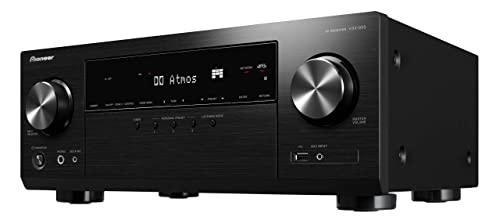
Pioneer VSX-LX105
This is the cheapest sensible way into real Dolby Atmos rather than a virtualized approximation, with enough channels for a 5.1.2 layout. Power stays modest, so it suits small to medium rooms and efficient speakers best. Owners report it runs out of headroom at high volume in larger spaces.
Pros
- Genuine Atmos processing at an entry price
- AirPlay 2 and Chromecast built in
- Compact for its class
Cons
- Limited power headroom in large rooms
- Basic room correction compared with rivals

Denon AVR-X3800H
Nine amplified channels with processing for more, plus Dirac Live support and extensive HDMI 2.1 connectivity, make this the receiver you buy once and grow into. The complexity is real, and setup takes an evening rather than an hour. For a dedicated cinema room, it is the most complete option here.
Pros
- Room to expand well beyond the initial setup
- Best in class correction options
- Extensive modern HDMI connectivity
Cons
- Setup is genuinely time consuming
- Far more capability than most living rooms need
The lineup, side by side
| # | Model | Channels | Best for | Score | Price |
|---|---|---|---|---|---|
| 1 | Denon AVR-S770H | Seven | Best overall | 9.4 | Check price |
| 2 | Yamaha RX-V6A | Seven | Best value | 9.2 | Check price |
| 3 | Onkyo TX-NR6100 | Seven | Best for gaming | 9.0 | Check price |
| 4 | Marantz Cinema 50 | Nine | Best for larger rooms | 8.8 | Check price |
| 5 | Sony STR-AN1000 | Seven | Best for PlayStation owners | 8.6 | Check price |
| 6 | Pioneer VSX-LX105 | Seven | Best budget Atmos | 8.3 | Check price |
| 7 | Denon AVR-X3800H | Nine amplified, more via processing | Best for future proofing | 8.0 | Check price |
How to pick the right one
How to read Atmos channel numbers like 5.1.2 The layout notation becomes straightforward once you know the code. In 5.1.2, the first number is ear level speakers, the second is the subwoofer, and the third is height channels. A seven channel receiver drives 5.1.2, while nine channels unlock 5.1.4 with four height speakers. Decide the layout your room can physically accommodate, then buy the matching receiver.
Does your ceiling support Atmos height channels? True Atmos height effects come from in ceiling speakers or upward firing modules that bounce sound off a flat ceiling. Vaulted, sloped, textured, or very high ceilings weaken that reflection considerably, and in those rooms in ceiling speakers become the only reliable option. Check your ceiling before spending extra on height capable amplification.
Which room correction system matters most for a real living room Speaker placement in a real living room is always a compromise, and correction systems measure and compensate for that gap. Audyssey and Dirac Live rank as the most capable tiers, with YPAO and MCACC covering the basics. Owners report correction makes a larger audible difference than modest increases in amplifier power.
How to check HDMI 2.1 support input by input for gaming Manufacturers sometimes advertise HDMI 2.1 while providing the full feature set on only one or two inputs. Connecting a console and a gaming PC means confirming how many inputs support 4K at 120Hz, variable refresh rate, and auto low latency mode. This is where receivers date fastest in practice.
Common questions
How many channels do you need for Dolby Atmos?
The minimum for real Atmos is a 5.1.2 layout, which needs seven amplified channels. Nine channels allow 5.1.4 with four height speakers, a noticeable step up in a dedicated room.
Do upward firing Atmos speakers actually work?
They work well with a flat, hard ceiling at a normal height. Sloped, vaulted, or heavily textured ceilings scatter the reflection and reduce the effect substantially. In those rooms, in ceiling speakers are the better answer.
Is more watts per channel important for an Atmos receiver?
Less than the specification suggests. Speaker sensitivity, room size, and correction quality matter more for most listeners. Power becomes relevant only with large rooms or inefficient speakers played loud.
Can I use an Atmos receiver with my existing speakers?
Usually yes, as long as impedance is compatible with the new unit. Height channels get added separately, either as in ceiling speakers or upward firing modules that sit on top of existing front speakers.
Dolby Atmos vs DTS:X, what is the difference?
Both are object based surround formats using the same speaker layouts. Almost every current Atmos receiver decodes DTS:X too, so choosing between them rarely matters in practice.
Do you need a subwoofer for Atmos sound?
It is strongly recommended for any Atmos setup. The point one in every layout is the low frequency channel, and without a subwoofer your speakers must reproduce bass they were not designed for, thinning the whole presentation.
Will an Atmos receiver pass through 4K at 120Hz for gaming?
Current models do, but check how many inputs support it fully. Older receivers and some entry models limit the complete HDMI 2.1 feature set to just one or two ports.
How long should an AV receiver last before replacement?
Owners commonly report ten years or more of reliable operation. In practice, HDMI standards and streaming app support usually make a receiver feel dated long before the amplifier section fails.
Which Atmos receiver is best for a small apartment living room?
A seven channel model like the Denon AVR-S770H or Pioneer VSX-LX105 fits most apartments, since a 5.1.2 layout needs less ceiling and floor space than 5.1.4. Compact placement and modest power suit smaller rooms better than a nine channel unit.
The verdict
For most living rooms, the Denon AVR-S770H is the right amount of receiver, with enough channels for a proper 5.1.2 Atmos layout and modern HDMI features that will not date immediately. Step up to the Marantz Cinema 50 or Denon AVR-X3800H only if your room can support four height speakers. Sort out your ceiling and speaker layout first, since that decision determines the channel count you actually need.
Marcus Chen
Marcus covered consumer electronics for enthusiast tech publications for six years before joining ChoiceCrest. He specializes in translating manufacturer spec sheets into plain-language buying advice, with a focus on audio, computing accessories and smart-home gear.
You might also need

Home Alarm Systems Compared: Monitoring, Setup and Cost

Laser Printers Compared for Home and Small Office Use
What Does an Ergonomic Home Office Desk Setup Look Like?
