Why Does a Timing Belt Need Replacing on a Schedule Even Without Symptoms?
Timing belts are made of reinforced rubber that degrades from heat and flexing cycles, not from friction you would notice as looseness or noise. The belt can look fine and still be near the end of its fatigue life, and because many engines are interference designs, a snapped timing belt lets the pistons and valves collide, causing expensive internal damage. That risk, not a felt symptom, is why manufacturers set a mileage or time interval instead of waiting for a warning sign.
Why the belt can look fine and still be near failure
A timing belt is a reinforced rubber belt with internal cords, usually fiberglass or Kevlar strands, that stretch and flex every time the engine turns over. Heat from the engine bay and the constant flexing around pulleys breaks down the rubber compound and the internal cords from the inside out, long before the outer surface shows cracking or glazing that a visual inspection would catch. A belt can pass a flashlight check and still be within a few thousand miles of snapping.
Interference engines turn a snapped belt into real damage
In an interference engine design, the valves and pistons occupy the same physical space at different points in the rotation, timed precisely by the belt. If the belt snaps while the engine is running, the crankshaft keeps spinning by inertia while the camshaft stops instantly, and open valves get struck by rising pistons, bending the valves and sometimes damaging the piston heads or cylinder walls. Non interference engines have enough clearance that a snapped belt just causes the car to stop running, which is a far cheaper outcome.
Why the interval is time based as well as mileage based
Most manufacturers list a timing belt interval as something like 60,000 to 100,000 miles or seven to ten years, whichever comes first. The time component exists because rubber degrades from heat and age even on a car that is driven lightly, so a low mileage car that sits for years in a hot climate can still need the belt replaced on schedule.
What usually gets replaced alongside the belt
Because the water pump, tensioner, and idler pulleys are often driven by the same belt and require similar labor to access, most shops recommend replacing them in the same job. Skipping this is not dangerous to the belt itself, but a failing water pump or tensioner a year later means paying for the same labor twice.
Why waiting for a noise or vibration is the wrong strategy
Some timing belt problems do create warning signs, like a ticking noise from a worn tensioner or a slight vibration from a cracked pulley, but these come from the hardware around the belt, not the belt’s internal fatigue. Treating the absence of noise as proof the belt is fine misses the actual failure mode, which is silent.
Timing belt versus timing chain
Not every engine uses a belt. Timing chains, made of metal, last closer to the life of the engine and do not carry a scheduled replacement interval the way belts do, though chains and their tensioners can still stretch and need attention over very high mileage. Knowing which system an engine uses matters, since a timing chain job and a timing belt job are different services with different intervals.
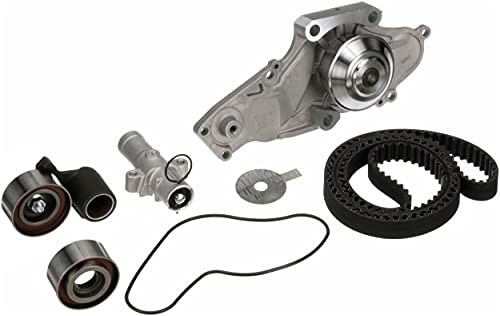
Gates PowerGrip Timing Belt
A widely used OEM-grade replacement timing belt line sold for most interference and non-interference engine applications.

Dayco Timing Belt Kit
A kit pairing the timing belt with matching tensioner and idler pulleys for a single complete job instead of separate purchases.
Frequently asked questions
How do I know if my car has a timing belt or a timing chain?
Check the owner’s manual or search the specific make and model. Many modern engines with chains do not list a replacement interval at all, while belt equipped engines always do.
What happens if I replace the timing belt late?
The risk of fatigue failure increases the longer the interval is exceeded, and in an interference engine design that failure tends to be expensive rather than a minor inconvenience.
Can a timing belt be inspected instead of replaced on schedule?
A visual inspection does not reveal internal cord fatigue, so it is not a reliable substitute for replacing the belt at the recommended interval.
Does a timing belt make noise before it breaks?
Usually not. The belt itself tends to be silent until it slips or snaps, though worn tensioners or idler pulleys around it can make noise separately.
Is it safe to drive a car with an overdue timing belt?
It is technically possible until it is not, and the risk of sudden failure compounds the further past the interval the belt gets.
Why do some cars have timing belts and others have timing chains?
It comes down to engine design tradeoffs around cost, noise, and weight, with both approaches still common across different manufacturers.
Does a timing belt break instantly or wear out gradually?
The internal fatigue builds gradually, but the actual failure is usually sudden rather than a slow, noticeable slip.
Why does interference engine damage from a broken belt cost so much to fix?
A broken belt in an interference engine often bends valves and can damage pistons, which typically requires removing the cylinder head to repair properly, far more labor than a scheduled belt swap would have needed.
Can I replace just the timing belt without the water pump?
Yes, mechanically it is possible, but many shops recommend doing both together since the labor to access them is largely the same.
Does synthetic oil or regular engine maintenance affect timing belt life?
No, timing belt life is governed by heat and flex cycles on the rubber itself, not by the engine oil or other unrelated maintenance.
Why do manufacturers give a mileage interval instead of only a time based one?
A car driven more sees more flex cycles sooner, so mileage captures that wear, while the time component catches low mileage cars that still age from heat and years sitting.
Is a timing belt the same thing as a serpentine belt?
No, they are different belts serving different purposes, one inside the engine controlling valve timing and the other outside the engine driving accessories like the alternator.
Can extreme heat or cold shorten timing belt life?
Sustained high heat accelerates rubber degradation noticeably, while cold temperatures contribute less on their own but repeated freeze and thaw tension cycles can still add up over time.
Should the timing belt tensioner be replaced even if it looks fine?
Yes, the same fatigue logic applies, and tensioner failure is a common cause of belt failure even when the belt itself was otherwise healthy.
Does timing belt replacement have to be done at a dealership?
No, any qualified mechanic with the correct tools and timing marks for that engine can perform the job; it is not a dealer exclusive service.
Can a timing belt be replaced preventively even if it still has life left according to mileage?
Yes, some owners choose to replace it slightly early for peace of mind before a long trip or when other related parts are already being serviced, though it is not required until the interval is reached.
Does a used car’s timing belt replacement history matter when buying?
Yes, checking maintenance records for a timing belt replacement is one of the more important things to verify on a used car with an interference engine, since an unknown or overdue belt is a real risk.
Can a timing belt stretch instead of snapping outright?
Belts can develop minor stretch before outright failure, which sometimes causes a check engine light for incorrect valve timing before a full break occurs, giving some warning in certain cases.
Is timing belt replacement more expensive on some engines than others?
Yes, labor cost varies a lot by how accessible the belt is, with some engines requiring removal of mounts or other components just to reach it.
Does a timing belt tensioner failure look different from a belt failure?
A tensioner failure often causes a rattling or slapping noise from loose belt tension before anything breaks, which is a distinct symptom from the belt’s own silent fatigue.
Can a dealership tell me my exact timing belt interval over the phone?
Most dealerships or parts lookup tools can confirm the interval for a specific year, make, and model using the vehicle identification number, which is more reliable than relying on a generic rule of thumb.
Our take
A timing belt’s replacement interval exists because the thing that kills it, rubber and cord fatigue, never shows up as a symptom until it is too late in an interference engine. Treating the mileage or age number as a hard deadline rather than a suggestion is one piece of car maintenance where staying ahead of schedule actually saves money instead of costing it.
Tony Russo
Tony trained as an automotive technician and spent years in service and parts retail before moving into writing. He focuses on garage tools, car care products and accessories from a hands-on maintenance perspective.