Why Does a Soundbar Sound Better Than TV Speakers Alone?
A soundbar sounds better mainly because modern TVs are too thin to fit speakers with any real size or power, forcing built-in audio into small, rearward or downward-firing drivers that can’t produce much bass or volume without distorting. A soundbar has room for larger drivers, dedicated amplification, and often a separate subwoofer, all of which a slim TV chassis simply has no physical space for. Even TVs marketed with premium audio branding are still working within the same few centimeters of chassis depth that every other modern TV has to fit speakers into.
Why TV speakers are limited by design, not just cost
Today’s TVs are often under an inch thick, which leaves almost no room for speaker drivers of meaningful size, and many TV speakers end up facing downward or backward rather than toward the viewer, since there’s nowhere else to mount them. Even an expensive TV is constrained by this same physical limitation. Some TV manufacturers try to compensate with software-based virtual surround or bass enhancement processing, but that processing can only work with whatever the small physical drivers are actually capable of reproducing.
What a soundbar’s extra size actually buys you
A soundbar’s longer, deeper enclosure allows for larger drivers that move more air, which translates to fuller mid-range and better volume without distortion. That extra internal volume also lets manufacturers include a passive bass port or a dedicated tweeter, neither of which fits inside a slim TV. The amplifier inside a soundbar is also typically more powerful and purpose-built than the small amplifier chip crammed into a TV’s circuit board, which matters for maintaining clean sound at higher volumes.
The subwoofer difference
Many soundbars include a separate wireless subwoofer specifically for low-frequency bass, which no TV speaker setup can replicate regardless of price, since producing deep bass requires moving a large amount of air, something only a larger dedicated enclosure can do well. A wireless subwoofer also lets you place it away from the TV itself, often in a corner or near a wall, positions that tend to reinforce bass response better than a subwoofer forced to sit directly behind a thin television.
How soundbars handle dialogue clarity
Many soundbars include a dedicated center channel or a specific dialogue enhancement mode that isolates and boosts the frequency range where human speech sits, which is why dialogue often sounds clearer through a soundbar than through a TV’s built-in speakers, even at a similar volume. Some models let you adjust the dialogue enhancement level manually, which is useful for viewers who find default settings either too subtle or too aggressive.
Why surround and virtual surround modes exist on soundbars
Some soundbars use multiple angled drivers or digital processing to bounce sound off walls and simulate a wider, more immersive soundstage than a single flat speaker bar could produce on its own, something a TV’s forward or downward-firing speakers have no ability to replicate.
When TV speakers are genuinely fine as-is
For casual daytime viewing, news, or background content in a small room, built-in TV speakers are often adequate, and the real gap shows up specifically with movies, music, or any content where bass, dialogue clarity, or immersive sound actually matter.

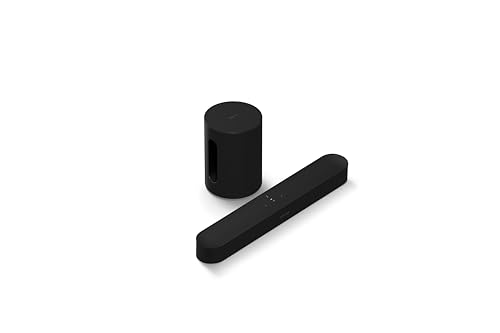
Sonos Beam (Gen 2)
A compact soundbar focused on dialogue clarity and a smart center channel, commonly used in smaller living rooms as a straightforward upgrade over TV speakers.

Vizio V-Series Soundbar
A budget-friendly soundbar that includes a wireless subwoofer, adding real bass response that built-in TV speakers can’t produce.
Frequently asked questions
Does a more expensive TV have better built-in speakers?
Somewhat, premium TVs sometimes include slightly better tuned drivers or more wattage, but they’re still bound by the same thin chassis limitation that affects every modern television, so the improvement is modest at best.
Do you need a subwoofer with a soundbar, or does the bar alone suffice?
A soundbar alone, even a good one, still can’t match the bass extension of a model that includes a separate subwoofer, so for movies and music with real low-end content, a subwoofer makes a noticeable difference.
Why does dialogue sometimes sound muffled on TV speakers specifically?
Downward or rear-firing TV speakers send sound away from the viewer before it reflects back, which blurs clarity, especially in the frequency range human speech occupies, compared to a forward-firing soundbar aimed directly at the room.
Does a soundbar replace the need for a full surround sound system?
For most living rooms, a good soundbar with virtual surround processing gets reasonably close to a basic surround setup without running wires to rear speakers, though a true multi-speaker surround system still outperforms it for dedicated home theater use.
Can a cheap soundbar actually sound worse than good TV speakers?
Yes, an extremely low-end soundbar with tiny drivers and no subwoofer can underperform a flagship TV’s built-in speakers, size and component quality matter more than simply being an external soundbar.
Does soundbar placement affect sound quality?
Yes, placing a soundbar directly below or above the TV at roughly ear height when seated gives the clearest, most direct sound, while placing it inside a cabinet or behind glass doors muffles the output.
Why do some soundbars need a separate HDMI ARC connection instead of just an optical cable?
HDMI ARC carries more advanced audio formats, including some surround formats and the ability to control volume with your TV remote, while a basic optical cable is limited to older, simpler audio formats.
Does Dolby Atmos actually require a special soundbar?
Yes, Dolby Atmos needs either upward-firing drivers on the soundbar itself or a setup designed specifically to bounce sound off the ceiling, a standard stereo soundbar without that hardware can’t reproduce the height effect, even if the source content includes it.
Can you use a soundbar and still keep the TV’s own speakers active?
Most setups automatically mute the TV’s internal speakers once a soundbar is connected and set as the audio output, since running both at once usually causes audio delay or doubling rather than added volume.
Do wireless soundbars sound different from wired ones?
The wireless connection is typically just between the soundbar and its subwoofer or rear speakers, not the main audio signal from the TV, so wireless versus wired in that specific sense usually has little to no impact on overall sound quality.
Is a soundbar harder to set up than it looks?
Most modern soundbars connect with a single HDMI ARC cable and are recognized automatically, basic setup is usually simpler than people expect, though getting surround and Atmos modes fully optimized can take extra steps.
Why do TV speakers sound especially thin during action movies?
Loud, bass-heavy action scenes push TV speakers past what their small drivers can cleanly reproduce, which is when the gap versus a soundbar with a dedicated subwoofer becomes most obvious.
Does a soundbar help with late-night viewing at lower volumes?
Many soundbars include a night or dialogue mode that compresses the volume range, keeping speech audible while reducing loud effects, something basic TV speakers generally don’t offer as a dedicated feature.
Can a soundbar be too big or too powerful for a small room?
In a very small room, an oversized soundbar with a powerful subwoofer can produce boomy, overwhelming bass, matching the soundbar’s size and power to the room is part of getting good sound, not just buying the biggest option available.
Does soundbar size need to visually match the TV size?
Not strictly, though a soundbar noticeably wider or narrower than the TV can look visually mismatched, functionally what matters more is the soundbar’s internal components and room size rather than matching the TV’s exact width.
Our take
The gap between TV speakers and a soundbar isn’t really about brand or price tiers, it’s about physical space for drivers and bass, something no amount of clever engineering inside a slim TV chassis can fully overcome. Even a modest soundbar with a separate subwoofer tends to outperform built-in TV audio simply because it isn’t fighting the same size constraints.
Marcus Chen
Marcus covered consumer electronics for enthusiast tech publications for six years before joining ChoiceCrest. He specializes in translating manufacturer spec sheets into plain-language buying advice, with a focus on audio, computing accessories and smart-home gear.