Why Do Measuring Cups Vary So Much by Brand?
Measuring cups vary between brands because manufacturing tolerances, where the fill line is printed or molded, and the material used for the cup all introduce small but real differences in actual volume, even though every cup is nominally labeled the same standard size. A US cup is defined as 236.6 milliliters, but a plastic cup molded slightly differently from a glass one, or a cup with a fill line set a hair above or below true capacity, can be off by a small percentage that adds up in recipes with several measured ingredients.
Manufacturing tolerance is the biggest hidden factor
Mass-produced measuring cups are made to a tolerance range rather than a single exact volume, meaning a batch of cups from the same brand can vary slightly from each other, let alone between brands. Plastic cups made by injection molding are especially prone to small dimensional shifts from mold wear over a production run, while a cup stamped from metal or cut from glass tends to hold tighter tolerances batch to batch.
Where the fill line sits changes what counts as full
Some cups mark the fill line right at the rim, meaning the liquid has to come level with the very top edge, while others set the line a bit below the rim to leave room for a slight overfill without spilling. Two cups both labeled one cup but with different fill line placement relative to true capacity will measure slightly different actual volumes even if someone fills each exactly to its own printed line.
Dry measuring cups versus liquid measuring cups measure differently by design
Dry measuring cups are meant to be filled level to the rim and scraped flat, since dry ingredients like flour settle and pack differently than liquid, while liquid measuring cups have a spout and are read at eye level against a line below the rim to leave headroom for pouring. Using one type for the other job is a more common source of measuring error than the actual brand-to-brand manufacturing difference.
Why glass and metal cups tend to be more consistent than plastic
Glass and stainless steel do not warp or shrink after manufacturing the way some plastics can with repeated heating, washing, and handling over time. A plastic cup that has gone through the dishwasher dozens of times and been exposed to hot liquids can very slightly deform, which plastic is more prone to than rigid glass or metal, compounding brand-level manufacturing variance with wear over the life of the cup.
Why US customary cups and metric cups are not the same size to begin with
A US cup equals roughly 236.6 milliliters, while a metric cup, used in Australia and some other countries, is defined as exactly 250 milliliters. A set of measuring cups imported from a country using the metric cup standard will measure meaningfully more than a US-labeled cup even before any manufacturing variance is considered, which is a separate and larger source of difference than brand-to-brand tolerance alone.
Does the small variance actually matter in real cooking
For most everyday cooking, a few percent of variance in a single cup measurement rarely changes the outcome noticeably. It matters more in baking, where ratios between flour, liquid, and leavening are more sensitive, and in recipes that call for several cups of the same ingredient, since small per-cup errors compound across the full recipe.

OXO Good Grips Angled Measuring Cup
A liquid measuring cup with an angled interior that lets you read the fill line from above without bending down to eye level, a common reference point for liquid measuring design.
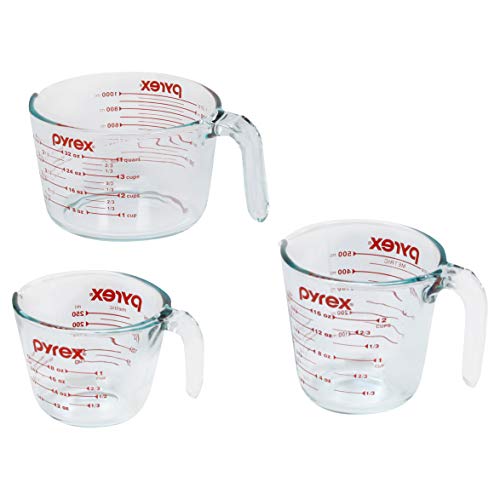
Pyrex Prepware Glass Measuring Cup Set
A glass measuring cup set often used as a baseline example of dimensionally stable, non-warping measuring cups compared to lower-cost plastic sets.
Common questions
Is a US cup the same as a cup in a UK recipe?
No, UK recipes commonly use weight rather than volume for dry ingredients, and when a cup measurement is used it can trace back to either US or metric cup conventions depending on the source, which is part of why converting recipes between regions can introduce error.
Can I check if my measuring cups are accurate at home?
Yes, filling a liquid measuring cup to its one-cup line and weighing the water on a kitchen scale, where one cup of water should weigh close to 236.6 grams, is a simple way to check accuracy at home.
Do more expensive measuring cups tend to be more accurate?
Not necessarily tied to price directly, but cups made from more dimensionally stable materials like stainless steel or glass, which often cost a bit more than basic plastic sets, do tend to hold their accuracy better over time.
Why does flour measured in different cups give different baking results?
Flour volume is also affected by how it is scooped versus spooned into the cup, which can create a bigger measurement difference than the cup’s manufacturing tolerance itself, making technique as important as the cup.
Is it better to weigh ingredients instead of using cups at all?
For baking specifically, weighing ingredients on a scale removes almost all of the variance described here, since weight measurement does not depend on cup shape, fill line placement, or scooping technique.
Do nesting measuring cup sets vary more than individual cups?
Not inherently, but a full nesting set is manufactured as a batch, so if one mold in the set runs slightly off, every cup of that size made from that mold run will share the same small deviation.
Why do my dry and liquid measuring cups give different amounts for the same stated volume?
They are designed for different tasks, dry cups are meant to be leveled flush with the rim while liquid cups have headroom below the rim for pouring, so reading each to its own fill line correctly actually gives correct results, just using different reference points.
Does temperature affect how accurate a plastic measuring cup stays over time?
Yes, repeated exposure to hot liquids and dishwasher heat cycles can cause minor warping in some plastics over years of use, which is one reason plastic cups are more likely to drift from their original accuracy than glass or metal.
Is there an official standard that measuring cup brands have to follow?
There is a defined US customary cup volume, but enforcement of manufacturing tolerance is largely left to each manufacturer’s own quality control rather than a single mandated inspection standard for consumer kitchenware.
Can using a slightly inaccurate measuring cup ruin a recipe?
For most everyday recipes, no, since small percentage differences rarely change the result in a way most people would notice, though highly precision-dependent baking recipes are more sensitive to it.
Why do some measuring cups have multiple unit markings on the same cup?
Many cups print cups, ounces, and milliliters together for convenience across different recipe sources, and because these units are not perfectly interchangeable round numbers, the printed markings are sometimes close approximations rather than mathematically exact conversions at every line.
Does the shape of the cup, straight-sided versus tapered, affect measurement accuracy?
Shape mainly affects how easy it is to read the fill line accurately and how cleanly the cup can be leveled for dry ingredients, rather than changing the actual calibrated volume at each printed line.
Is it normal for a one-cup measure to actually hold slightly more than one cup?
Yes, within a small tolerance this is common and generally considered acceptable by most manufacturers, since practical kitchen use does not usually require laboratory-level precision.
Do collapsible silicone measuring cups measure as accurately as rigid ones?
They can, but because silicone flexes, inconsistent pressure while filling or reading the cup can introduce more user-side measurement error than with a rigid cup, even if the cup itself was molded accurately.
Why does the same brand’s older and newer measuring cup sets sometimes differ slightly?
Manufacturing molds wear and get replaced over a product’s production lifespan, and small design or tooling changes between production runs can introduce slight differences even within the same product line and brand.
Should I buy measuring cups from the same brand as my mixing bowls or other kitchen tools for consistency?
Matching brands has no real effect on measuring accuracy, since accuracy depends on that specific cup’s own manufacturing, not on what other kitchen tools happen to match it visually.
Is it worth owning both a dry measuring set and a liquid measuring cup?
Yes, this matters more for accuracy than brand choice does, since using the correct cup type for the ingredient and reading it the way it was designed to be read reduces far more error than switching brands would.
The bottom line
The variation between brands is real but usually small, and in most everyday cooking it will not be the reason a dish turns out wrong. For baking where precision matters more, a kitchen scale sidesteps the whole issue, while for regular cooking, consistently using the same set and reading it correctly matters more than chasing a brand with a reputation for being exact.
Dana Whitfield
Dana spent eight years buying and merchandising for a regional kitchenware retailer before moving into editorial work. She has handled thousands of SKUs across cookware, small appliances and kitchen organization, and focuses on the practical differences that matter once a product is actually in daily use.


