Why Do Kitchen Shears Dull Faster Than Knives?
Kitchen shears dull faster than knives mainly because their two blades rub against each other with every cut, they are routinely used on materials that a knife would never touch (wire, twine, packaging, bones), and their edge geometry is thinner and less supported than a knife’s. Add in the fact that most people never sharpen or maintain them, and the wear adds up quickly.
The rubbing action of two blades
A knife edge meets food and separates it with a single clean pass. Shears work by bringing two edges together, and those edges slide against each other along their full length with every squeeze. That metal-on-metal contact is a constant low-grade abrasion that a knife never experiences. Even a well-adjusted pair of shears wears at the contact point over time, and once the pivot loosens or the blades get slightly misaligned, the rubbing gets worse and the edges round off faster.
What people actually cut with shears
A knife is usually reserved for food. Shears get used on poultry bones, lobster shells, flower stems, twine, plastic packaging, wire, and sometimes even light metal. Each of those materials is far harder or more abrasive than cooked vegetables or raw meat. Cutting through a chicken backbone or a lobster shell puts a concentrated load right at the edge intersection, and that chips or rolls the fine edge quickly. A knife would suffer the same damage, but most cooks do not subject their chef’s knife to those tasks.
Edge geometry and support
Shears often have a thinner, more acute edge than a typical kitchen knife because they need to slice cleanly through soft materials without wedging. That thin edge has less metal behind it to support the cutting edge, so it deforms more easily under stress. Knives, especially chef’s knives, have a thicker primary grind that backs up the edge and resists rolling. The trade-off is that shears cut delicate things more precisely but pay for it with faster wear.
The pivot and alignment problem
The pivot is the weak point of any pair of shears. As it wears or loosens, the blades no longer meet at the ideal angle, and the edges start to rub harder or even cross over each other. That misalignment accelerates dulling dramatically. A knife has no pivot, so it never develops this kind of mechanical wear. Keeping the pivot clean and properly tensioned is one of the few things you can do to slow shear dulling.
Maintenance gap: shears rarely get sharpened
Most home cooks sharpen their knives at least occasionally, but very few ever sharpen their kitchen shears. Shears are often treated as a utility tool that gets replaced when it stops cutting well. That lack of maintenance means the edge never gets restored, so the dulling that would be corrected on a knife simply accumulates on shears until they are unusable. A few passes with a sharpening tool designed for shears can add years of life.
Storage and handling
Shears often live loose in a drawer, where they knock against other tools and dull each other. Knives are more likely to be stored on a magnetic strip, in a block, or with edge guards. That difference in storage alone can account for a significant portion of the wear. A simple sheath or a dedicated spot for shears makes a real difference.
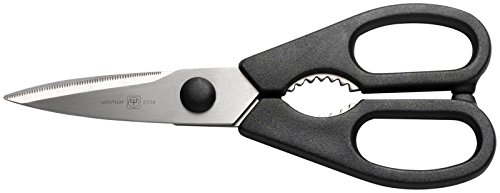
Wüsthof 5558 Kitchen Shears
A take-apart pair with a stainless steel blade and a built-in bone notch, designed for tasks like cutting poultry and herbs.

Fiskars 8 Inch Take Apart Kitchen Shears
A widely available pair that separates for thorough cleaning and has a built-in bottle opener and nutcracker.
Good to know
Can you sharpen kitchen shears at home?
Yes, but you need to sharpen each blade separately and maintain the original bevel angle. A simple pull-through sharpener designed for shears, or a fine diamond file, works for most home pairs. Take the shears apart if the manufacturer allows it, and sharpen only the beveled side, not the flat side.
Why do my kitchen shears cut paper fine but struggle with food?
Paper is thin and easy to shear, so even a slightly dull pair will manage it. Food, especially meat or vegetables, offers more resistance and requires a keener edge. If shears cut paper but not food, the edge is likely rolled or slightly rounded and needs sharpening.
Is it normal for kitchen shears to last only a few years?
For everyday use, yes. Most home pairs see a few years of service before the edge or pivot degrades noticeably. Higher-quality shears with a take-apart pivot and better steel can last much longer, especially if you sharpen them occasionally and avoid cutting wire or very hard materials.
Can I use my knife sharpener on kitchen shears?
Most knife sharpeners are not designed for shears because the blades are curved and the bevel angle is different. Using a knife sharpener can ruin the edge geometry. Look for a sharpener specifically made for scissors and shears, or use a file and follow the existing angle.
Why do my shears have a screw or pivot that loosens over time?
The pivot takes all the force of cutting and naturally works loose with use. Some shears have an adjustable screw you can tighten with a screwdriver. If the pivot is riveted and loosens, the shears are usually at the end of their life. Keeping the pivot clean and occasionally checking tightness helps.
Do expensive kitchen shears stay sharp longer than cheap ones?
Generally yes, because higher-quality steel holds an edge better and the pivot is often more precisely made. However, even expensive shears will dull if used on wire or bones and never sharpened. The biggest factor is still how you use and maintain them, not the price alone.
Can kitchen shears be used to cut through bone?
Some shears have a bone notch specifically for poultry, but the force required still stresses the edge. Use the notch and avoid twisting. For thick bones, a knife or cleaver is a better choice. Cutting bone with shears will dull them faster than almost anything else.
How often should I sharpen kitchen shears?
For typical home use, once a year is a reasonable interval, or whenever they start to crush rather than cut herbs. If you use them daily on tough materials, you may need to sharpen them every few months. Professional sharpening is an option, but many home cooks do it themselves with a simple tool.
Why do my shears cut better on one side than the other?
That usually indicates the blades are misaligned or one edge is duller than the other. Check the pivot for tightness and inspect both edges under good light. If one edge is rounded, sharpening both blades evenly should restore balanced cutting.
Can I put kitchen shears in the dishwasher?
Check the manufacturer’s instructions. Many are dishwasher safe, but the harsh environment can accelerate wear on the pivot and edge. Hand washing and drying immediately is gentler and helps them last longer. If you do use the dishwasher, dry them promptly to prevent rust.
What is the best way to store kitchen shears to keep them sharp?
Keep them in a drawer with a sheath, or hang them on a hook where they will not knock against other tools. Avoid tossing them loose in a crowded drawer. Some shears come with a blade guard; use it. Proper storage prevents the edge from getting nicked and the pivot from getting dirty.
Do kitchen shears dull faster if you cut a lot of acidic foods?
Acidic foods can corrode the edge over time, especially on carbon steel blades, but most kitchen shears are stainless steel and resist this. The mechanical wear from cutting is a much bigger factor than acidity. Rinse and dry after cutting acidic foods to be safe.
Can I use kitchen shears to cut through packaging and tape?
You can, but the adhesive from tape can gum up the blades and the packaging materials can be abrasive. It is better to keep a separate pair of utility scissors for those tasks. Using kitchen shears on tape and cardboard is a common reason they dull prematurely.
Why do my shears sometimes cut better after I tighten the pivot?
A loose pivot lets the blades separate slightly, so they do not meet cleanly and the cut feels rough. Tightening the pivot brings the edges back into proper contact, which improves cutting performance. It does not sharpen the edge, but it restores the mechanical advantage.
Are take-apart kitchen shears worth it?
Yes, if you want to clean the pivot area thoroughly and sharpen the blades properly. Take-apart shears are easier to maintain, and that maintenance directly extends their life. They cost a bit more, but the ability to separate the blades is a real advantage for anyone who cooks often.
Can I sharpen serrated kitchen shears?
Serrated shears are sharpened on the beveled side only, using a file or sharpening rod that fits the serrations. Do not sharpen the flat side. It takes more care than a straight edge, but it is doable. If the serrations are very fine, professional sharpening may be the safer route.
Why do my shears feel sticky when I cut?
Sticky residue from tape, packaging, or food can build up on the blades and make cutting feel drag. Clean the blades with rubbing alcohol or a gentle solvent, then dry thoroughly. A clean blade cuts more smoothly and also resists corrosion.
Do all kitchen shears have the same edge angle?
No, edge angles vary by manufacturer and intended use. Some are designed for delicate tasks with a finer angle, others for tough tasks with a more robust angle. When sharpening, try to match the original angle. If unsure, a slightly more obtuse angle will be more durable but less keen.
Can I use a honing rod on kitchen shears?
A honing rod is not ideal for shears because the blades are curved and the rod is straight. It can be used carefully on the beveled side, but a flat diamond file or a dedicated shear sharpener is better. Honing is mainly for realigning a knife edge, not for shears.
Why do my shears cut better after I clean them?
Dirt, dried food, or adhesive on the blades creates friction and can prevent the edges from meeting properly. Cleaning removes that interference, so the shears cut more smoothly. Regular cleaning is one of the simplest ways to keep shears performing well.
Our take
Kitchen shears are not poorly made; they are simply asked to do more abrasive work than knives, with a thinner edge and a pivot that wears. Understanding that helps you get more life out of them: use them for the right tasks, keep the pivot tight, store them protected, and sharpen them occasionally. Do that, and a good pair will last far longer than the typical drawer-dweller.
Dana Whitfield
Dana spent eight years buying and merchandising for a regional kitchenware retailer before moving into editorial work. She has handled thousands of SKUs across cookware, small appliances and kitchen organization, and focuses on the practical differences that matter once a product is actually in daily use.


