Why Does a Martingale Collar Work Better Than a Flat Collar for Some Dogs?
A martingale collar tightens slightly, within a limited range, when a dog pulls backward or tries to back out of it, which closes the gap a narrow-headed or neck-shy dog would otherwise slip through in a flat collar, without choking the dog the way a slip collar with no limit can. That built-in limit is the key difference, giving a snugger hold under pressure while still stopping well short of a full cinch.
How the limited-tightening mechanism actually works
A martingale has two loops, a larger one that sits around the neck and a smaller control loop that the leash clips to. Pulling the leash tightens the larger loop only until it reaches a preset limit, normally sized to snug comfortably rather than cinch down fully. Once that limit is reached, further pulling on the leash doesn’t continue tightening the collar any further.
Why flat collars fail on certain head and neck shapes
Dogs with a neck roughly the same width as or narrower than their head, common in sighthounds like Greyhounds and Whippets, can simply back out of a flat collar that’s loose enough to slip over their ears, since a flat collar has no mechanism to close that gap under pressure. This same issue shows up with any dog that panics and pulls backward hard enough during a startling moment, not just sighthound breeds specifically.
The difference between a martingale and a full slip collar
A slip collar has no limiting loop and can continue tightening indefinitely under constant pressure, which is why martingales are generally considered safer for everyday walking, since the built-in limit stops it from closing past a comfortable, pre-adjusted point no matter how hard a dog pulls. This distinction is often lost on new owners who assume any collar that tightens must work the same way.
Fitting a martingale correctly matters as much as the design
A martingale sized or adjusted too loosely still allows a dog to back out before the limit loop engages, while one adjusted correctly should only tighten a small amount, generally room for two fingers when fully snug, to hold securely. Rechecking the fit periodically matters too, since a growing puppy or a dog that gains or loses weight can shift what counts as a correct adjustment.
When a flat collar is still the better choice
For dogs that don’t pull or try to back out, and for leaving a collar on all day with ID tags attached, a flat collar is simpler and more comfortable. Martingales are mainly suited for walking and training sessions rather than full-time wear, since the limited loop design isn’t intended to sit against the neck continuously the way a standard buckle collar is.
Martingale versus harness for escape-prone dogs
For dogs that are especially anxious or prone to bolting, many trainers pair a martingale with a harness using a double connection, so that even if a collar were to somehow fail, the harness is still attached, adding a layer of backup beyond the collar alone. This double-connection approach is especially common advice for newly adopted dogs whose reactions to leash pressure aren’t yet well known.

PetSafe Martingale Collar
An adjustable martingale collar commonly used for dogs prone to backing out of a standard flat collar.
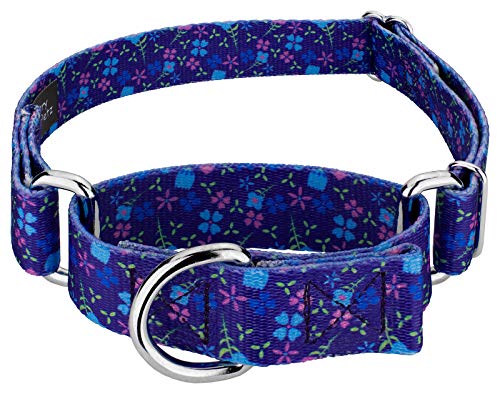
Blueberry Pet Martingale Dog Collar
A padded martingale collar sold in multiple sizes for everyday walking and training use.
Frequently asked questions
Can a dog still slip out of a properly fitted martingale collar?
A correctly adjusted martingale significantly reduces that risk, since it closes the gap under pressure, though no collar is completely escape-proof in every scenario.
Is a martingale collar safe to leave on a dog all day?
It’s generally recommended mainly for walking and training rather than full-time wear, since the limited loop isn’t designed the same way a flat collar is for constant use.
How do you know if a martingale collar is adjusted correctly?
When fully tightened, there should be just enough room to fit two fingers comfortably between the collar and the dog’s neck, not looser or tighter.
Are martingale collars better for dogs with narrow heads like Greyhounds?
Yes, this is one of the main reasons they’re recommended, since narrow-headed breeds can often back straight out of a loose flat collar.
What is the difference between a martingale collar and a choke chain?
A martingale has a built-in limit that stops it from tightening past a preset point, while a traditional choke chain has no such limit under constant pulling.
Can a martingale collar be used for everyday walking, or only training?
It works well for everyday walking on dogs prone to backing out or pulling, not just for formal training sessions specifically.
Do martingale collars work for puppies, or are they meant for adult dogs?
They can work for puppies too, provided the collar is sized and adjusted appropriately for a smaller, still-growing neck.
Is it normal for a martingale collar to tighten a little during every walk?
Yes, slight tightening when a dog pulls or turns its head is expected behavior and part of how the collar maintains a secure, snug fit.
Can a martingale collar hurt a dog’s neck if pulled on hard enough?
The built-in limit reduces this risk considerably compared to a slip collar, though sustained hard pulling on any collar can still cause discomfort over time.
Should a martingale collar be used with a harness instead of alone?
Many trainers recommend pairing both for especially anxious or escape-prone dogs, giving a backup connection point beyond the collar alone.
Do martingale collars come in different sizes for small versus large dogs?
Yes, they’re sold across a range of sizes and loop lengths to properly fit everything from small breeds to large, broad-necked dogs.
How tight should a martingale collar be when it’s fully closed?
It should close snugly without being able to slip over the dog’s head or ears, while still comfortably fitting two fingers underneath at full tightness.
Can a martingale collar replace a flat collar for ID tag attachment?
It can hold tags, but many owners still keep a separate flat collar on for daily ID purposes since martingales are typically used during walks only.
Is training needed to get a dog used to wearing a martingale collar?
Most dogs adjust quickly, though a short introduction period with treats and gradual wear helps a dog get comfortable with the slight tightening sensation.
Why do some shelters and rescues require martingale collars specifically for walks?
Shelters often handle dogs with unknown or anxious temperaments, and the reduced slip-out risk makes martingales a safer default for unfamiliar dogs on leash.
Can a martingale collar be adjusted without removing it from the dog?
Most have a sliding adjustment on the larger neck loop that can be resized while the collar is on, making periodic refitting straightforward as a dog grows or changes.
Do martingale collars work well for dogs that lunge suddenly at other animals?
They help reduce the slip-out risk during a sudden lunge, though a harness is often recommended as an additional layer of control for dogs with strong reactive behavior.
Is chain-style martingale material different from fabric martingale collars?
Chain martingales use metal links for the tightening loop, while fabric versions use webbing, and the fabric style is generally considered gentler and more common for everyday walking.
Can a martingale collar be too tight even at its loosest adjustment?
If the smallest adjustment still feels snug at rest on a particular dog’s neck, it’s likely sized wrong for that dog and a different size should be tried instead.
Do martingale collars make a clicking or tightening sound that could startle a dog?
Fabric versions are generally silent, while chain-style martingales can make a faint sliding sound, which is one reason some owners prefer the fabric style for sound-sensitive dogs.
The bottom line
The appeal isn’t that it’s a stricter collar, it’s that the built-in limit gives it a self-correcting snugness a flat collar can’t offer, which is exactly why it’s the standard recommendation for narrow-headed breeds and nervous dogs prone to backing out, while still falling short of a full no-limit slip collar’s tightening range, and that balance is precisely what makes it the safer everyday choice for those specific dogs.
Olivia Hartley
Olivia spent several years working at an animal shelter and a pet-supply retailer before joining the editorial team. She researches pet gear with an emphasis on safety, comfort and the fine print that owners often miss.