Why Does a Compost Thermometer Matter for Breaking Down Compost Faster?
A compost thermometer matters because the speed of decomposition depends almost entirely on internal pile temperature, and that temperature is not something you can judge accurately by touch or smell from the outside. A pile running in the ideal hot range breaks down in weeks, while a pile that has quietly gone cold can sit for months without much progress, and the only reliable way to tell the difference is a probe reading from the pile’s core.
What temperature range actually matters
Active composting microbes work fastest in the hot range, and a pile sitting in that zone for several days is going hard at breaking down material and also killing off most weed seeds and pathogens in the process. Below that range, decomposition continues but much more slowly, and well below it, the pile is essentially dormant.
Why you cannot judge pile temperature from outside
The outer few inches of a compost pile are exposed to ambient air and insulate the hot core, so a pile can feel cool to the touch at the surface while running well above body temperature just a foot deeper. A long-probe thermometer is built specifically to reach that core, which a surface check simply cannot do.
What a dropping temperature actually tells you
A pile that was hot and is now cooling has usually run through its easily available nitrogen and oxygen, which commonly means it needs turning to reintroduce air, or a fresh addition of nitrogen-rich material like grass clippings or kitchen scraps to restart the microbial activity.
Why overheating is also a real risk
A pile that spikes well above the ideal hot range for an extended period can start killing off the beneficial microbes doing the actual breakdown work, along with risking a genuine fire in very large, dense piles. A thermometer catches this before it becomes a problem, not just when the pile has gone cold.
How thermometer readings guide turning schedule
Rather than turning a pile on a fixed weekly schedule, many composters turn based on temperature trend: turn when the reading plateaus or starts dropping from its peak, since that is the practical signal that oxygen has been depleted and fresh air needs mixing in.

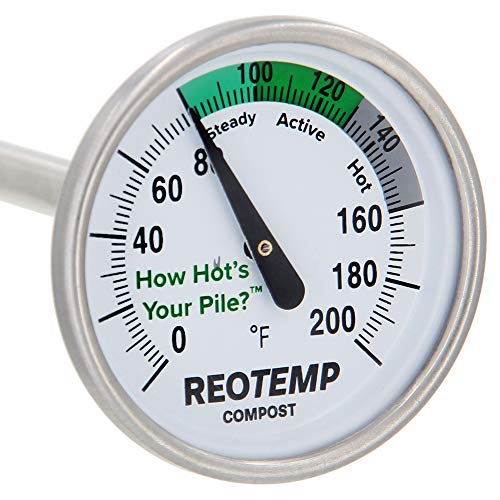
REOTEMP Compost Thermometer
A long-stem probe thermometer built specifically to reach deep into a pile’s core rather than just the surface layers, with a dial readout sized for outdoor use.
AcuRite Compost Thermometer
A more budget-oriented stainless probe thermometer that still reaches a usable depth for home-sized compost piles and raised bins.
Frequently asked questions
How deep should a compost thermometer probe go into the pile?
Most probes are designed to reach well into the pile’s core, often a foot or more, since that is where the active microbial heat actually concentrates rather than near the cooler outer surface.
Can compost get too hot and die off?
Yes, extended periods well above the ideal active range can kill the beneficial microbes doing the breakdown work, so a sustained spike is a signal to turn the pile and let it release heat rather than leaving it packed tight.
How often should I check compost temperature?
Checking every few days during the active hot phase helps you catch the point where it plateaus or starts dropping, which is the practical cue to turn the pile again.
Does a cold compost pile mean it has failed?
Not necessarily. Cold composting still breaks material down, just much more slowly over months instead of weeks, and some gardeners intentionally run a slower cold pile because it requires less turning and attention.
What ingredients help a compost pile heat up faster?
A balance of nitrogen-rich green material like grass clippings or food scraps with carbon-rich brown material like dry leaves or straw, plus enough moisture and airflow, is what typically gets a pile into its active heating phase.
Why did my compost pile heat up and then suddenly cool off?
This is a normal pattern as the easily accessible nitrogen and oxygen get used up by the first wave of microbial activity, and it is usually the signal to turn the pile or add fresh green material to restart the cycle.
Can I use a regular meat or candy thermometer in compost?
A standard kitchen probe thermometer is often too short to reach the active core of a full-sized pile and is not built for repeated outdoor exposure, so a dedicated long-stem compost thermometer is a better fit for reliable readings.
Does weather affect how hot a compost pile gets?
Cold ambient temperatures slow a pile down somewhat and can make it harder to get a cold pile started, but a well-built, properly sized pile can still sustain internal heat well above freezing air temperatures through insulation from its own mass.
Is there a minimum pile size needed to generate real heat?
Yes, a pile needs enough mass to insulate its own core, and very small piles often struggle to hold heat regardless of ingredients, which is why many composting guides recommend a minimum size before expecting a strong hot phase.
How do I know if my compost is actually finished, not just cooled down?
Finished compost is cool, dark, crumbly, and smells earthy rather than sour or ammonia-like, and temperature alone is not the full picture since a pile can cool because it finished or because it stalled, so checking texture and smell alongside temperature gives the clearer answer.
Does turning the pile always cause a temperature spike afterward?
Often yes, because turning reintroduces oxygen that the microbes need, and a noticeable rise in the days following a turn is usually a good sign that there is still active material left to break down.
Can a compost thermometer help me know when to add more material?
Indirectly yes, since a pile that will not heat up even after turning and moisture adjustment often needs a fresh addition of nitrogen-rich material to restart active decomposition.
Is a dial thermometer or digital probe better for compost?
Both work, though dial probes tend to be more durable for repeated outdoor use and do not depend on batteries, while digital probes can offer a faster, more precise readout if kept dry and maintained.
Does the time of year affect how useful a compost thermometer is?
It stays useful year round, but in colder months it becomes more important, since it is often the only way to tell whether a pile has genuinely gone dormant for the season or just needs a turn and some fresh material to restart activity before winter fully sets in.
Can a compost thermometer help diagnose a bad smell coming from the pile?
Indirectly yes, since a pile running too cold or too wet and lacking oxygen often smells sour or like ammonia, and a low temperature reading combined with that smell points toward turning the pile for more airflow rather than leaving it undisturbed.
Do bigger compost bins need a different kind of thermometer than small backyard tumblers?
Not a fundamentally different type, but a bigger pile needs a longer probe to reach its deeper, hotter core, while a compact tumbler or small bin may not build up enough mass to need a long-stem probe at all.
Is it worth tracking compost temperature readings over time in a log?
Many experienced composters find that logging temperature readings over days and weeks makes patterns like plateaus and drop-offs much easier to spot early, rather than relying on memory or occasional spot checks to judge how the pile is progressing.
Can rain or excess moisture throw off a compost temperature reading?
Heavy rain soaking into a pile can cool it down and also displace oxygen in the material, both of which lower the internal temperature, so a sudden drop in readings after a storm is often more about moisture and air than a sign the pile has stopped working for good.
Where this leaves you
A compost thermometer is not a gadget for serious composters only, it is the one tool that turns guesswork about pile activity into an actual number. Without it, a stalled pile and a finished pile can look identical from the outside.
Sierra Daniels
Sierra's background is in landscape design and nursery retail. She focuses on lawn and garden equipment, outdoor furniture and gear durability, weighing published specs against how materials actually hold up outside.

