Why Does a Car Vacuum Lose Suction Faster Than a Home Vacuum?
A car vacuum’s motor is working with a fraction of the electrical power a home vacuum gets from a wall outlet, since it typically runs off a 12 volt car outlet or a small internal battery rather than 120 volt household current. On top of that lower power ceiling, its filter and dust cup are much smaller and clog far faster with the fine debris common in cars, like sand and crumbs, and clogged filters cause suction to drop off exponentially rather than gradually.
The power source puts a hard ceiling on performance
A standard 12 volt car outlet simply cannot deliver the wattage a 120 volt household outlet provides, which means a corded car vacuum’s motor is inherently capped at a lower power level than almost any plug-in home vacuum regardless of design quality. Cordless car vacuums face an even tighter constraint, since they’re limited by whatever battery capacity fits in a small handheld housing.
Small filters and dust cups clog disproportionately fast
Car interiors generate a lot of fine particulate, sand, dried mud, crumbs, that clogs a filter’s pores quickly, and because car vacuums use much smaller filters and dust cups than home vacuums to stay compact, that same amount of debris represents a much larger percentage of total capacity. A partially clogged filter doesn’t just reduce suction proportionally, it restricts airflow in a way that causes suction to drop off sharply rather than in a straight line.
Cordless models lose power as the battery drains
In a cordless handheld car vacuum, suction strength is directly tied to motor RPM, which falls as battery voltage sags during use. Unlike a corded vacuum drawing steady power the whole time, a cordless unit noticeably weakens the longer a single cleaning session runs, especially once the battery drops below roughly half charge.
Small motors in tight housings overheat faster
Car vacuum motors are packed into compact housings with limited airflow for cooling, so sustained use can trigger thermal protection that throttles power or shuts the unit off to prevent damage, which feels exactly like suction fading even though the motor itself isn’t failing. Home vacuum motors, built larger with more ventilation, are designed for longer continuous runtimes without hitting that same thermal limit.
Maintenance habits make the gap worse over time
Car vacuum filters get cleaned far less often than home vacuum filters in most households, partly because they’re smaller and less obviously dirty-looking and partly because they’re simply less top of mind, which compounds the clogging problem that was already working against the smaller unit from the start.
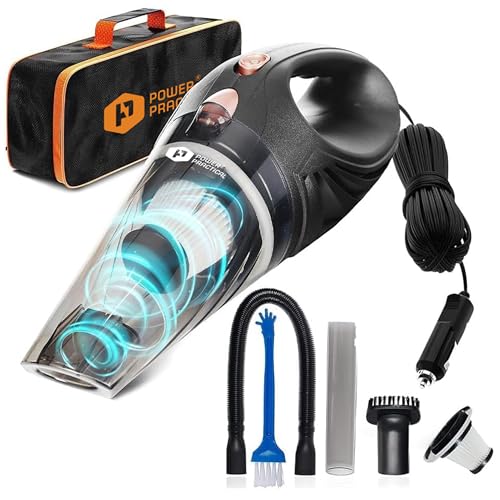
ThisWorx Car Vacuum Cleaner
A popular corded 12V car vacuum designed for quick interior cleanups, with a compact filter and dust cup sized for portability rather than extended runtime.

Black+Decker dustbuster AdvancedClean Cordless Handheld Vacuum
A cordless handheld vacuum commonly used for car interiors, illustrating the battery-drain suction drop-off that corded units don’t experience.
Good to know
Can a corded car vacuum ever match a home vacuum’s suction?
Not typically, since even plugged into a 12 volt car outlet, the available wattage is still far below what a 120 volt home outlet supplies, which caps corded car vacuum motor power well below most upright or canister home vacuums.
How often should a car vacuum’s filter actually be cleaned?
Checking and cleaning it after every two or three uses is a reasonable habit given how small the filter surface area typically is, since fine debris common in cars clogs these smaller filters much faster than people expect.
Does a bigger dust cup on a car vacuum actually help suction last longer?
Yes, a larger cup means more room before airflow gets restricted by accumulated debris pressing against the filter, so models with larger cups for their size class generally maintain suction longer between cleanings.
Why does my cordless car vacuum feel strong at first and weak a few minutes later?
This is normal battery voltage sag, since suction strength in a cordless unit is tied directly to motor speed, which declines as the battery’s charge and voltage drop during continuous use.
Is it worth buying a shop vac instead of a dedicated car vacuum?
A shop vac plugged into household power avoids the car vacuum’s power ceiling entirely and often holds suction far longer, though it sacrifices the portability of a 12 volt or battery unit that can be used directly in a parked car away from an outlet.
Does washing a car vacuum’s filter extend its life?
Many filters are washable and reusable, and rinsing out trapped fine particulate restores much of the lost suction, though filters should be completely dry before reinstalling to avoid motor damage from moisture.
Why do some car vacuums have multiple filter stages?
Multi-stage filtration, often a foam pre-filter plus a finer filter, catches larger debris before it reaches the fine filter, which extends the time before the fine filter clogs and suction starts noticeably dropping.
Does heat in a parked car affect a car vacuum’s battery or motor?
Yes, prolonged heat exposure accelerates battery degradation in cordless units and can shorten motor life over time, which is part of why many manufacturers recommend storing a car vacuum somewhere other than a hot trunk or dashboard.
Can emptying the dust cup more often improve suction without cleaning the filter?
It helps somewhat, since an overly full cup can restrict airflow on its own, but a dirty filter is usually the bigger factor in suction loss, so both should be addressed together rather than relying on emptying the cup alone.
Why does my car vacuum sound different when suction drops?
A change in motor pitch, often a slightly higher whine, frequently accompanies restricted airflow from a clogging filter or a blocked hose, since the motor spins faster trying to compensate for the resistance.
Is a wet or dry rated car vacuum better for maintaining suction?
Wet and dry rated vacuums handle spills without damage, but they don’t inherently maintain suction better for dry debris; suction longevity still comes down to filter size, motor power, and how often the filter is cleaned.
Does a longer hose on a car vacuum reduce suction compared to a shorter one?
Yes, airflow resistance increases with hose length, so a longer hose for reaching rear seats or trunk corners does slightly reduce effective suction at the nozzle compared to a shorter hose on the same motor.
Does using a car vacuum on wet spills affect suction differently than on dry debris?
Yes, wet debris can clog a filter even faster than dry debris and, on units not rated for wet use, can damage the motor entirely, so checking whether a specific car vacuum is rated for wet pickup matters before using it on spills.
Can attaching a smaller nozzle attachment help maintain stronger suction?
Yes, a narrower attachment concentrates the same airflow into a smaller area, which can make suction feel stronger at the tip even though the motor’s total output hasn’t changed, useful for tight seams and crevices.
Is it worth buying a car vacuum with a HEPA filter for better long-term suction?
A HEPA-rated filter captures finer particulate more effectively, which can help air quality, but finer filtration also tends to clog faster under heavy dust load, so it’s a tradeoff between filtration quality and how often the filter needs cleaning.
Does the length of time a car vacuum runs continuously affect how much suction it loses?
Yes, longer continuous runs give both battery voltage sag in cordless units and thermal buildup in any motor more time to reduce output, so breaking a big cleaning job into shorter sessions can help maintain stronger suction throughout.
Our take
A car vacuum losing suction faster than a home vacuum isn’t really a quality defect, it’s the predictable result of a much smaller motor, a much smaller filter, and in cordless models a draining battery, all packed into a housing built for portability rather than sustained performance. Keeping the filter clean and emptying the cup regularly closes some of that gap, but the underlying power and capacity ceiling never fully goes away.
Tony Russo
Tony trained as an automotive technician and spent years in service and parts retail before moving into writing. He focuses on garage tools, car care products and accessories from a hands-on maintenance perspective.