Do Car Battery Testers Actually Predict When a Battery Will Fail?
A decent battery tester, whether a conductance tester or a load tester, gives a genuinely useful early-warning signal by measuring something that correlates well with remaining capacity, not just a surface-level voltage reading. What it can’t do is name an exact date, it places the battery into a risk category like good, marginal, or replace soon, which is meaningfully more useful than guessing but still short of a precise prediction. Sudden failures from cracked cases or internal shorts can still happen without much warning on a reading taken days earlier.
How conductance testers actually work
A conductance tester sends a small AC signal through the battery and measures how the plates respond, which correlates to the battery’s internal plate surface area that’s still chemically active. As plates degrade from sulfation or corrosion over years of use, conductance drops in a measurable way, which the tester translates into an estimated cold cranking amp rating relative to what the battery was rated for when new.
How load testers work differently
A load tester draws a real direct current load, typically around half the battery’s rated cold cranking amps, for a set number of seconds and watches how much the voltage sags under that draw. This is a more direct simulation of what happens during an actual cold start, but it requires the battery to be reasonably well charged beforehand or the test gives a falsely poor result that looks like battery failure when it’s really just low charge.
Why a simple voltage reading alone is misleading
A battery sitting at a resting voltage of 12.4 volts or higher can look perfectly healthy by that number alone, yet still fail to crank a cold engine, because resting voltage reflects state of charge, not the battery’s actual capacity to deliver current under load. This is the main reason a basic voltmeter check gives a less reliable picture than a dedicated tester designed to measure capacity rather than charge level.
What even a good tester can’t catch
A battery can test fine today and still fail abruptly from an internal short developing between plates, a cracked case letting electrolyte leak, or a corroded post connection that has nothing to do with the battery’s internal capacity. These failure modes aren’t capacity-related, so no capacity-based test, however accurate, reliably flags them in advance.
Why shops combine a tester reading with other context
Professional shops typically weigh a tester’s result alongside the battery’s age, since most lead-acid batteries show meaningfully higher failure risk after three to five years regardless of what a single test says, plus any reported symptoms like slow cranking or dimming lights. Treating a tester reading as one data point among several, rather than a standalone verdict, is standard practice for a reason.

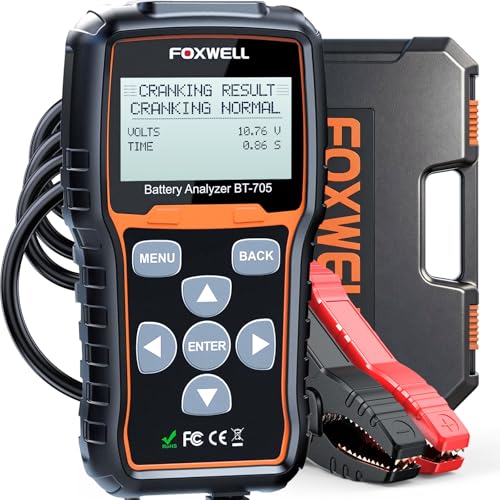
Ancel BA101 12V Battery Tester
A handheld conductance tester that estimates cold cranking amps and state of health from a quick clamp-on reading without needing to load the battery.

Schumacher BT-100 12V Battery Load Tester
A carbon-pile load tester that draws a real current load to simulate cranking demand, giving a more direct real-world style result than a conductance-only reading.
Common questions
Can a battery tester tell me exactly how many months a battery has left?
No, it places the battery into a general risk category such as good, marginal, or replace, based on measured capacity relative to its rated specification, which is useful for prioritizing replacement but isn’t a precise countdown.
Why did my battery test fine and then fail a week later?
This usually points to a failure mode the test wasn’t measuring, such as a developing internal short, a cracked case, or a loose or corroded terminal connection, none of which a capacity-based test is designed to detect.
Is a load test more accurate than a conductance test?
Each measures something slightly different; a load test more directly simulates real cranking demand but needs a well-charged battery to be accurate, while a conductance test works even on a partially discharged battery but relies more on an estimated correlation to actual capacity.
Do I need to charge my battery before testing it?
For a load test, yes, since an undercharged battery will show a poor result that looks like failure even if the battery itself is healthy; conductance testers are generally more tolerant of a partial charge state but still work best on a reasonably charged battery.
Can a battery tester be used on AGM or lithium batteries, not just standard lead-acid?
Many modern testers include specific settings for AGM, gel, and some lithium chemistries, but using the wrong battery-type setting on a tester can produce an inaccurate reading, so checking the tester supports your exact battery chemistry matters.
Why does my battery test as marginal but still starts the car fine every day?
A marginal result reflects reduced capacity relative to new, but a battery can still comfortably start an engine under mild conditions even at reduced capacity; the risk shows up more in cold weather or after the battery degrades further.
Does a battery tester measure the alternator or charging system at all?
No, a battery tester measures the battery itself; checking the charging system requires a separate test, usually measuring voltage output at the battery terminals with the engine running, since a failing alternator can look like a battery problem.
Can testing a battery too often damage it?
No, a standard conductance or load test draws a brief, controlled load that doesn’t meaningfully affect battery life, so testing periodically to track a battery’s trend over time is a reasonable practice.
Why do some auto parts stores offer free battery testing?
It’s a quick way to identify batteries that are likely near end of life and in need of replacement, which benefits both the customer catching a failure early and the store, though the free test typically uses the same conductance method available in consumer handheld testers.
Is it worth buying my own battery tester instead of relying on a shop’s test?
If you own multiple vehicles or want to track a battery’s health trend over time rather than a single snapshot reading, a personal tester pays for itself quickly compared to repeated shop visits.
Does cold weather affect how a battery tester reading should be interpreted?
Yes, battery capacity naturally drops somewhat in cold temperatures even in a healthy battery, so a marginal reading taken in very cold conditions may look slightly worse than the same battery would test at a moderate temperature.
Can a new battery test as marginal right out of the box?
It’s uncommon but possible if the battery sat in storage for an extended period before sale, since even unused batteries slowly self-discharge and lose some surface charge over time, which is why checking the manufacture date on a new battery is worthwhile.
What’s the single biggest limitation of any handheld battery tester?
It can only measure what correlates to internal capacity at that moment, so sudden mechanical failures like a cracked case or a loose connection fall completely outside what any capacity-based test is built to catch.
Does a battery’s size or group number affect how a tester interprets its reading?
Yes, testers typically ask for or detect the battery’s rated cold cranking amps before testing, since the same conductance or load reading means something different relative to a small battery’s rating versus a larger one.
Can a tester distinguish between a battery that’s just discharged and one that’s actually failing?
A capable tester can often tell the difference by checking whether the battery responds normally to a charge and subsequent test, since a simply discharged but healthy battery recovers its readings after charging, while a genuinely failing battery continues to test poorly even once recharged.
Where this leaves you
A battery tester earns its place as a genuine early-warning tool, not a crystal ball. It turns a vague worry about an aging battery into an actual risk category based on measured capacity, which is real, useful information. What it won’t do is promise a specific failure date or catch the sudden mechanical failures that have nothing to do with capacity, so a good reading today is reassuring, not a guarantee.
Tony Russo
Tony trained as an automotive technician and spent years in service and parts retail before moving into writing. He focuses on garage tools, car care products and accessories from a hands-on maintenance perspective.