Why Do C-Clamps Leave Marks on Wood?
C-clamps leave marks because they concentrate the full clamping force onto two small, hard metal contact points, one at the fixed jaw and one at the adjustable screw end, rather than spreading that force across a wider area. Wood compresses under concentrated pressure long before it would under the same total force spread over a larger surface, which is why even a properly used clamp at a reasonable tightness can still dent softer wood.
Why the contact area matters more than clamp strength
Pressure is force divided by area, and a C-clamp’s small metal pads apply the entire clamping force through a contact area often smaller than a coin. The same total force spread across a block of wood the size of your palm would barely compress the surface, while concentrated through that tiny pad it easily crushes wood fibers locally.
Softwood dents more easily than hardwood
Pine, cedar, and other softwoods have lower density and more open cell structure, which compresses more readily under point pressure than denser hardwoods like oak or maple. The same clamp, same tightness, and same wood thickness will leave a visibly deeper mark on pine than on oak purely because of this density difference.
The screw end often marks worse than the fixed jaw
Many C-clamps have a swiveling pad at the screw end, but if that pad is worn, stuck, or missing, the bare screw tip can dig in at a slight angle rather than sitting flat, concentrating pressure even further into a smaller point than the fixed jaw side experiences.
Clamping harder does not actually mean clamping better
Beyond the point needed to hold a joint secure during glue-up or assembly, additional tightening mostly just increases the depth of the dent without adding meaningful holding benefit. Many dents trace back to overtightening out of habit rather than the clamp actually needing that much force to do its job.
Using cauls and pads prevents the mark entirely
Placing a scrap piece of wood, cork, leather, or rubber between the clamp jaws and the workpiece spreads the same clamping force across a much larger area, which is the standard woodworking fix and adds only a few seconds to the clamping process.
Marks that happen even with cauls usually mean uneven pressure
If dents still appear despite using a protective caul, the caul itself may be too thin or too small, not fully covering the contact point, or the clamp may be seated at a slight angle that concentrates pressure on one edge of the caul rather than distributing it evenly.
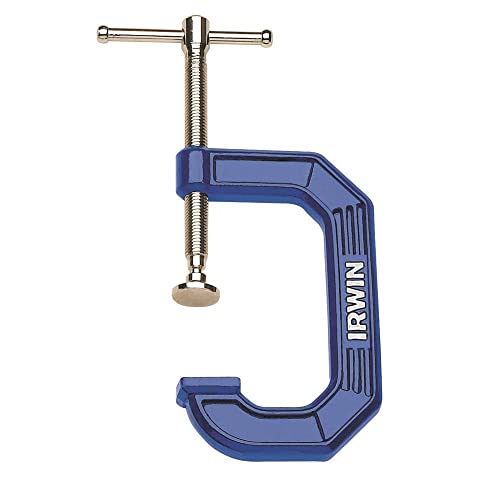
IRWIN Quick-Grip C-Clamp
A traditional C-clamp with a swiveling pressure pad commonly used for woodworking and general shop clamping tasks.

Olympia Tools C-Clamp Set
A multi-size set of C-clamps often used for general home workshop clamping where a range of jaw openings is needed.
Common questions
Why do C-clamps dent wood even when used carefully?
Because the clamp’s small metal contact pads concentrate all the clamping force into a tiny area, and wood compresses under that concentrated pressure even at moderate tightness.
Does using a wood block between the clamp and the workpiece actually help?
Yes, a scrap wood caul or similar pad spreads the same force across a much larger surface area, which is the most common and effective fix for preventing dents.
Is it the clamp’s fault or the user’s fault when wood gets dented?
Usually neither in a meaningful sense, since dents are a predictable physical result of point pressure on wood, and the fix is adding a protective pad rather than blaming technique or the tool.
Why does pine dent more easily than oak under the same clamp?
Pine has a lower density and more open cell structure than oak, so it compresses more readily under the same concentrated pressure from a clamp’s contact pad.
Can overtightening a C-clamp make the dent worse without adding real holding strength?
Yes, past the point needed to hold the joint secure, additional tightening mostly deepens the dent rather than improving the clamp’s actual holding performance.
Do all C-clamps have a swiveling pad at the screw end?
Most quality C-clamps do, but a worn, missing, or stuck swivel pad can let the bare screw tip dig in at an angle, which concentrates pressure even more than a properly functioning pad.
What materials work well as a clamping caul to prevent marks?
Scrap wood, cork, leather, and rubber pads are all commonly used, with the softer options like cork or rubber also helping to grip the workpiece and resist slipping during clamping.
Can a dent in wood from a clamp be fixed afterward?
Light dents in many woods can often be raised by applying a damp cloth and a warm iron to swell the compressed wood fibers back up, though deep or very dry dents may not fully recover.
Is there a type of clamp that avoids this marking problem entirely?
Clamps with wide, flat composite or rubber-coated jaws, such as many bar clamps and quick-grip style clamps, distribute pressure more evenly than a traditional C-clamp’s small metal pads, reducing dent risk.
Does clamp size affect how much marking happens?
Larger clamps with bigger contact pads spread force over a slightly wider area than small clamps, but the difference is modest, and a protective caul still makes the biggest difference regardless of clamp size.
Why do woodworkers still use C-clamps if they can dent wood?
C-clamps are simple, strong, and inexpensive for their clamping force, and the denting issue is easily managed with a protective caul, so the tradeoff is considered worth it for most general clamping needs.
Does the angle of the clamp affect how deep a mark becomes?
Yes, a clamp seated at a slight angle concentrates pressure unevenly on one edge of the contact point rather than distributing it flat, which can create a deeper or more uneven mark than a properly squared clamp.
Can metal clamps be used directly on finished or painted wood safely?
Not without a protective pad, since the same point pressure that dents bare wood can also crack, dent, or scuff a painted or finished surface, often more visibly than on raw wood.
Is cork or rubber better than plain scrap wood as a clamping pad?
Cork and rubber add some grip and cushioning on top of distributing pressure, while plain wood mainly distributes pressure, so either works, with the choice coming down to what is on hand and whether slip resistance is also needed.
Does humidity affect how easily a clamp dents wood?
Yes, wetter or more humid wood tends to be slightly softer and more prone to compressing under pressure, while dry, fully cured wood resists denting a bit better under the same clamping force.
Why do some woodworkers keep a dedicated set of caul blocks instead of grabbing random scrap?
A matched set of flat, consistently sized cauls seats more evenly against the workpiece than mismatched scrap, which reduces the chance of one edge of an uneven caul concentrating pressure the same way a bare clamp pad would.
Can plastic-jawed clamp covers be bought separately to retrofit an existing C-clamp?
Yes, snap-on plastic or rubber jaw covers are sold specifically for this purpose and are a convenient alternative to cutting fresh wood cauls for every clamping session.
Does the direction of wood grain affect how visible a clamp dent looks?
Yes, a dent across the grain tends to show more visually than one running parallel to it, since it disrupts the grain lines in a way the eye notices more readily on a finished surface.
Our take
A C-clamp denting wood is not a sign of a bad tool or bad technique, it is simple physics from concentrating force onto a small metal pad. Keeping a few scrap wood cauls or rubber pads within reach solves the problem completely and costs nothing beyond remembering to grab one before tightening down. It is one of the cheapest habits in woodworking for the amount of sanding and touch-up it saves later.
Jake Monroe
Jake worked as a residential contractor for over a decade before shifting to full-time writing. He evaluates power tools, hand tools and workshop gear through the lens of someone who has actually used them on job sites, not just read the box.