Which C-Clamp Fits Your Shop: Wood, Metal, or Welding
The IRWIN 4-Inch Heavy-Duty C-Clamp tops this list for its forged steel frame and swivel pad, ideal for general shop use. The WORKPRO 4-Piece Set delivers the best value with four graduated sizes, while the Olympia Tools 4-Inch C-Clamp fits buyers who want one basic clamp at low cost.
IRWIN’s 4-Inch Heavy-Duty C-Clamp fits shop owners who want one dependable all-purpose clamp. A drop-forged steel frame and swivel pad handle general woodworking and metalwork alike. Its 4-inch jaw opening still can’t reach around thicker stock, where a 6-inch model does better.
Jaw opening, throat depth, and frame material trade off against each other once material thickness changes, which complicates a single answer. We compared listed specifications, owner feedback, and real use cases like welding, woodworking, and one-hand clamping to rank these seven picks.
Our top picks

IRWIN 4-Inch Heavy-Duty C-Clamp
A drop-forged steel frame gives this clamp a 4-inch jaw opening and 2-3/8 inch throat depth for general woodworking and metalwork. Its swivel pad keeps pressure even against angled stock and protects finished surfaces. Owners report the sliding T-bar handle tightens firmly by hand, without needing a wrench.
Pros
- Swivel pad protects finished surfaces from marring
- Compact frame fits tight workbench spaces
- Corrosion-resistant finish holds up in shop conditions
Cons
- Handle lacks a rubber grip
- 4-inch opening limits use on larger stock

WORKPRO 4-Piece C-Clamp Set
Four steel clamps ship in this set, spanning 1 to 4 inch jaw openings for everything from trim work to panel glue-ups. Each one carries a swivel pad and a rust-resistant coating. Graduated sizing means one purchase can replace several single clamps in a home shop.
Pros
- Four sizes cover most household projects
- Every clamp includes a swivel pad
- Compact set stores easily in a tool bag
Cons
- Smallest clamp offers limited throat depth
- Coating wears faster than forged models

Olympia Tools 4-Inch C-Clamp
Occasional users get a straightforward 4-inch clamp here, with a fixed swivel pad and a straight steel handle. The frame is stamped rather than drop-forged, trading extra thickness for a lighter, simpler build. It suits basic repairs and small assembly jobs rather than daily shop use.
Pros
- Low entry point for occasional use
- Lightweight design eases one-hand positioning
- Simple build with no moving parts to fail
Cons
- Stamped frame flexes more under heavy load
- Not rated for continuous industrial clamping

BESSEY GS Series Forged Steel C-Clamp 6-Inch
Fabrication and welding work call for this 6-inch clamp, built around a deep forged steel frame that resists heat distortion. An acme-style screw thread holds tension through repeated use and vibration. A wide base keeps it stable when holding steel plate in place.
Pros
- Withstands heat near welding work
- Acme thread holds force under vibration
- Wide base resists tipping on flat stock
Cons
- Heavier build makes one-hand use awkward
- Bulkier profile takes up more storage space
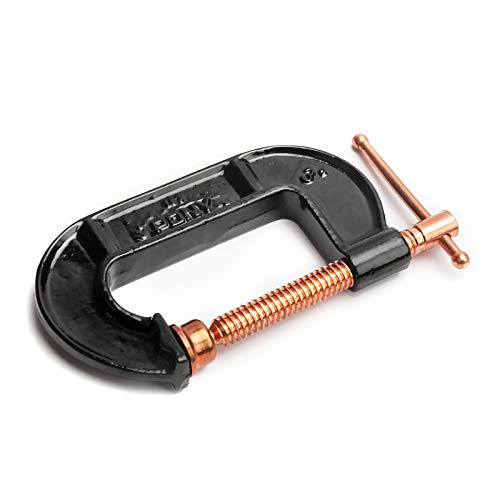
Jorgensen Classic 3-Inch C-Clamp
Edge-gluing and jig assembly suit this 3-inch clamp’s forged steel frame and swivel pad. Its shorter throat depth favors flat panel work over deep-reach tasks. A knurled handle grip makes repeated hand-tightening easier during glue-ups.
Pros
- Compact size fits tight glue-up spacing
- Swivel pad avoids marring wood surfaces
- Knurled grip reduces hand slip
Cons
- Limited reach on thick stock
- Smaller jaw opening than metalworking-focused clamps
TEKTON 6-Inch Drop-Forged C-Clamp
Thick assemblies need extra reach, which this 6-inch clamp provides through a wide jaw opening paired with a 3-1/4 inch throat depth. A black oxide finish on the drop-forged frame resists shop humidity and corrosion. Its sliding T-handle speeds up repositioning between clamping points.
Pros
- Extended throat depth reaches past edge-limited spots
- Black oxide finish resists shop humidity
- Sliding T-handle speeds repositioning
Cons
- Larger footprint than 3 or 4 inch clamps
- Heavier to carry in a tool bag

Yost Tools Heavy-Duty 4-Inch C-Clamp
One-hand tightening comes easier with this 4-inch clamp’s shorter handle arm compared to deep-throat designs. Forged steel and a swivel pad handle small assembly, jig setup, and repair tasks. Its compact profile slides into narrow tool drawers without trouble.
Pros
- Short handle arm suits one-hand tightening
- Compact size fits narrow storage
- Swivel pad protects workpiece surfaces
Cons
- Shorter throat depth limits reach on thick stock
- Not intended for heavy welding fixtures
How to pick the right one
What to Check Before Buying a C-Clamp Measure your thickest workpiece first, since jaw opening caps how wide the clamp can span. Throat depth decides how far the frame reaches in from an edge toward a panel’s center. Drop-forged and forged steel frames resist bending better than stamped steel under load. A swivel pad rounds out the picture, keeping pressure even on angled or uneven stock.
How Much Clamping Capacity Do You Actually Need Repairs and small assembly jobs rarely call for more than a 3 or 4 inch jaw opening. Cabinet work and panel glue-ups often need 4 to 6 inches to span wider boards. Welding fixtures and metal fabrication typically demand 6 inches or more, plus a deeper throat for plate stock. Owning one clamp per size range beats stacking several at the same capacity.
C-Clamps for Welding vs Woodworking A wide base and acme thread, like on the BESSEY GS Series, keep welding clamps from loosening near heat. Woodworking clamps such as the Jorgensen Classic 3-Inch lean on a swivel pad that won’t dent softer material during glue-ups. Metalworking shops also favor black oxide or heavier forged finishes that shrug off grime. Matching clamp to material cuts down on both marring and slippage.
When a Single Clamp Isn’t Enough Projects with mixed board thicknesses call for a multi-piece set, such as the WORKPRO 4-Piece C-Clamp Set. Angled or uneven workpieces do better under a self-adjusting swivel pad than a fixed jaw face. Assemblies deeper than a standard throat depth need a deep-reach model like the TEKTON 6-Inch. Narrow, tight spots favor a shorter handle arm that one hand can tighten without added leverage.
Compared at a glance
| # | Model | Jaw Opening | Best for | Score | Price |
|---|---|---|---|---|---|
| 1 | IRWIN 4-Inch Heavy-Duty C-Clamp | 4 inches | Best overall | 9.4 | Check price |
| 2 | WORKPRO 4-Piece C-Clamp Set | 1, 2, 3, 4 inches | Best value | 9.1 | Check price |
| 3 | Olympia Tools 4-Inch C-Clamp | 4 inches | Best budget | 8.8 | Check price |
| 4 | BESSEY GS Series Forged Steel C-Clamp 6-Inch | 6 inches | Best for heavy-duty welding | 8.5 | Check price |
| 5 | Jorgensen Classic 3-Inch C-Clamp | 3 inches | Best for woodworking | 8.3 | Check price |
| 6 | TEKTON 6-Inch Drop-Forged C-Clamp | 6 inches | Best for deep-throat reach | 8.1 | Check price |
| 7 | Yost Tools Heavy-Duty 4-Inch C-Clamp | 4 inches | Best for one-hand small projects | 8.0 | Check price |
Common questions
What size C-clamp do I need for woodworking?
Most cabinet and panel glue-ups work well with a 3 to 4 inch jaw opening, based on listed specifications from clamps like the Jorgensen Classic 3-Inch and IRWIN 4-Inch models.
How much weight can a C-clamp hold?
Holding capacity depends more on frame material and thread type than a single weight rating; forged steel frames with acme threads, like the BESSEY GS Series, generally hold tension better than stamped steel under repeated use.
Which C-clamp works best for welding projects?
The BESSEY GS Series Forged Steel C-Clamp suits welding and fabrication work, since its wide base and forged frame resist heat distortion better than lighter stamped clamps.
Can a C-clamp mark metal or wood surfaces?
Models with a swivel pad, such as the IRWIN 4-Inch or Yost Tools 4-Inch, spread pressure evenly and reduce marring on both metal and wood.
Is a C-clamp or bar clamp better for panel glue-ups?
C-clamps suit shorter panels and jig assembly, while bar clamps generally span wider gaps; a graduated set like the WORKPRO 4-Piece covers narrower glue-ups without adding a bar clamp.
What is the difference between a C-clamp and a G-clamp?
C-clamp and G-clamp name the same tool shape, based on the letter its frame resembles; both terms show up on Amazon listings for the same style of clamp.
How many C-clamps does a home workshop need?
A mixed set spanning 2, 3, and 4 inch jaw openings, such as the WORKPRO 4-Piece C-Clamp Set, handles most household repair and small woodworking tasks without buying single clamps repeatedly.
Are forged steel C-clamps better than cast iron for heavy use?
Forged and drop-forged steel clamps, like the TEKTON 6-Inch and BESSEY GS Series, tend to resist bending and impact damage better than cast iron frames found on some budget clamps.
What’s the best C-clamp for one-hand tightening in tight spaces?
The Yost Tools Heavy-Duty 4-Inch C-Clamp uses a shorter handle arm than deep-throat designs, making it easier to position and tighten with one hand in narrow spots.
Our pick
The IRWIN 4-Inch Heavy-Duty C-Clamp remains the strongest all-around choice, pairing a forged steel frame with a swivel pad and compact footprint for everyday shop use. Anyone doing regular welding or fabrication work should reach for the BESSEY GS Series Forged Steel C-Clamp instead, since its wider frame and acme thread hold up better against heat and vibration.
Jake Monroe
Jake worked as a residential contractor for over a decade before shifting to full-time writing. He evaluates power tools, hand tools and workshop gear through the lens of someone who has actually used them on job sites, not just read the box.