Is an Exercise Ball a Good Replacement for a Chair?
An exercise ball can offer short-term benefits like increased core engagement and more movement variety compared to sitting still in a regular chair, but research does not support it as a full-time chair replacement, since it lacks back support, encourages poor posture over long periods, and most people’s core engagement from sitting on one drops off quickly once it stops feeling novel.
What sitting on a ball actually requires
Balancing on an unstable surface forces small, continuous muscle adjustments throughout the core and legs to stay upright, which is a real muscular demand, especially in the first days or weeks of use, before the body adapts and those stabilizing muscles start working less consciously.
Why the core benefit tends to fade with familiarity
Studies measuring muscle activity while sitting on a ball over time generally find that the heightened core engagement seen initially diminishes significantly as a person’s body adapts to the balance challenge, meaning the long-term core benefit for someone using it as a daily desk chair is smaller than many people expect.
The posture problem over long sitting periods
A ball has no back support and no fixed, stable seat depth, which makes it easy to slump or lean into poor posture during long periods of focused work, and without the conscious effort of active sitting, many people’s posture actually degrades rather than improves over a full workday.
Why it is not ideal for full-time desk use
Beyond posture, a ball lacks armrests, height adjustment in most basic models, and any back support, all of which matter over an eight-hour workday, and the lack of stability can also be a genuine distraction or minor safety concern during focused work or video calls.
Where it genuinely works well instead
Short, intentional sessions, such as sitting on a ball for ten to twenty minutes during breaks, using it for mobility and light core exercises, or alternating it with a standard chair throughout the day, captures more of the benefit without the drawbacks of extended continuous use.
What the better alternative often looks like
Many ergonomics specialists recommend alternating between a proper ergonomic chair, a standing desk, and short ball sitting sessions rather than committing to any single seating option for an entire workday, since variety in posture and position matters more than any one seat type.
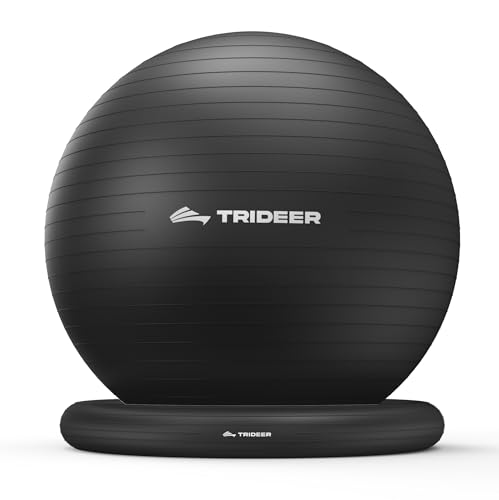
Trideer Exercise Ball with Stability Base
An anti-burst exercise ball sold with a stabilizing base ring, sometimes used for short desk sitting sessions alongside general exercise use.

Gaiam Balance Ball Chair
A ball integrated into a wheeled base with a backrest, designed specifically as a compromise between a standard chair and a plain exercise ball.
Common questions
How long can you safely sit on an exercise ball at a time?
Most ergonomics guidance suggests limiting continuous ball sitting to short stretches, often cited around twenty to thirty minutes at a time, rather than using it as an all-day continuous seat.
Does sitting on a ball help with lower back pain?
Results are mixed, some people with mild lower back discomfort report feeling better with the gentle movement a ball allows, while others with more specific back issues find the lack of support makes symptoms worse, so individual response varies considerably.
Is a balance ball chair better than a plain exercise ball for desk use?
For sustained desk use, yes, since the added backrest and stable base address the two biggest drawbacks of a plain ball, lack of back support and the tendency to roll, while still offering some of the core engagement.
Can sitting on a ball improve posture long term?
Long-term posture improvement is not well supported in research, since the initial core engagement benefit tends to fade with familiarity, and without back support many people’s posture actually worsens over long sitting periods rather than improving.
Is there an ideal ball size for sitting at a desk?
Yes, a ball that is too large or small for a person’s height changes hip and knee angle at a desk, and most sizing charts recommend a ball that keeps the hips level with or slightly above the knees when seated.
Does using a ball as a chair actually burn more calories?
The calorie difference compared to sitting in a regular chair is minimal, the main effect is increased muscle activation for balance rather than any meaningful increase in overall energy expenditure.
Can sitting on an exercise ball be bad for certain people?
Yes, people with certain back conditions, balance or vestibular issues, or those recovering from certain injuries should check with a doctor before using a ball as a regular seating option.
How often should someone alternate between a ball and a regular chair?
There is no single fixed ratio, but alternating every twenty to thirty minutes, or using the ball mainly during shorter work blocks and a standard chair the rest of the time, is a commonly suggested approach.
Does an anti-burst rating matter if using a ball as a chair?
Yes, an anti-burst rated ball is designed to deflate slowly rather than pop suddenly if punctured, which matters specifically for safety when using it as a seat rather than just for occasional floor exercises.
Can kids safely use an exercise ball instead of a chair at school or home?
It can work for short periods under supervision, but the same posture and balance concerns that apply to adults apply to children, and most schools and ergonomics guidance favor limited, supervised use rather than full-time replacement of a regular chair.
Is it normal to feel more tired using a ball instead of a regular chair?
Yes, especially initially, since the continuous small stabilizing effort required to balance can be genuinely more tiring than sitting in a fixed, supportive chair, though this effect lessens somewhat as the body adapts.
Does using a ball help with core strength the way regular exercise does?
Not to the same degree as dedicated core exercises, since passive sitting, even on an unstable surface, produces lower muscle activation than active, targeted exercises specifically designed to challenge the core.
Can you work at a standard desk height while sitting on a ball?
It depends on ball size relative to standard desk height, since a ball that puts the user too low or too high relative to a fixed desk can create awkward wrist, shoulder, or neck positioning over time.
Should pregnant women use an exercise ball as a chair?
Many pregnant women use exercise balls, often specifically for gentle movement and birthing preparation exercises, but using one as a primary desk chair should be discussed with a doctor given changing balance and center of gravity.
Is a wobble cushion a good alternative to a full exercise ball?
A wobble cushion offers a milder, more contained version of the same instability challenge and can be a reasonable lower-risk alternative for short periods at a regular chair, without the full balance demand of an actual ball.
Does flooring type affect how safe it is to sit on a ball?
Yes, a ball used on a slick or uneven floor is more prone to rolling or losing stability, while a non-slip mat or carpeted surface provides more secure footing for sitting safely.
Can sitting on a ball cause any new aches if done too much?
Yes, extended or improper use can sometimes lead to new discomfort in the hips, lower back, or pelvis, particularly if the ball size or desk setup does not fit the user properly.
Is there a noticeable difference between an exercise ball and a kneeling chair for desk use?
Yes, a kneeling chair maintains a more fixed, stable posture that encourages a forward pelvic tilt without the continuous balance demand of a ball, making it a different ergonomic tradeoff rather than a similar alternative.
The bottom line
An exercise ball is a useful occasional tool, not a genuine chair replacement, since the core benefit fades with familiarity and the lack of back support becomes a real downside over a full workday. Using it in short, deliberate stretches alongside a proper chair gets more of the upside without the posture trade-off that comes with sitting on one all day.
Derek Holt
Derek has a background coaching recreational and amateur athletes and has worked the sales floor at specialty fitness retailers. He focuses on equipment durability, ergonomics and realistic use cases rather than marketing claims.


