Is a Cordless Circular Saw Powerful Enough for Framing?
Yes, a modern high-voltage cordless circular saw, generally 18V or 20V with a brushless motor and at least a 6.0Ah battery, is genuinely powerful enough for most residential framing work including repeated cuts through dimensional lumber and engineered beams. Lower-voltage or older brushed cordless saws, by contrast, often struggle with sustained framing cuts and bog down on thicker material in a way corded saws rarely do.
What changed to make cordless saws framing-capable
Brushless motor technology and higher-capacity lithium batteries over the last several years closed most of the power gap that used to separate cordless saws from corded ones. A brushless 18V or 20V saw paired with a high-amp-hour battery now delivers torque and RPM comparable to a mid-range corded saw, which simply was not true a decade ago with older brushed cordless designs.
Why battery capacity matters as much as the saw itself
The same cordless saw performs very differently depending on which battery is attached. A 2.0Ah battery sags under sustained load and runs out of cuts quickly, while a 6.0Ah or larger battery sustains voltage better across a full day of framing cuts and simply lasts through more lumber before needing a swap.
Where cordless saws still fall short of corded performance
Very thick engineered lumber, extended ripping cuts, or back-to-back cutting with minimal breaks can still reveal a gap, since even a strong cordless saw’s battery eventually depletes mid-task in a way a corded saw plugged into a generator or outlet never does. Framing crews doing all-day production work often keep a corded saw as backup for this reason.
How blade choice affects whether a cordless saw feels powerful enough
A dull or poorly matched blade makes any saw, corded or cordless, struggle and bog down, and this effect is more pronounced on cordless saws since the battery has to work harder to push through resistance that a sharp blade would not create. A quality 24-tooth framing blade paired with a cordless saw outperforms a dull blade on even the strongest corded saw.
Does blade diameter matter for cordless framing saws?
Most framing-capable cordless saws use a 7-1/4 inch blade, which handles standard 2x lumber in a single pass at typical framing angles. Compact cordless saws with smaller blades, like 6-1/2 inch models, can struggle with full-depth bevel cuts on thicker material and are better suited to lighter trim or remodeling work.
What a realistic expectation looks like on a real job site
A quality brushless cordless saw with two charged high-capacity batteries can reasonably handle a full day of typical residential framing, including wall sections, headers, and blocking, as long as the operator swaps batteries during natural breaks rather than running one battery completely flat mid-cut.

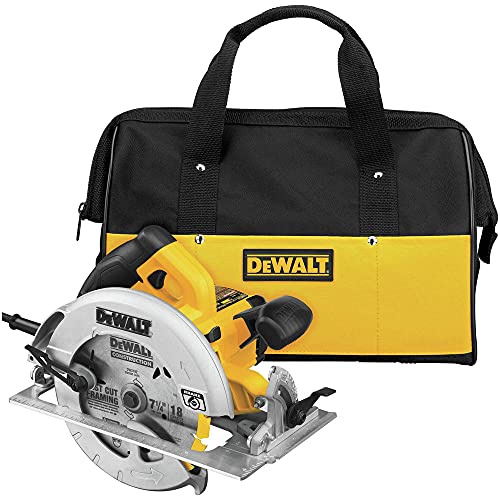
DeWalt DCS577 FlexVolt 7-1/4 inch Cordless Circular Saw
A 60V-class cordless framing saw commonly used on residential job sites, built specifically to match corded saw cutting speed through dimensional lumber.

Milwaukee M18 Fuel 7-1/4 inch Circular Saw
A widely used brushless 18V circular saw often paired with high-capacity batteries for sustained framing cuts throughout a work day.
Good to know
What voltage cordless circular saw is needed for framing?
18V or 20V brushless saws are generally the practical minimum for serious framing work, with 60V-class or dual-battery high-voltage models offering a further step up for heavy, sustained use.
Do brushless cordless saws really outperform brushed ones for framing?
Yes, brushless motors run more efficiently, generate less heat, and maintain torque better under load, which translates directly into fewer bogged-down cuts during repeated framing work.
How many batteries should a framer carry for a full day of cordless saw use?
At least two to three fully charged high-capacity batteries is a realistic minimum to avoid downtime, with a charger kept running on-site to keep spares ready.
Can a cordless circular saw cut through engineered lumber like LVL beams?
A strong brushless cordless saw can cut LVL and similar engineered lumber, though very thick sections may require a sharp blade and a bit more patience than standard dimensional lumber.
Is a corded circular saw still better for all-day framing production?
Corded saws have the advantage of never running out of power mid-task, which matters most on large, continuous production framing jobs, though many crews now rely on cordless as primary with corded as backup.
Does a 6-1/2 inch cordless saw work for framing, or only 7-1/4 inch?
A 7-1/4 inch blade is generally preferred for framing since it cuts full-depth bevels through standard 2x lumber in one pass, while 6-1/2 inch saws are better suited to lighter cutting tasks.
How long does a high-capacity battery last cutting 2×4 lumber?
A 6.0Ah or larger battery can typically make several hundred standard 2×4 crosscuts before needing a recharge, though actual numbers vary with blade sharpness and cut type.
Does cold weather affect cordless saw battery performance on a framing site?
Yes, lithium batteries lose some effective capacity and power output in cold temperatures, which can make a cordless saw feel noticeably weaker on winter job sites compared to summer conditions.
Is it worth buying a dual-battery cordless saw for framing instead of single-battery?
Dual-battery or high-voltage single-battery platforms offer more sustained power for heavy framing, making them worth the extra cost for anyone framing regularly rather than occasionally.
Can a cordless circular saw rip plywood sheathing as well as crosscut lumber?
Yes, with a sharp appropriate blade, cordless saws handle ripping plywood sheathing comparably to crosscutting dimensional lumber, though long rip cuts draw down battery charge faster than short crosscuts.
Do cheaper cordless circular saws struggle more with framing than premium ones?
Yes, budget cordless saws often use less efficient motors and lower-capacity included batteries, which shows up as more frequent bogging down and shorter run time per charge during demanding framing cuts.
Is bevel cutting capacity affected by using a cordless saw for framing?
Most 7-1/4 inch cordless framing saws maintain full bevel range comparable to corded models, so angled cuts for rafters and similar framing work are not meaningfully limited by going cordless.
How important is blade sharpness specifically for cordless saw framing performance?
Very important, since a dull blade forces the motor and battery to work harder for the same cut, draining the battery faster and increasing the chance of bogging down mid-cut.
Can a cordless circular saw overheat during heavy framing use?
Brushless motors run cooler than older brushed designs, but extended continuous cutting without breaks can still build up heat, so pacing the work slightly helps both the motor and battery longevity.
Is there a noticeable weight difference between cordless and corded framing saws?
Cordless saws with large batteries attached are often comparable in weight to corded saws once the battery pack is factored in, so the ergonomic difference is smaller than many expect.
Can mixing battery brands or voltages across a framing crew cause problems?
Yes, different brands and even different battery generations within the same brand are usually not interchangeable, so crews standardizing on one platform avoid the logistical headache of sorting incompatible batteries and chargers on a busy job site.
Does a cordless saw need a break-in period before it reaches full framing performance?
No, a cordless saw performs at its rated power from the first cut, though battery capacity can degrade slightly if a brand new pack is first fully drained and recharged a few times before heavy daily use.
Can a cordless circular saw keep up with a corded saw on a long day of repetitive cuts?
A strong brushless cordless saw with enough spare batteries on hand can match a corded saw’s daily output on most residential jobs, with the only real difference being the few seconds spent swapping a battery versus a corded saw that never needs that pause.
Final word
A current-generation brushless cordless saw with real battery capacity behind it is not a compromise for framing anymore, it is a legitimate primary tool on most residential sites. The honest caveat is that battery management, not raw cutting power, is what separates a smooth day from a frustrating one.
Jake Monroe
Jake worked as a residential contractor for over a decade before shifting to full-time writing. He evaluates power tools, hand tools and workshop gear through the lens of someone who has actually used them on job sites, not just read the box.