Is a Benchtop Drill Press Worth It Over a Handheld Drill for Precision Work?
For work that genuinely needs a consistent, perfectly vertical hole with repeatable depth, like drilling dowel holes, metal that needs exact perpendicular holes, or repeated identical holes across multiple pieces, a benchtop drill press is worth it, since no amount of skill with a handheld drill matches a fixed column and table for that kind of repeatability. For occasional general drilling where a slightly off-angle hole does not matter, a handheld drill remains more practical simply because it is portable and does not need a dedicated bench spot. For anyone weighing the purchase, it often helps to count how many past projects actually needed that level of precision, rather than estimating from memory alone.
What a drill press actually controls that a handheld drill cannot
A drill press locks the bit’s travel to a single vertical axis fixed relative to the table, so the bit cannot wander off angle the way a handheld drill can from hand movement or body position. It also lets you set a hard depth stop, guaranteeing every hole in a batch stops at exactly the same depth without eyeballing it. This same fixed geometry is also why a drill press is the standard tool for operations like counterboring or spot facing, where a handheld drill’s inherent play would make consistent results nearly impossible.
Where this precision genuinely matters
Dowel joinery, shelf pin holes that need to line up across multiple panels, metal fabrication that requires a hole perfectly perpendicular to the material’s face, and repeated production-style drilling where even a one or two degree variance would be visible or structurally weak, are all tasks where a handheld drill’s inherent wobble becomes a real problem. Woodworkers building face-frame cabinets or furniture with exposed joinery in particular rely on this repeatability, since even a small visible misalignment between dowel holes stands out clearly on a finished piece.
Where a handheld drill is still the better practical choice
Drilling into an already-installed wall stud, working on a large piece of furniture or material too big to fit on a drill press table, or a quick one-off hole where exact angle and depth do not matter, are all situations where a handheld drill’s portability outweighs any precision benefit a drill press offers. A handheld drill also allows working at odd angles or in awkward positions that a stationary drill press table simply cannot accommodate, which matters for anything from automotive repair to on-site construction work.
What a benchtop model trades away compared to a floor-standing drill press
A benchtop drill press is smaller and lighter, which limits the maximum workpiece size and spindle travel compared to a larger floor-standing model, but it is considerably more affordable and takes up far less shop space, which is why it remains the common choice for home workshops rather than a compromise people regret. Many home workshops end up with a benchtop model specifically because it can be moved, stored, or relocated far more easily than a floor-standing press, which matters in a shared or multi-use garage space.
Why speed control adds to the precision argument
Most drill presses let you change spindle speed through a belt or pulley system, which matters because drilling metal, hardwood, and softwood each perform better at different speeds. A handheld drill’s variable speed trigger is a rough approximation of this, while a drill press’s fixed speed settings are far more consistent and repeatable for a given material and bit size. Some benchtop models also include a digital readout for spindle speed, which removes the guesswork that comes with reading a belt-and-pulley chart taped inside an older machine’s cover.
When the cost and bench space are genuinely not worth it
If precision drilling is a rare, occasional need rather than a regular part of your projects, a drill guide attachment for a handheld drill can approximate some of the benefit at a fraction of the cost and space commitment, even though it will not match a true drill press’s rigidity and repeatability. A drill guide also helps compensate for a handheld drill’s lack of a depth stop, though it still depends on steady hand pressure in a way a drill press table never does.
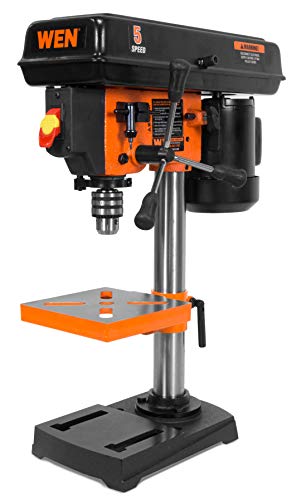
WEN 4208 Benchtop Drill Press
A compact, affordably priced benchtop drill press commonly used in home workshops for repeatable, perpendicular holes in wood and light metal.

SKIL 3320-02 Drill Press
A benchtop drill press with a laser-guided alignment feature aimed at hobbyist and light fabrication use.
Frequently asked questions
Can a handheld drill ever be as accurate as a drill press?
With a dedicated drill guide attachment, it can get closer, but it still will not match a drill press’s fixed, rigid column for repeated consistency.
Is a benchtop drill press good enough for drilling metal?
Yes, for light to moderate metal drilling a benchtop model works well, though heavier industrial metal fabrication typically calls for a larger floor-standing press.
Does a drill press need to be bolted down to the bench?
It is strongly recommended, since an unsecured drill press can tip or shift under lateral force, especially when drilling harder materials.
Can a benchtop drill press handle large workpieces?
Its table size and spindle travel limit how large a piece it can comfortably handle, so very large panels or lumber are often better suited to a floor-standing press or a handheld drill with a guide.
Is speed control on a drill press really necessary?
Yes, different materials and bit sizes perform noticeably better at different spindle speeds, and a drill press makes that adjustment far more precise than a handheld drill’s trigger.
How much more accurate is a drill press than a handheld drill in practice?
A drill press essentially eliminates angle drift entirely, while even a careful handheld drill user typically has some small, inconsistent deviation from true vertical.
Is a drill press overkill for simple home repairs?
For occasional simple repairs, yes, a handheld drill is usually more practical since it does not require bringing the material to a fixed bench location.
Can a drill press drill at an angle, not just straight down?
Many models allow the table or head to tilt for angled drilling, though this varies by model and is less common on entry-level benchtop presses.
Does a drill press reduce bit breakage?
It can, since the fixed, rigid alignment reduces the side loading and wobble that causes bits to snap, especially with smaller diameter bits.
Is it worth buying a drill press just for woodworking dowel joints?
If dowel or shelf-pin alignment across multiple pieces is a regular part of your projects, yes, since consistent depth and angle are exactly what a drill press is built for.
How much space does a benchtop drill press actually need?
It needs a stable bench or stand with enough headroom above for the full travel of the chuck and handle, typically a few feet of clearance depending on the model.
Can a drill press replace a mortising machine?
With a dedicated mortising attachment, a drill press can approximate some mortising work, though a true mortiser is built specifically for that repeated, precise task.
Does a cheaper benchtop drill press sacrifice much precision?
Lower-cost models can have more play in the chuck or column than premium models, which slightly reduces precision, though most still outperform a handheld drill for repeatable work.
Is a laser guide on a drill press actually useful?
It helps with initial bit placement over a marked hole location, though it does not replace the fundamental vertical alignment the column itself provides.
Does a drill press need regular maintenance beyond basic lubrication?
Periodically checking belt tension, column alignment, and chuck runout keeps a drill press performing at its intended precision, since even a stationary tool can drift out of alignment with heavy use over time.
Our take
The honest answer depends on how often repeatable, perfectly vertical holes actually matter in your projects. For anyone doing that kind of work even occasionally, a benchtop drill press earns its bench space quickly, while for general household drilling it is a nice-to-have rather than a necessity. A drill press is ultimately a tool that pays for itself in consistency rather than in any single dramatic task, which is exactly the kind of value that is easy to underestimate until you have used one for a while.
Jake Monroe
Jake worked as a residential contractor for over a decade before shifting to full-time writing. He evaluates power tools, hand tools and workshop gear through the lens of someone who has actually used them on job sites, not just read the box.