Benchtop Drill Presses for Precise, Repeatable Holes
WEN 4214T leads for knob controlled variable speed and a digital readout, which suit a bench that sees both wood and steel. JET JWDP-12 buys tighter machining and better repeatability. Shop Fox W1668 adds oscillating spindle sanding plus the mass to steady deep cuts in hardwood.
WEN 4214T covers the widest range of home shop jobs, since its speed changes with a knob and shows on a digital display. Precision work belongs on the JET JWDP-12. Metal and hardwood favour the heavier Shop Fox W1668, which doubles as an oscillating spindle sander.
Drill press listings hide the parts that matter, because a low price often means a table that flexes, a quill that wanders or belt covers that fight you at every speed change. We compared published swing, motor, travel and speed figures across all seven. Owner reports on runout, table squareness and long term accuracy filled the gaps that specifications leave open.
How to pick the right one
What swing and motor power do you need? Swing measures the full distance across, so a 10 inch press centres a hole 5 inches from an edge. That covers shelving, chair parts and most cabinet work. Panels and wide stock need 12 or 13 inch class machines. Motor rating matters more for metal than wood, since steel demands slow speeds under steady pressure and a weak motor stalls rather than cuts.
Variable speed or belt changes: which is better? Belt driven presses are cheaper to build and completely reliable, but every speed change means opening a cover and moving a belt across pulleys. Variable speed models turn that into a knob, which matters if you swap between a 3 inch hole saw and a 1/8 inch bit in the same session. Anyone drilling one material repeatedly will not miss the feature.
How to judge table, quill travel and accuracy Cast iron tables resist flex where stamped steel gives under a clamp. Check that the table tilts, locks square and returns to 90 degrees without a fight. Quill travel sets how deep a single plunge goes: 2 inches suits sheet goods and shelving, while 3 inches or more handles thick timber and deep mortises. A depth stop that repeats reliably is what makes batch drilling possible.
Which extras are actually worth having? Laser crosshairs shorten setup but drift out of calibration and need checking against a test hole. Work lights help most in a garage where the head casts a shadow over the bit. Digital readouts remove guesswork about RPM, which is useful when a chart calls for 500 RPM in steel. Spindle sanding, as on the Shop Fox W1668, saves a whole second machine if bench space is short.
The shortlist, ranked
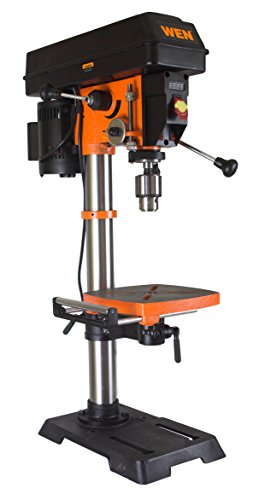
WEN 4214T
Speed changes with a knob across roughly 530 to 3,100 RPM, so a large Forstner bit and a small twist bit both get the right rate without opening the cover. A digital display shows the selected speed, and the depth stop repeats holes across a batch of parts. Its 12 inch swing centres a hole 6 inches in from any edge.
Pros
- Knob speed control with no belt swapping
- Digital speed display and repeatable depth stop
- Large cast iron table tilts for angled holes
Cons
- Heavier than the small belt driven models
- Takes a wide footprint on the bench

JET JWDP-12
Machining quality is where this one separates from the pack, with a ground table and a quill that returns to the same spot pass after pass. Variable speed runs from about 500 to 3,000 RPM and reads out digitally. Serious hobbyists and small shops doing jig work will notice the difference, while occasional drilling will not.
Pros
- Smooth variable speed with digital display
- Ground table stays flat and square
- Low runout suits jig and joinery work
Cons
- More machine than light drilling needs
- Larger footprint than the 10 inch models

Shop Fox W1668
Extra mass keeps the quill steady when a bit bites into steel or dense hardwood, which is where lighter presses chatter. The same machine accepts sanding drums and oscillates them, saving a separate tool and a chunk of bench space. Speed changes still mean moving a belt between pulleys.
Pros
- Oscillating spindle sander built into the same base
- Heavy build resists chatter in steel
- Long quill stroke reaches through thick stock
Cons
- Needs the most bench space of any model here
- Belt changes to alter speed

SKIL 3320-01
Two laser lines cross directly over the mark, which cuts the fiddling that usually precedes a hole. Five belt speeds spanning roughly 570 to 3,050 RPM handle pine, plywood and thin aluminium. A cast iron table that tilts and locks keeps the workpiece steady at angles.
Pros
- Crossing laser lines speed up alignment
- Cast iron table tilts and locks firmly
- Covers most hobby drilling without extras
Cons
- Belt changes needed to switch speed
- Laser drifts and needs occasional recalibration
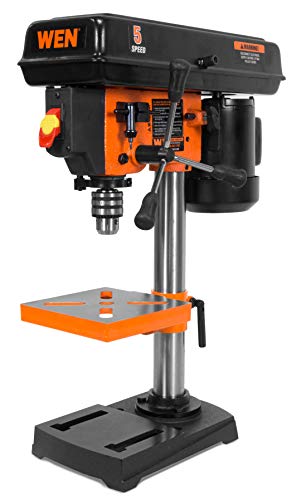
WEN 4208T
An 8 inch swing and 2 inch quill travel mark the limits, but those numbers still beat any handheld drill for square holes. Five belt speeds run from about 740 to 3,140 RPM, enough for pine, plywood and plastic. Weekend shelving, small repairs and hobby parts are its territory.
Pros
- Smallest footprint of the seven
- Assembles and squares up in under an hour
- Light enough to lift onto a shelf between jobs
Cons
- 2.3 amp motor struggles in thick steel
- Small table and 2 inch travel limit stock size

CRAFTSMAN CMEW320
Five belt speeds, a laser guide and a 10 inch swing cover the drilling a weekend woodworker actually does. Setup is straightforward and replacement parts stay easy to source through a familiar brand. Table adjustments feel plain next to the JET, though they hold position once locked.
Pros
- Laser guide shortens hole alignment
- Parts and support easy to find
- Size fits a standard garage bench
Cons
- Belt swaps to change speed
- Table adjustment hardware feels basic
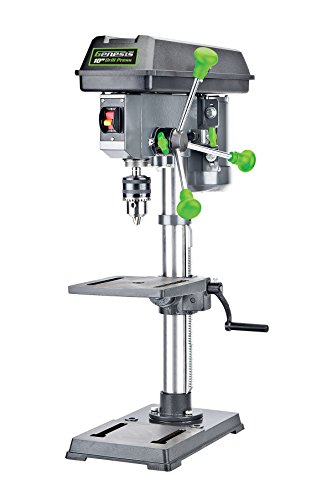
Genesis GDP1005A
Cramped garages and apartment workspaces are the case for this one, since it delivers a real quill and column in a small chassis. A built in work light removes the shadow that a benchtop lamp usually casts over the bit. Five belt speeds and a 4.1 amp motor keep it in wood, plastic and thin metal.
Pros
- Small chassis fits a crowded bench
- Work light aimed at the bit
- Reasonable power for its footprint
Cons
- Table is small for wide workpieces
- Fit and finish is basic throughout
Side by side
| # | Model | Swing | Best for | Score | Price |
|---|---|---|---|---|---|
| 1 | WEN 4214T | 12 inch | Best overall | 9.4 | Check price |
| 2 | JET JWDP-12 | 12 inch | Best premium | 9.2 | Check price |
| 3 | Shop Fox W1668 | 13 inch class | Best for metalwork | 9.0 | Check price |
| 4 | SKIL 3320-01 | 10 inch | Best value | 8.7 | Check price |
| 5 | WEN 4208T | 8 inch | Best budget | 8.5 | Check price |
| 6 | CRAFTSMAN CMEW320 | 10 inch | Best for home shops | 8.2 | Check price |
| 7 | Genesis GDP1005A | 10 inch | Best compact | 8.0 | Check price |
Good to know
What size benchtop drill press do you need?
A 10 inch swing covers the majority of home projects and fits a standard bench. Move to 12 or 13 inch class if you drill wide panels or need holes far from an edge. Buying larger than your work requires mostly costs bench space.
Is a variable speed drill press worth it?
Yes if you switch materials often, since dialling in RPM takes seconds instead of a belt swap. Correct speed also prevents burnt wood and blued bits. For someone drilling pine all day, a belt driven press does the same job for less.
Can a benchtop drill press drill through metal?
Within limits. Steel and aluminium are fine at low speed with a sharp bit and cutting fluid. Heavy or continuous metal drilling wants a machine with more mass, which is why the Shop Fox W1668 sits at the top of that category here.
How important is spindle travel on a drill press?
Travel sets how deep you can plunge before repositioning the workpiece. Around 2 inches handles sheet goods and shelving. Anything past 3 inches lets you drill through thick timber or a stack of parts in one pass.
Do you need a laser guide on a drill press?
Not really. A laser speeds up rough alignment, but it needs recalibration to stay honest. Spotting the mark with the bit tip is still the accurate method, so treat lasers as convenience rather than a deciding feature.
How do you keep drilled holes straight and accurate?
Start with a flat table locked square to the quill, then clamp the workpiece so it cannot spin. Centre punch the mark, set the depth stop, and let the bit cut at its own rate. Steady technique beats any single feature on the spec sheet.
Should you bolt a drill press to the bench?
Bolting the base down removes vibration and stops the machine walking under load, which matters most with large bits. Use a mobile base or a dedicated stand if the press has to move. Either way, clamp or bolt it before drilling.
Benchtop or floor standing drill press: which should you choose?
Benchtop models save floor space and suit hobby shops with moderate work. Floor standing machines offer more headroom under the quill for tall workpieces and usually more power. Space and the height of your typical work decide it more than anything else.
What speed should you drill wood and metal at?
Large diameter bits and hard materials want low RPM, small bits in softwood want high. As a rough guide, run steel near the bottom of the range and small twist bits in pine near the top. Burnt edges or a squealing bit mean the speed is wrong.
Our pick
WEN 4214T is the benchtop drill press most home shops should buy, because knob controlled speed and a digital readout make it as easy to drill steel as pine. Choose the JET JWDP-12 if repeatable precision on jigs and joinery is the point, or the Shop Fox W1668 for metal work and built in spindle sanding. Light hobby drilling on a crowded bench is still well served by the WEN 4208T or the laser equipped SKIL 3320-01.
Jake Monroe
Jake worked as a residential contractor for over a decade before shifting to full-time writing. He evaluates power tools, hand tools and workshop gear through the lens of someone who has actually used them on job sites, not just read the box.