Is a Battery Powered Lawn Mower Actually Strong Enough for a Full Yard?
For most yards under roughly half an acre of average grass, a quality battery mower now cuts just as well as a comparable gas mower in a single charge. The real limits show up on larger properties, thick or overgrown grass, and steep terrain, where either a second battery or a higher voltage model becomes necessary to finish without stopping mid-mow.
What actually limits a battery mower, voltage or runtime
Voltage mostly determines how much torque the motor has for pushing through thick or tall grass, while amp-hours on the battery determine how long that power lasts. A higher voltage platform with a smaller battery can bog down less in tough grass but still run out of charge sooner than a lower voltage mower with a larger pack, so the two specs answer different questions.
How yard size translates to runtime needs
A typical battery mower in the 40 to 80 volt range covers somewhere between a quarter acre and half an acre on one charge under normal conditions, though thick grass, tall grass, or wet conditions can cut that range noticeably. Yards larger than that usually need a spare battery swapped in partway through, not necessarily a different mower.
Why thick or overgrown grass is the real stress test
A battery mower struggles more with dense, overgrown grass than a gas mower does, because the motor has to work harder against the same resistance while draining a fixed energy reserve instead of pulling from a gas tank. Regular mowing on a normal schedule keeps grass within a range battery mowers handle comfortably; letting it go several weeks between cuts is where battery mowers show their limits most.
Does hilly or uneven terrain change the picture
Pushing or self-propelling uphill draws noticeably more power than flat ground, which shortens effective runtime on sloped yards compared to the same mower’s rated range on flat test conditions. A self-propelled battery mower generally handles moderate slopes fine, but very steep or extensive hilly terrain will drain a battery faster than its flat-ground rating suggests.
When a second battery actually makes sense versus upgrading the mower
If a single charge gets through most but not quite all of the yard, a second battery pack is usually the cheaper and simpler fix, letting you swap packs mid-mow rather than buying a new machine. If the mower is also struggling with cutting power in thick grass, that points more toward needing a higher voltage platform rather than just more capacity.
How battery mowers compare to gas on raw cutting power today
The gap has narrowed considerably over the past several years as brushless motors and higher voltage platforms have matured, and on most residential grass types a good battery mower does not feel underpowered compared to a similarly priced gas mower. The remaining gap shows up mainly at the extremes: very large properties and consistently thick, overgrown grass.

EGO Power+ 56V Self-Propelled Mower
A higher voltage battery platform commonly recommended for yards that previously needed a gas mower, with a swappable battery design for extending a single mowing session.
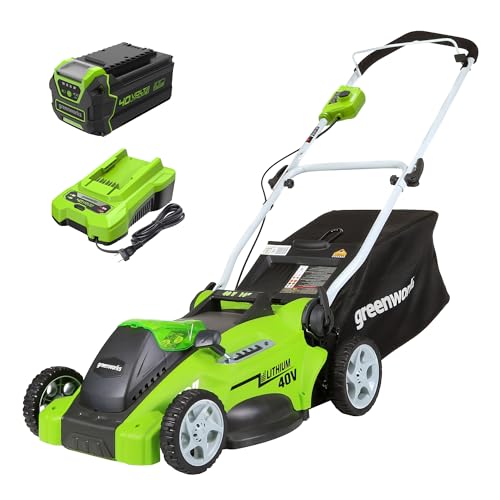
Ryobi 40V Brushless Lawn Mower
A widely available mid-range battery mower that fits typical quarter to half acre yards on a single charge under normal grass conditions.
Common questions
How many square feet can a battery mower cut on one charge?
It varies by voltage and battery size, but a common range for mid-size battery mowers is somewhere around a quarter to half an acre under normal grass conditions on a single charge.
Does cold weather reduce battery mower runtime?
Yes, lithium batteries generally deliver somewhat less usable capacity in cold temperatures, so early spring or late fall mowing sessions may run shorter than the same battery delivers in warm weather.
Can I buy a spare battery for a battery mower I already own?
Most major battery mower brands sell additional batteries compatible with their existing mower platforms, which is usually the simplest way to extend total mowing time without replacing the mower itself.
Is a battery mower powerful enough for wet grass?
Wet grass adds extra resistance and can clump under the deck, which taxes both gas and battery mowers, though battery mowers may notice the added draw on runtime more directly since there is a fixed energy reserve.
Do battery mowers lose power as the charge gets low, or cut the same until they die?
Many battery mowers do show a gradual drop in cutting power as the charge depletes, particularly in thicker grass, rather than cutting at full strength right up until shutoff.
How long does a battery mower take to recharge fully?
Charge times vary widely by battery size and charger type, ranging from under an hour with a fast charger on a smaller pack to several hours for a larger high-capacity battery on a standard charger.
Will a battery mower struggle on a half acre yard with hills?
Hills add real power demand, so a half acre yard with significant slopes may push a battery mower closer to its runtime limit than the same half acre on flat ground, making a spare battery more useful in that situation.
Are battery mowers heavier or lighter than gas mowers?
Battery mowers are often lighter overall since they skip the gas engine, though the battery pack itself adds some weight, and the net difference varies by specific model and voltage class.
Do battery mowers require more maintenance than gas mowers over time?
Generally less, since there is no oil to change, no spark plug, and no carburetor to clean, though the blade still needs regular sharpening and the battery has its own long-term care needs like avoiding full drain storage.
Can a battery mower handle a full acre yard with two batteries?
Often yes, swapping in a second fully charged battery partway through typically gets a battery mower through a full acre of average grass, assuming the mower’s cutting power was already adequate for the grass type.
Does mowing height setting affect how long a battery lasts per charge?
Yes, cutting at a lower height removes more material per pass and generally draws more power than a higher cutting height on the same grass, which can meaningfully shorten runtime.
Is self-propelled drive a bigger drain on battery life than the cutting motor?
The cutting motor is usually the larger power draw overall, but self-propel drive does add additional consumption, particularly on hills or thick grass where the drive motor works harder to maintain speed.
How do I know if my yard needs a higher voltage mower instead of just a spare battery?
If the mower already struggles to cut cleanly through your grass type at full charge, a higher voltage platform addresses that cutting power issue, whereas a spare battery only helps if the mower cuts fine but simply runs out of charge before finishing.
Do battery mowers cut as evenly as gas mowers on uneven terrain?
Cutting evenness depends more on deck design and wheel height adjustment than power source, so a well-designed battery mower cuts just as evenly as a comparable gas model, though both struggle similarly on very bumpy or root-covered ground.
Does mowing in a single direction every time affect battery runtime?
Mowing the same pattern repeatedly does not meaningfully change battery runtime, though alternating direction between mows is generally recommended for lawn health reasons rather than anything related to the mower’s power draw.
Can I run a battery mower on a long extension-style charging setup while mowing to avoid running out of power?
No, battery mowers are cordless by design and are not built to run while plugged in, so the only practical way to extend a session mid-mow is swapping in a second charged battery rather than attempting to charge while cutting.
Is it normal for a battery mower to feel less powerful on the first few uses before settling in?
Some battery packs and motors perform slightly below their full rated output during an initial break-in period, though most buyers do not notice a meaningful difference, and any real power shortfall after several uses usually points to grass conditions rather than the mower needing to break in further.
The bottom line
A battery mower is genuinely strong enough for the large majority of residential yards today, and the honest caveat is really about edge cases: very large lots, consistently overgrown grass, or steep terrain, where a spare battery or a step up in voltage closes the remaining gap.
Sierra Daniels
Sierra's background is in landscape design and nursery retail. She focuses on lawn and garden equipment, outdoor furniture and gear durability, weighing published specs against how materials actually hold up outside.