How Does a Torque Wrench Know When to Stop Tightening?
A standard click-type torque wrench doesn’t sense torque electronically at all, it uses a calibrated spring mechanism inside the handle set to a specific resistance by the torque scale you dial in. Once the force you apply matches that preset spring tension, an internal lever snaps over, producing the click you feel and hear, which is simply a mechanical signal that the target has been reached, not something that physically stops the wrench from being turned further.
The click-type mechanism explained
Inside a micrometer-style click wrench, twisting the handle compresses or releases a calibrated spring connected to an internal lever. When the torque applied through the handle reaches the force that spring is currently set to resist, the lever pivots over abruptly, which produces the audible click and a brief, slight give you feel through the handle. That mechanical snap is the entire signaling system, there’s no sensor or electronics involved in a purely mechanical click wrench.
Beam-type wrenches work on a completely different principle
A beam-type torque wrench is mechanically simpler still, using a flexible metal beam with a pointer and printed scale. As you apply force, the beam itself bends proportionally to the torque being applied, and you read the current torque value directly off the scale in real time rather than waiting for any click, which makes it less prone to the calibration drift click-type wrenches can develop but also more dependent on the user reading the scale accurately mid-pull.
Digital and electronic torque wrenches add a sensor layer
Electronic torque wrenches use a strain gauge built into the wrench head that measures how much the metal flexes under load, converting that into a real-time digital torque reading on a screen, often paired with a beep or vibration once the preset target is reached. This design tends to be more precise and repeatable over time than a mechanical click wrench, since there’s no internal spring that can gradually lose calibration.
Why calibration drift is a real issue with click wrenches
Storing a click-type wrench at a non-zero torque setting keeps its internal spring under tension continuously, which can gradually wear the spring and shift its calibration point away from true over time. Dropping the wrench or using it outside its rated torque range accelerates this drift, which is why manufacturers typically recommend returning the setting to the lowest value after each use and having the wrench periodically checked against a calibration standard.
What actually happens if you keep tightening past the click
A basic click wrench has no mechanical stop that prevents further tightening once it clicks, the click is purely a signal, not a limiter, so continuing to apply force past that point will keep tightening the fastener beyond the intended torque value. This is a genuine user-error risk on click wrenches, which is part of why torque-limiting or breakaway wrenches exist for production and assembly settings where hands-off compliance with a torque spec matters more than relying on an operator noticing a click.
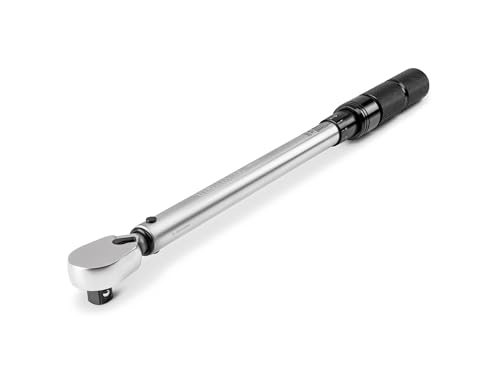
TEKTON 24335 1/2-Inch Drive Click Torque Wrench
A widely used mechanical click-type torque wrench with a dial-adjustable scale, representative of the spring-and-lever mechanism common in home garage torque wrenches.

ACDelco ARM601-4 Digital Torque Wrench
An electronic torque wrench using a strain gauge sensor to display real-time torque readings and alert the user audibly once the target value is reached.
Good to know
Why doesn’t the wrench physically stop turning when it clicks?
A click-type wrench’s spring mechanism only produces a signal that the preset torque has been reached, it has no physical stop built in, so continued force past the click will keep tightening the fastener further.
How often should a click-type torque wrench be calibrated?
Many manufacturers recommend checking calibration roughly once a year for regular use, or any time the wrench is dropped or used near the top of its rated range frequently, since the internal spring can drift gradually even with careful use.
Is a digital torque wrench more accurate than a click-type one?
Generally yes, since a strain gauge sensor doesn’t rely on a spring that can mechanically wear or drift the way a click wrench’s internal mechanism does, making digital models more consistently accurate over the long term.
Why should I set a click wrench back to its lowest setting after use?
Leaving the internal spring under tension at a higher setting between uses can accelerate wear and calibration drift over time, so returning it to the lowest setting is a simple habit that helps the wrench hold its accuracy longer.
Can a beam-type torque wrench go out of calibration like a click-type one can?
It’s less prone to drift since there’s no spring mechanism involved, just a beam that flexes proportionally to force, though a bent or damaged beam from misuse can still throw off its readings.
What happens if I use a torque wrench outside its rated range?
Using a wrench below its minimum rated torque gives unreliable readings since the mechanism isn’t designed for accurate feedback that low, and using one above its maximum rating risks damaging the internal mechanism or the wrench itself.
Do I need different torque wrenches for small and large fasteners?
Often yes, since a single wrench’s accurate range is limited, and using a wrench rated for high torque on a small fastener requiring low torque tends to give much less precise results than a wrench specifically suited to that smaller range.
Can a torque wrench be used to loosen bolts as well as tighten them?
Most click-type torque wrenches are designed and calibrated specifically for tightening, and using them to break loose a tight or seized bolt can damage the internal mechanism, so a separate breaker bar is generally the better tool for loosening stuck fasteners.
Why did my torque wrench click but the bolt still feels loose?
This can happen if the wrench’s calibration has drifted low, if the fastener’s threads are damaged or stripped, or if there’s debris or old thread locker preventing proper seating, any of which can make a bolt feel underdone despite an accurate click.
How do I know if my torque wrench has drifted out of calibration?
The most reliable way is checking it against a calibrated reference, such as a torque tester or a known calibration service, since there’s no way to visually tell a drifted click wrench from an accurate one just by using it.
Is it safe to use a torque wrench with an extension or adapter?
Using an extension changes the effective lever arm length, which can throw off the actual torque delivered to the fastener unless you recalculate for the extension’s length, so many manufacturers advise against extensions unless the math is adjusted for.
Do click-type torque wrenches work the same in both tightening directions?
Most are designed and calibrated specifically for one direction of use as labeled on the wrench, since the internal mechanism’s geometry is often optimized for that direction, so checking the manual before using one in reverse is worthwhile.
Why do mechanics sometimes use a torque wrench and then a breakaway wrench for the same job?
A standard click wrench depends on the user noticing and stopping at the click, while a breakaway or torque-limiting wrench mechanically disengages at the set torque, giving more reliable hands-off compliance in settings where consistent torque across many fasteners matters more than relying on operator attention.
Does temperature affect how accurately a torque wrench performs?
Extreme cold can slightly stiffen the internal spring mechanism in a click-type wrench, which can shift its effective calibration marginally, so using a torque wrench in more moderate temperatures when precision matters most is generally preferable.
The bottom line
The click isn’t a stop, it’s a signal, and understanding that difference is the whole key to using a torque wrench correctly. Whether the feedback comes from a flexing spring, a bending beam, or a digital strain gauge, every design is really just answering the same question, how much force is currently being applied, and leaving the decision to stop entirely up to whoever’s holding the handle.
Tony Russo
Tony trained as an automotive technician and spent years in service and parts retail before moving into writing. He focuses on garage tools, car care products and accessories from a hands-on maintenance perspective.


