How Does a Paper Shredder’s Cut Type Affect Document Security?
A shredder’s cut type directly determines how hard a discarded document is to reconstruct after it leaves the machine. Strip-cut leaves long, readable strips that can realistically be taped back together with patience, cross-cut chops paper into small confetti-like pieces that are far harder to reassemble into anything readable, and micro-cut reduces it further into particles small enough to meet the higher security levels required for financial records, tax documents and anything carrying a Social Security number.
Strip-cut and why it’s the weakest option
Strip-cut shredders slice paper into long, narrow vertical ribbons, and the text often stays largely intact and perfectly readable on each individual strip once it comes out the other end. With enough patience, someone could realistically lay those strips back out in their original order and tape them together into a legible page, which is why strip-cut is generally not recommended for anything sensitive beyond basic junk mail or non-identifying paperwork.
Cross-cut and the jump in security it provides
Cross-cut shredders cut both vertically and horizontally at the same time, producing small rectangular or diamond-shaped confetti pieces instead of long continuous strips. This represents a meaningful security jump since reconstructing a full document from hundreds of small, similarly shaped pieces is far more time-consuming and genuinely impractical than lining up a handful of strips, and most cross-cut machines sold today land in the P-4 security range under current international standards.
Micro-cut and why it goes further still
Micro-cut shredders reduce paper into particles roughly a third the size of standard cross-cut confetti, typically landing in the P-5 or even P-6 security range depending on the specific model’s blade design. That significantly smaller particle size is exactly why banks, accountants and anyone regularly handling identity documents are usually advised to use micro-cut rather than settling for standard cross-cut shredding on routine paperwork.
What the DIN 66399 security level actually measures
The DIN 66399 standard rates shredders from P-1 all the way up to P-7 based specifically on maximum particle size and total surface area per piece, not just the general cut shape alone. Higher-sensitivity documents like financial records or classified material are defined explicitly by the standard as needing a higher P-level, which in practical terms simply means a finer, smaller particle size than casual document shredding typically requires.
The real tradeoffs of going finer
Finer cuts mean more individual cutting edges doing more mechanical work on the exact same sheet of paper passing through, which generally translates into noticeably slower feed speed, more heat buildup during long continuous shredding sessions, and a real price premium over a basic strip-cut or standard cross-cut machine offering a similar rated sheet capacity.
What actually matters for home use versus business compliance
For everyday junk mail and old receipts, cross-cut is generally more than enough to deter any casual snooping around the recycling bin. For tax returns, medical records, or anything carrying account or identification numbers, stepping up to micro-cut closes a real gap that cross-cut genuinely leaves open, and some regulated industries require a specific documented P-level by internal policy regardless of personal preference on the matter.

Fellowes Powershred 99Ci 18-Sheet Cross-Cut Shredder
A high-capacity cross-cut shredder built for sustained home office use, landing at the P-4 security level that covers most everyday sensitive mail and documents.
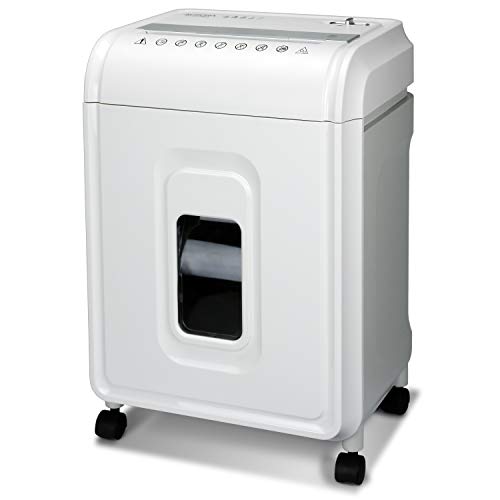
Aurora AS1016XA Micro-Cut Paper Shredder
A micro-cut model built specifically for the higher security particle size recommended for tax documents, bank statements and anything carrying a Social Security number.
Good to know
Is strip-cut ever good enough for home use?
For plain junk mail with no account numbers or personal details printed on it, strip-cut is generally fine, but it’s genuinely not recommended for anything carrying financial information or identifying details someone could plausibly reassemble with patience.
What does a P-4 security rating actually mean?
It’s a DIN 66399 classification tied directly to maximum particle size, and P-4 corresponds to standard cross-cut shredding, which is widely considered adequate protection for general sensitive business and everyday personal documents alike.
Can cross-cut shredded documents really be reconstructed?
In theory with enough time, patience and specialized reassembly techniques, yes, but in practice it’s dramatically harder than reconstructing strip-cut output and not a realistic risk for casual, everyday household document disposal.
Does cut type affect how many sheets a shredder can handle at once?
Finer cuts generally reduce the per-pass sheet capacity compared to strip-cut machines, since more individual cutting edges are doing more mechanical work on the exact same thickness of paper feeding through at once.
Why do micro-cut shredders jam more often than cross-cut ones?
The finer teeth on a micro-cut blade have less tolerance for folded paper, stray paperclips or simply overfeeding past the rated sheet count, so they tend to be noticeably more sensitive to operator error overall.
Is micro-cut overkill for regular junk mail?
For most everyday junk mail, yes, standard cross-cut is already more than enough protection for that purpose. Micro-cut earns its extra cost specifically on tax, banking and identity-related documents instead of routine mail.
Do shredders handle credit cards or CDs differently depending on cut type?
Many cross-cut and micro-cut machines include separate dedicated card or CD slots with their own distinct cutting mechanism, since these harder materials shred differently than paper regardless of which paper cut type the machine uses.
How fine does the cut need to be for tax documents specifically?
General guidance tends to point toward P-4 as a bare minimum and P-5 or higher for anything carrying a Social Security number, which lines up more closely with micro-cut than with basic cross-cut shredding.
Does cut type change how full the shredder’s bin fills up over time?
Yes, finer cuts produce a noticeably greater total volume of smaller loose pieces from the same stack of paper, so micro-cut bins tend to fill up faster than cross-cut bins shredding an identical number of sheets.
Why are micro-cut shredders usually priced higher than cross-cut models?
More individual cutting elements, tighter manufacturing tolerances and often added jam-resistance features all add genuine manufacturing cost compared to a simpler cross-cut or strip-cut mechanism built with fewer moving parts overall.
Does the cut type affect whether the shredded paper can be recycled?
Most municipal recycling programs accept shredded paper regardless of cut type, though some specifically ask that it be bagged separately first, since very small pieces can jam automated sorting equipment at the actual facility.
Can you run strip-cut output through a cross-cut shredder for extra security?
Not practically, since strip-cut output is usually too thin, tangled and uneven to feed cleanly a second time through another machine. It’s generally better to just choose the right cut type for the job from the start.
Is there a security level between standard cross-cut and micro-cut?
DIN 66399 defines several intermediate P-levels sitting between the two, so some machines marketed simply as cross-cut actually land closer to a P-5 particle size without being formally labeled or sold as micro-cut.
Do government agencies require a specific cut type for sensitive paperwork?
Many regulated environments specify a minimum P-level directly in their internal disposal policy, which in practice usually rules out strip-cut entirely and often requires at least standard cross-cut or higher by default company-wide.
Does a higher sheet capacity rating usually mean a less secure cut type?
Not always, but very high-capacity machines are more commonly built around strip-cut or basic cross-cut mechanisms, since finer micro-cut blades generally trade some throughput speed in exchange for that added security benefit.
The bottom line
Cut type isn’t a marketing detail, it’s the actual mechanism that decides whether a thrown-away document is realistically recoverable by someone digging through the trash later. Strip-cut is fine for harmless mail, cross-cut covers most everyday sensitive paperwork, and micro-cut is the right call specifically for tax, banking and identity documents where the extra cost buys a genuine reduction in real risk.
Dana Whitfield
Dana spent eight years buying and merchandising for a regional kitchenware retailer before moving into editorial work. She has handled thousands of SKUs across cookware, small appliances and kitchen organization, and focuses on the practical differences that matter once a product is actually in daily use.