How to Choose a Bread Knife That Won’t Crush the Crust
Victorinox Swiss Army Fibrox Pro is the top bread knife here, slicing crusty loaves cleanly for a fraction of premium prices. Wusthof Classic’s double serrated blade grips the hardest bakery crusts. Mercer Culinary Millennia gives a busy kitchen the best value for a full length blade.
Victorinox Swiss Army Fibrox Pro tops this ranking because its pointed serrations bite into crust without tearing it, and the knife costs far less than rivals that cut no better. Wusthof Classic’s double serrated blade handles the hardest bakery crusts. Mercer Culinary Millennia works as the shared kitchen workhorse where knives take daily abuse.
Serration shape matters more than material or brand name, yet photos rarely show that difference. We compared serration pattern and pitch, blade length and flex, steel type and how owners rate edge retention, plus handle grip and balance. Seven knives were ranked from soft sandwich loaves to hard crusted sourdough.
Before you buy
What serration shape cuts bread best? Pointed serrations bite into hard crust immediately, which suits sourdough and baguettes. Wavy or scalloped edges glide more gently, giving cleaner results on soft sandwich loaves and cakes. Double serration adds small teeth within larger scallops for the most aggressive grip on tough bakery crusts. That grip comes at the cost of a slightly rougher cut face.
How long should a bread knife blade be? A blade should cross the widest loaf you cut in a single pass, since sawing back and forth compresses the crumb. Ten inches suits most home baking and handles a typical boule. Eight inches works fine for sandwich loaves in a small kitchen. Anything past eleven inches becomes awkward to store and wash for little extra benefit.
How do you slice bread without crushing it? Pressing down is the most common mistake, and it squashes the loaf before the serrations engage. Long, light strokes let the teeth pull through the crust under the blade’s own weight. A steady sawing motion with almost no downward pressure produces even slices. Fresh bread that has not fully cooled needs this technique most.
How do you sharpen and store a serrated knife? Serrated edges stay usable far longer than plain edges, but they eventually dull and cannot be restored on an ordinary stone or pull through sharpener. Each scallop needs a tapered rod or professional service instead. Store the knife in a block, on a magnetic strip or with a blade guard. Knocking serrations against other cutlery in a drawer damages them fastest.
Our top picks
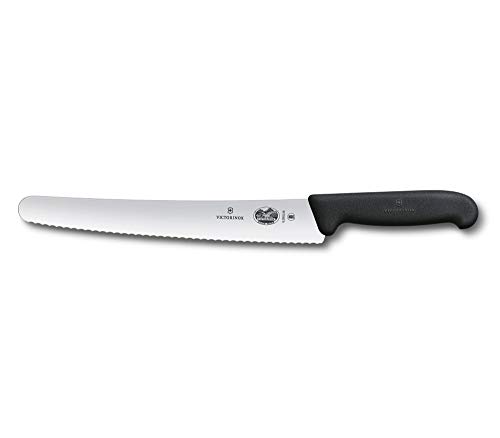
Victorinox Swiss Army Fibrox Pro Bread Knife
Pointed serrations on this Victorinox bite through crust on the first stroke instead of skating across it, exactly what a bread knife needs to do. Fibrox handle material stays grippy even with wet or greasy hands. Most home cooks can buy this once and never think about upgrading.
Pros
- Cuts crusty loaves without crushing them
- Grip stays secure when wet
- Costs a fraction of premium rivals
Cons
- Plain looks compared with forged knives
- Serrated edge needs professional sharpening

Wusthof Classic 9-Inch Double Serrated Bread Knife
Double serration places small teeth inside larger scallops, gripping a tough bakery crust that a standard blade slides across. Forged construction adds weight that works through a dense loaf with less effort. Owners report it also excels on melons and tomato skins.
Pros
- Best grip on hard artisan crusts
- Forged weight reduces sawing effort
- Handles fruit and tomatoes well
Cons
- Considerably more expensive
- 9 inches is short for very wide loaves
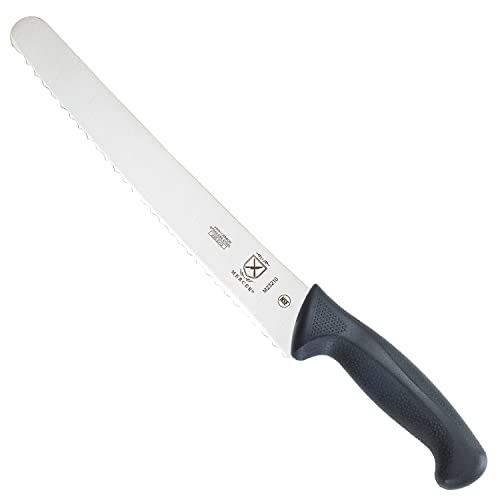
Mercer Culinary Millennia 10-Inch Wavy Edge Bread Knife
Mercer’s Millennia earns a spot in professional kitchens by working well, costing little and surviving careless treatment. Its wavy edge suits soft loaves and cakes particularly well. A textured handle with a finger guard helps when hands turn wet.
Pros
- Excellent value for a full length blade
- Comfortable grip with a safety guard
- Handles cakes and soft loaves neatly
Cons
- Wavy edge grips hard crust less aggressively
- Stamped blade feels light to some cooks

Tojiro Bread Slicer 270mm
At 270mm, this blade crosses a wide sourdough boule in a single stroke, and its thin profile cuts with less resistance through the crumb. Japanese steel holds a keen edge longer than most rivals here. Keep the stroke steady rather than forcing it, since the thinner blade flexes more.
Pros
- Long enough for wide boules in one pass
- Thin blade produces very clean slices
- Edge holds up well over time
Cons
- Flexes if you push too hard
- Wood handle needs hand washing

Shun Classic 9-Inch Bread Knife
Shun pairs a hard core steel with Damascus cladding and a D shaped handle built for right handed users. Finer serrations than most give unusually smooth cut faces. Buying this knife is partly about the pleasure of using it, and it needs matching care.
Pros
- Exceptionally clean cut surfaces
- Hard steel holds its edge
- Comfortable, well balanced handle
Cons
- Hand wash and careful storage required
- D shaped handle suits right handers best

Dalstrong Gladiator Series 10-Inch Bread Knife
Extra weight compared with most bread knives helps the Gladiator power through dense loaves. It arrives with a blade guard, more useful than it sounds for a serrated edge stored in a crowded drawer. Owners describe the finish as more striking in person than in listing photos.
Pros
- Weight helps through dense loaves
- Blade guard protects the edge in a drawer
- Comfortable full tang balance
Cons
- Heavier than some cooks prefer
- Wood handle needs hand washing
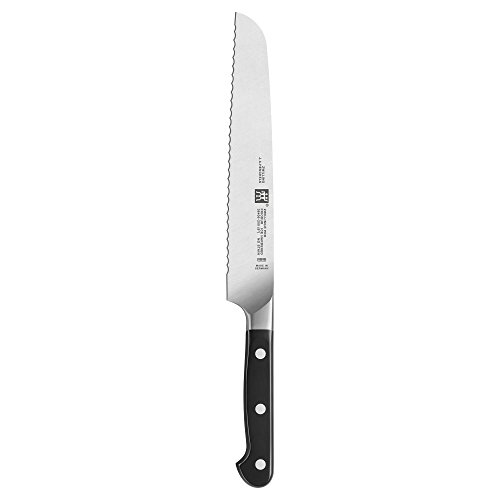
Zwilling Pro 8-Inch Bread Knife
At eight inches, this is the shortest knife in the group, easier to store, wash and control in a small kitchen. It handles sandwich loaves, baguettes and rolls with ease. Wide sourdough boules are where the shorter blade starts to feel limiting.
Pros
- Easy to store and manoeuvre
- Forged quality in a compact size
- Comfortable handle shape
Cons
- Too short for wide artisan loaves
- Needs more strokes on big boules
The lineup, side by side
| # | Model | Blade length | Best for | Score | Price |
|---|---|---|---|---|---|
| 1 | Victorinox Swiss Army Fibrox Pro Bread Knife | 10.25 inches | Best overall | 9.4 | Check price |
| 2 | Wusthof Classic 9-Inch Double Serrated Bread Knife | 9 inches | Best for hard crusts | 9.2 | Check price |
| 3 | Mercer Culinary Millennia 10-Inch Wavy Edge Bread Knife | 10 inches | Best value | 9.0 | Check price |
| 4 | Tojiro Bread Slicer 270mm | 270mm, around 10.6 inches | Best for long loaves | 8.7 | Check price |
| 5 | Shun Classic 9-Inch Bread Knife | 9 inches | Best premium choice | 8.5 | Check price |
| 6 | Dalstrong Gladiator Series 10-Inch Bread Knife | 10 inches | Best for heavy use | 8.2 | Check price |
| 7 | Zwilling Pro 8-Inch Bread Knife | 8 inches | Best compact blade | 8.0 | Check price |
Good to know
How long should a bread knife be?
Around 9 to 10 inches suits most kitchens, since the blade needs to cross the widest loaf in one stroke. An 8 inch blade works for sandwich loaves and baguettes but struggles with large round sourdough.
Can bread knives be sharpened?
Yes, though not with a standard stone or pull through sharpener. Each serration needs individual work with a tapered ceramic or diamond rod, or professional sharpening. Well made serrated edges usually go years between sharpenings.
What is the difference between pointed and wavy serrations?
Pointed serrations grip and pierce hard crust quickly, ideal for artisan bread. Wavy or scalloped edges slice more gently, giving cleaner results on soft loaves, cakes and pastries.
Is a forged bread knife better than a stamped one?
Not necessarily for bread. Forged blades feel heavier and more substantial, which helps through dense loaves. A well designed stamped blade like the Victorinox cuts just as cleanly for far less money.
Can a bread knife handle other foods?
Yes. Serrated blades excel on tomatoes, melons, citrus, cakes and anything with a tough skin over a soft interior. Many cooks reach for their bread knife more often for those jobs than for bread.
Are bread knives dishwasher safe?
Some synthetic handled models list as dishwasher safe, though hand washing suits every knife here better. Dishwasher detergent dulls edges over time, and wood or Pakkawood handles crack under repeated cycles.
How do you slice fresh bread without squashing it?
Let the loaf cool fully first, then use long light strokes with almost no downward pressure. Turning very soft bread onto its side also helps, since the crust supports the crumb while you cut.
Is an offset bread knife worth buying?
Offset handles lift your knuckles above the board, useful when slicing on a flat surface or cutting sandwiches. They work less well for freehand slicing of a whole boule.
Our pick
Victorinox Swiss Army Fibrox Pro suits almost every kitchen, cutting crusty loaves cleanly with a grip that stays secure when hands turn floury. Step up to Wusthof Classic’s double serrated blade for regular hard bakery crusts. Choose Mercer Culinary Millennia for a dependable full length knife without spending much at all.
Dana Whitfield
Dana spent eight years buying and merchandising for a regional kitchenware retailer before moving into editorial work. She has handled thousands of SKUs across cookware, small appliances and kitchen organization, and focuses on the practical differences that matter once a product is actually in daily use.