How Often Should You Replace Sawzall Blades?
There is no fixed schedule. A reciprocating saw blade lasts anywhere from a few minutes of cutting through nail-embedded lumber to dozens of clean cuts in softwood, depending on the material and blade type. Replace it when cutting speed drops noticeably, the teeth are rounded or missing, the blade bends or wanders in the cut, or the tip has lost its set.
The honest answer: it depends on what you cut
A wood-cutting blade used on clean pine can keep going for many projects. The same blade hitting a hidden nail or a knot can be dull in seconds. Demolition work with embedded fasteners, cast iron pipe, or hardened steel will kill a blade far faster than cutting PVC or drywall. So the real answer is condition-based, not calendar-based: check the teeth and the cut quality, not the date you bought it.
Signs a blade is past its prime
The clearest signal is speed. If a blade that used to slice through a 2×4 in a few seconds now smokes and crawls, it is dull. Look at the teeth: rounded tips, missing teeth, or a shiny worn strip along the cutting edge mean the hardened teeth are gone. A blade that starts wandering off your line, or that you have to push hard to keep cutting, is also done. Bending is another one; a bent blade will never track straight again and can snap under load.
Why blades fail before the teeth look worn
Reciprocating saw blades fail in three main ways: tooth dulling, tooth stripping (losing teeth entirely), and blade breakage. Tooth stripping usually happens when the blade is too coarse for the material or when the saw is run at too high a speed, which overheats the teeth. Breakage often comes from flexing a thin blade in a deep cut or from binding in the kerf. A blade with a cracked or fatigued shank is unsafe and should be swapped even if the teeth look fine.
How blade type changes the lifespan
Bi-metal blades last longer in wood with nails and general demolition because the hardened teeth resist dulling. Carbide-tipped blades last much longer in tough materials like cast iron and stainless, but they cost more and are less forgiving of abuse. High-carbon steel blades are cheap and sharp but dull quickly, so they are best for clean wood or occasional use. Matching the blade to the material is the single biggest factor in how long it lasts.
When to replace versus when to keep going
If you are making rough cuts where finish does not matter, a slightly dull blade can keep going until it really struggles. For finish work, visible cuts, or plumbing where a wandering blade can ruin a fitting, swap as soon as the cut quality drops. Keep a few spares on hand so you are not tempted to push a dull blade through a job it is not suited for.
Storage and handling that extend blade life
Blades dull against each other in a drawer. Store them in a case or sleeve so the teeth do not knock together. Let the saw do the work instead of forcing it, and use the correct speed for the material. A little cutting oil helps on metal. Also, make sure the blade is fully seated and the shoe is against the work; a loose blade chatters and wears faster.

Diablo DS0612BW Bi-Metal Reciprocating Saw Blade
A bi-metal blade with a variable tooth design for wood with nails and general demolition, often sold in multi-packs.
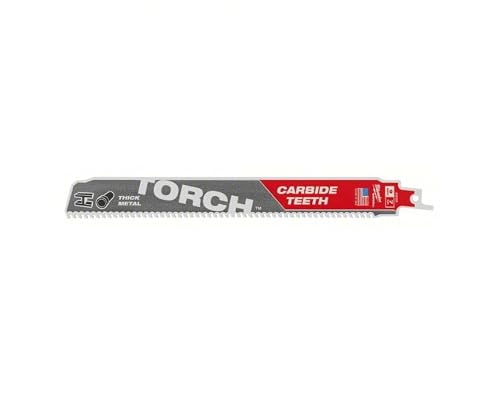
Milwaukee 48-00-5186 The Torch Carbide Reciprocating Saw Blade
A carbide-tipped blade aimed at cast iron, stainless steel, and other hard materials where standard bi-metal blades dull quickly.
Frequently asked questions
How long does a Sawzall blade typically last?
It varies widely. In clean wood, a good bi-metal blade might last through dozens of cuts. In demolition with embedded nails or in cast iron, it might last only a few minutes. There is no standard lifespan because the variables are so different.
Can you sharpen a reciprocating saw blade?
Generally no. The teeth are hardened and sharpened at the factory, and attempting to sharpen them usually ruins the set and temper. It is almost always more practical to replace the blade.
Why do the teeth on my Sawzall blade keep breaking off?
Tooth stripping usually means the blade is too coarse for the material, the saw speed is too high, or the blade is binding in the cut. Using a finer tooth count and letting the saw cut at its own pace helps.
Does cutting metal ruin a wood blade?
Yes. Wood blades have a different tooth geometry and are not hardened for metal. Using them on metal will dull them quickly and can strip teeth. Always match the blade to the material.
How can I tell if a blade is dull without cutting with it?
Look at the teeth under good light. Rounded tips, a shiny worn edge, or missing teeth are clear signs. Also check for a bent or cracked shank, which means the blade is done regardless of tooth condition.
Is it worth buying carbide-tipped reciprocating saw blades?
For tough materials like cast iron, stainless steel, or fiberglass, yes. They last much longer than bi-metal in those applications. For general wood and demolition, bi-metal is usually more cost-effective.
Can a dull blade damage my saw?
A dull blade makes you push harder, which puts more strain on the motor and can overheat it. It also increases vibration and the chance of binding. Replacing a dull blade is cheaper than repairing a saw.
Why does my blade wander off the cut line?
Blade wander can come from a bent blade, a dull blade that you are forcing, or a blade that is too long for the work. A fresh, straight blade and a steady, light touch usually fix it.
Do more expensive blades last proportionally longer?
Often yes, especially in tough materials. Premium bi-metal and carbide blades typically outlast cheap high-carbon blades by a wide margin, so the cost per cut can actually be lower despite the higher upfront price.
Can I use a wood blade to cut through nails?
Only if it is designed for it. Bi-metal blades labeled for wood with nails can handle occasional nails. Standard wood blades will dull or strip teeth quickly on nails.
How do I avoid breaking blades in deep cuts?
Use a blade long enough for the cut, keep it straight, and let the saw do the work. Binding and side-loading are the main causes of breakage. Also make sure the material is well supported so it does not pinch the blade.
Do reciprocating saw blades have a break-in period?
Not really, but new blades are sharpest. Some users find that the first few cuts are the fastest, and performance gradually declines from there. There is no need to baby a new blade.
What is the best tooth count for general demolition?
A 6 to 10 teeth per inch (TPI) blade is a good general-purpose choice for wood and demolition. Finer teeth (14 to 18 TPI) are better for metal and clean cuts.
Can I use the same blade for wood and metal?
There are multi-purpose blades that can handle both, but they are a compromise. Dedicated blades will always perform better and last longer in their intended material.
How should I store spare blades?
Keep them in a case or sleeve so the teeth do not rub against each other. A rolled-up pouch or a small toolbox compartment works well. Avoid tossing them loose in a bag.
Does saw speed affect blade life?
Yes. Running a blade too fast for the material generates heat and wears teeth faster. Use a slower speed for metal and harder materials, and a higher speed for wood.
Can a blade be too long for the job?
Yes. A blade much longer than needed can flex and wander, especially in tight spaces. Use the shortest blade that comfortably clears the cut.
Why does my blade get hot and smoke?
That usually means the blade is dull, the speed is too high, or you are forcing the cut. Smoke is a sign of friction and heat, which quickly ruins the temper of the teeth.
Are there any safety concerns with worn blades?
Yes. A worn or damaged blade can break and send pieces flying. Inspect blades before use and replace any with cracks, bends, or missing teeth. Always wear eye protection.
Where this leaves you
Replace Sawzall blades based on performance, not a schedule. Watch for slower cuts, rounded teeth, wandering, or bending, and keep a few spares of the right type on hand. Matching the blade to the material and letting the saw do the work will stretch every blade further.
Jake Monroe
Jake worked as a residential contractor for over a decade before shifting to full-time writing. He evaluates power tools, hand tools and workshop gear through the lens of someone who has actually used them on job sites, not just read the box.