How Often Should You Replace Garden Hose Washers?
Garden hose washers, the small rubber rings inside hose and nozzle couplings, typically need replacing roughly once a year for hoses used regularly, or as soon as a connection starts dripping. They are cheap and wear out from sun exposure and repeated compression long before the hose itself fails, and a leak at a connection point is almost always the washer rather than the hose or the fitting threads.
What the washer actually does
A washer seals the small gap at a threaded connection between a hose end and a spigot, nozzle, or another hose, so water pressure escapes only out the far end instead of spraying sideways at every joint. Without it, even perfectly matched threads leave enough of a gap for water to force its way through under pressure.
Why rubber washers degrade over time
UV exposure and repeated compression and decompression, as hoses are connected and disconnected, cause rubber to harden, crack, or flatten permanently and lose its spring-back. This happens well before the thicker hose wall itself shows any comparable wear, which is why washers fail years ahead of the hose.
Signs a washer needs replacing
A fine spray or steady drip at the spigot or nozzle connection, even when the fitting is screwed on tight, almost always points to the washer rather than the threads. If hand-tightening harder doesn’t stop the leak, that’s usually the clearest sign the rubber itself has lost its seal, not that the connection needs more torque.
Rule of thumb for replacement frequency
For a hose left connected and exposed to sun and weather most of the season, checking and replacing the washer roughly once a year is a reasonable baseline. Hoses that get disconnected and reconnected frequently wear their washers out faster through mechanical flexing than hoses that mostly sit still, so frequent users may need to check every few months instead.
Picking a longer-lasting washer
Basic rubber washers are the cheapest option but also wear fastest under repeated compression. Thicker or reinforced rubber washers resist flattening longer, which matters more for a hose bib used daily, like one near a vegetable garden watered every morning, than for a hose connected once a week.
What to check before blaming the washer
Cross-threaded fittings, a cracked female coupling, or mineral buildup on the threads from hard water can all mimic a bad washer leak. A quick wipe-down and visual check of the threads themselves before replacing the washer avoids swapping a part that wasn’t actually the problem.
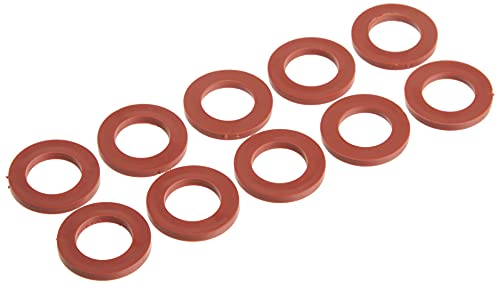
Gilmour 09WA Rubber Hose Washers (10-pack)
A basic multipack of standard rubber hose washers sized for most garden hose and nozzle connections, inexpensive enough to keep a few spares on hand.

Flexzilla Garden Hose with SwivelGrip
A hybrid polymer hose with a swivel connector designed to reduce the kinking and twisting that accelerates washer wear at the coupling.
Questions worth asking
Can a dripping hose connection just be over-tightened instead of replacing the washer?
Sometimes a little extra hand-tightening helps temporarily, but if the rubber has already hardened or cracked, no amount of tightening will restore the seal and the washer needs swapping.
Do brass fittings wear out washers faster than plastic fittings?
Brass fittings tend to grip and compress a washer more evenly than plastic, which can actually extend washer life slightly compared to a rougher or slightly warped plastic connector.
Is it normal for a brand new hose to still leak at the spigot?
It can happen if the factory-installed washer is misaligned or a bit undersized, and simply reseating or swapping that washer usually resolves a brand new hose’s leak.
Can you reuse an old washer if it still looks intact?
You can if it hasn’t hardened, cracked, or flattened, but a washer that’s been in service for a year or more and starts leaking has usually already lost enough elasticity that reusing it just delays another leak.
Do all hose washers fit every hose size?
Most standard garden hoses use a common washer size, but heavy-duty or commercial hoses sometimes use a slightly different diameter, so checking fit before buying a multipack is worth the extra minute.
Why does my hose leak only at full water pressure?
A worn washer can still seal adequately at low flow but get forced open slightly once full pressure pushes against it, which is a strong sign the washer has lost some of its original thickness or elasticity.
Can a worn washer cause lower water pressure at the nozzle?
Yes, water escaping sideways at a leaking connection reduces the volume actually reaching the nozzle, so a hose that suddenly sprays weaker at the end sometimes has a leak upstream rather than a clog.
Is it worth buying a universal washer assortment?
For a household with several hoses and nozzles of slightly different ages and brands, an assorted multipack is usually more convenient than buying single washers one at a time as each fails.
Does hot weather make washers wear out faster?
Yes, sustained heat and UV exposure accelerate the hardening and cracking process in rubber, which is why hoses left in direct summer sun often need washer replacement sooner than ones kept in shade.
Can plumber’s tape substitute for a hose washer?
Not really, plumber’s tape is designed for threaded pipe joints, not the flat gasket-style seal a hose washer provides, and it won’t create a reliable seal in a standard hose coupling.
Do soaker hoses and sprinkler hoses use the same washer type?
Generally yes, most consumer garden hose fittings share a common standard, though some specialty irrigation fittings use their own connector style with a different washer size.
How do you remove a stuck washer from inside a coupling?
A small screwdriver or needle-nose pliers can usually pry out a stuck washer by catching its edge, working carefully to avoid scratching the inside of the coupling itself.
Should every connection point on a hose run have a washer?
Yes, any threaded connection, including hose-to-hose, hose-to-spigot, and hose-to-nozzle, relies on a washer to seal, so a multi-hose run has multiple washers that can each fail independently.
Can a bad washer damage the spigot threads over time?
Not directly, but the constant dripping and moisture from a leaking washer can accelerate corrosion on metal spigot threads over months or years, so fixing a leak promptly protects the fitting too.
Is a leaking washer a sign the hose itself needs replacing?
No, washer failure is unrelated to the hose body’s condition, and a hose with years of life left can leak purely from a worn washer that takes seconds to replace.
Do quick-connect fittings still need washers?
Yes, quick-connect systems still rely on an internal O-ring or washer to seal the connection, and that part wears out and needs replacement the same way a standard threaded washer does.
Can a hose washer wear out faster at a spigot used year-round versus seasonally?
Yes, continuous use through all four seasons exposes the washer to far more freeze-thaw cycles, UV exposure, and compression cycles than a hose only connected during a few warm months, so a year-round connection typically needs washer checks more often.
Is it better to buy washers made of rubber or a synthetic compound like silicone?
Silicone and other synthetic compounds generally resist UV degradation and temperature extremes better than basic rubber, holding their shape and seal longer, though they typically cost a little more per washer than standard rubber options.
Can you tell a washer is failing just by looking at it, without waiting for a leak?
Yes, a washer that looks flattened, cracked, or has lost its original thickness compared to a new one is usually close to failing even before it starts visibly dripping, so a quick visual check during routine hose coiling can catch it early.
Where this leaves you
Washers are the cheapest, most overlooked part of a garden hose setup, and replacing one at the first sign of a drip is almost always faster and less wasteful than living with a leak or assuming the whole hose needs to go.
Sierra Daniels
Sierra's background is in landscape design and nursery retail. She focuses on lawn and garden equipment, outdoor furniture and gear durability, weighing published specs against how materials actually hold up outside.
You might also need
How Often Should You Replace a Garden Hose Nozzle?
How Often Should a Pond Pump’s Filter Be Cleaned for Clear Water?

Commercial Grade Weatherproof Garden Beds That Last for Years
