How Often Should You Inspect CV Axle Boots?
CV axle boots should be visually inspected at least every oil change, roughly every 5,000 to 7,500 miles, since catching a small tear or crack early is the difference between a low-cost boot replacement and a full CV joint or axle replacement once grease has leaked out and contaminants have gotten in.
What the boot is actually protecting
The CV, or constant velocity, joint sits at each end of a drive axle and allows power to transfer smoothly through a wide range of steering and suspension angles. The rubber or thermoplastic boot wrapped around it is purely a protective cover, sealing in the specialized grease the joint needs and sealing out dirt, water, and road debris that would otherwise wear the joint’s internal bearings quickly.
Why a small tear becomes a big problem fast
Once a boot splits, even a small crack, grease begins slinging out from centrifugal force every time the wheel turns, while road grit and water work their way in through the same opening. The joint inside can go from well-lubricated to running dry and contaminated within a relatively short number of miles, especially in wet or dusty driving conditions, which accelerates wear dramatically compared to a properly sealed joint.
What to actually look for during a visual check
Grease flung onto the inside of a wheel, visible cracks or splits in the boot’s rubber folds, a boot that looks collapsed or loose rather than taut, and any clicking or popping noise during tight turns are all signs worth investigating. A flashlight and turning the wheel by hand with the car safely raised makes small cracks much easier to spot than a quick glance from outside the tire.
Why oil change intervals are a convenient inspection point
Since the vehicle is often already raised or the undercarriage accessible during routine service, having a technician glance at the CV boots during each oil change catches most developing problems early without requiring a separate dedicated appointment, which is why many shops build this into their standard multi-point inspection.
Why clicking noises in turns mean it may already be too late for just a boot replacement
A rhythmic clicking or popping sound specifically when turning sharply, especially at low speed like a parking lot maneuver, usually indicates the outer CV joint has already been running without adequate grease long enough to develop wear in its internal bearings, at which point replacing just the boot will not fix the underlying noise.
Why driving conditions change the inspection math
Vehicles regularly driven on unpaved roads, through deep puddles, or in salted winter conditions are harder on CV boots than those driven mostly on clean paved roads, since abrasive grit and moisture exposure accelerate both boot wear and the consequences of any crack that does form. Those vehicles benefit from more frequent checks than the general interval.

Permatex CV Joint Boot Repair Kit
An emergency kit using a split boot design and tie wraps meant to temporarily reseal a damaged boot well enough to drive to a shop without losing more grease.
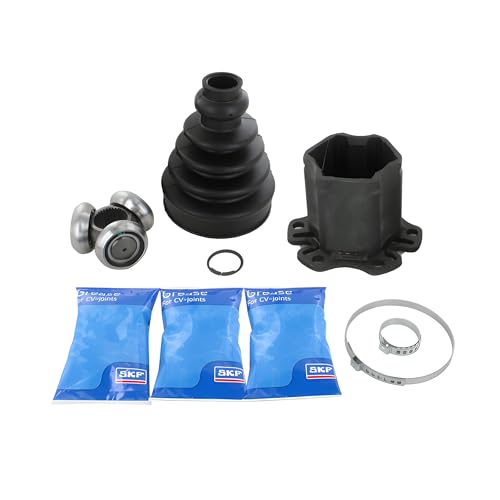
SKF VKJA Series CV Joint Boot Kit
A direct-fit replacement boot kit including fresh CV grease and clamps, used when the joint itself is still in good condition and only the boot has failed.
Common questions
Can you drive with a torn CV boot?
For a short distance to reach a repair shop, usually yes, but driving extensively on a torn boot risks contaminating the joint with dirt and water, which can turn a simple boot repair into a full axle replacement.
How much does CV boot replacement cost compared to a full axle?
A boot-only replacement is typically significantly cheaper than replacing the entire axle assembly, which is exactly why catching a torn boot early before the joint itself is damaged matters so much for repair cost.
What does a failing CV joint sound like?
A clicking or popping noise during sharp turns, particularly at low speed, is the classic symptom of a worn outer CV joint, and it typically gets more noticeable as the damage progresses.
Can a CV boot be repaired without removing the axle?
Some split-style emergency boots can be installed without removing the axle, but a proper, long-term boot replacement typically requires removing the axle to fully clean and repack the joint with fresh grease.
Does cold weather make CV boots more likely to crack?
Yes, rubber boots can become more brittle in very cold temperatures, making existing small cracks more likely to worsen and making a boot that is already aging more prone to splitting during cold weather driving.
How long does a CV boot typically last?
Lifespan varies widely with driving conditions and boot material, but many boots last well beyond 60,000 to 100,000 miles under normal conditions, while harsh conditions or a manufacturing defect can shorten that considerably.
Is it normal for CV grease to be slightly visible near the boot folds?
A small amount of grease sitting in the natural folds of an intact boot can be normal, but grease flung onto the wheel, tire, or underside of the car indicates the boot has failed and is actively losing lubricant.
Can both inner and outer CV boots fail at the same time?
It is possible, especially on an older vehicle where both boots are aging simultaneously, though they do not always fail together since the outer joint typically experiences more extreme angles and can wear or crack first.
Does a torn CV boot affect how the car drives immediately?
Not usually right away. The car may drive normally for a while even after a boot tears, which is part of why the damage often goes unnoticed until a clicking noise develops, underscoring the value of a visual inspection rather than waiting for symptoms.
Can I inspect CV boots myself without a lift?
Yes, with the vehicle safely supported on jack stands, a flashlight and turning the wheel by hand to see all sides of the boot is usually enough for a reasonably thorough visual check.
Does boot material, rubber versus thermoplastic, affect lifespan?
Thermoplastic boots generally resist cracking from UV exposure and temperature extremes somewhat better than traditional rubber boots, though both can fail from age, road debris impact, or physical damage over enough time.
Will a shop always recommend full axle replacement for a torn boot?
Many shops default to recommending a full reman axle assembly because it is faster labor and comes with a fresh joint and grease already sealed, even though a standalone boot kit can be cheaper if the joint itself tests out fine.
Can hitting a curb or pothole damage a CV boot directly?
Yes, a hard impact can tear or puncture a boot directly even if it was otherwise in good condition, which is a separate failure mode from gradual age-related cracking and worth checking after any significant impact.
Do all-wheel-drive vehicles have more CV joints to worry about?
Yes, AWD and 4WD vehicles typically have additional CV joints in the driveshaft and transfer case assemblies beyond the front axle joints found on front-wheel-drive cars, which means more boots to periodically inspect.
Is synthetic CV grease better than standard CV grease?
Synthetic CV grease generally offers better temperature stability and longer service life under extreme conditions, though standard CV grease is adequate for most normal driving and is what many factory joints ship with originally.
The bottom line
A CV boot is one of the cheapest parts on the car to replace and one of the most expensive to ignore. A thirty-second visual check at every oil change is enough to catch a tear before it turns into a joint replacement.
Tony Russo
Tony trained as an automotive technician and spent years in service and parts retail before moving into writing. He focuses on garage tools, car care products and accessories from a hands-on maintenance perspective.

