How Does a Heat Gun Differ From a Hair Dryer for Paint Stripping?
A heat gun produces far higher and far more concentrated heat than a hair dryer, typically ranging from around 300 up past 1,100 degrees Fahrenheit compared with a hair dryer’s roughly 140 to 160 degrees, and that heat is focused through a narrower nozzle rather than spread across a wide airflow pattern. That gap is why a heat gun can actually soften old paint and varnish enough to scrape it off, while a hair dryer at most warms a surface slightly without doing any real work on cured paint.
The actual temperature gap and why it matters for paint
Cured paint and varnish need sustained heat well above 300 degrees Fahrenheit before the film softens enough to lift with a scraper. A hair dryer’s output, capped far below that by design, simply cannot reach the temperature paint needs to let go of a substrate, no matter how long it’s held in one spot.
Airflow and nozzle focus differences
A heat gun directs a narrow, concentrated stream of hot air through a small nozzle, and swappable nozzle attachments can narrow or widen that stream further for detail work or broad surfaces. A hair dryer spreads its airflow wide on purpose, since it’s designed to dry hair evenly across a scalp rather than concentrate heat on one small area.
Why hair dryers are deliberately capped low
Hair dryers are built with a low maximum temperature and a built in thermal cutoff specifically because they’re meant to blow directly on skin and hair without causing burns. That safety ceiling is a design feature, not a limitation that happens to exist, which is exactly why it can’t be pushed into heat gun territory.
What heat guns risk that hair dryers don’t
A heat gun held too close or too long can scorch wood, melt vinyl siding or plastic trim, and on older homes, heating lead based paint releases fumes that genuinely require a respirator and proper ventilation rather than casual precautions. None of those risks apply meaningfully to a hair dryer, simply because it can’t generate enough heat to cause them.
Variable temperature control and why it matters
Most heat guns offer adjustable temperature and sometimes airflow settings, since different materials need different heat levels: heat shrink tubing, vinyl flooring, and old varnish each respond best at different temperatures, and running too hot on the wrong material can scorch or warp it rather than simply softening it.
When a heat gun is overkill and a hair dryer is actually the better tool
For small craft shrink wrap, loosening a light sticker, or gently drying a small glue spot, a hair dryer’s lower and gentler heat is genuinely the safer, more appropriate choice, since a heat gun’s concentrated output can scorch delicate materials that never needed anywhere near that much heat. Reaching for the bigger, hotter tool out of habit on these small jobs usually just adds risk without actually finishing the task any faster.

WAGNER FURNO 300 Heat Gun
A dual temperature heat gun aimed at homeowners doing occasional paint stripping, shrink wrap, and light DIY heat work.
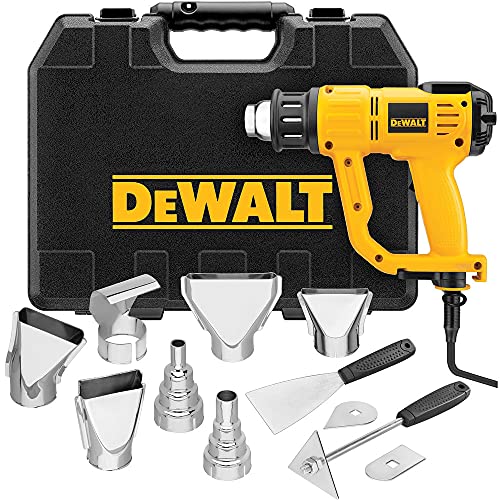
DEWALT D26960K Heavy-Duty Heat Gun
A variable temperature heat gun with digital readout and LCD display, built for contractors stripping paint and varnish across larger surfaces.
Common questions
Can a hair dryer strip paint at all if you hold it close enough?
No, holding it closer mainly redirects more of the same limited heat at a smaller area without raising the actual temperature output, and cured paint needs heat the dryer simply isn’t built to produce.
Why does a respirator matter when heat-stripping old paint?
Homes built before the late 1970s often have lead based paint underneath newer layers, and heating that paint releases lead containing fumes and particles that are genuinely hazardous to inhale, which is why proper ventilation and a rated respirator matter for that specific scenario.
Can a heat gun start a fire if left in one spot too long?
Yes, a heat gun held stationary against wood, especially near dust, sawdust, or old dry finishes, can scorch and in rare cases ignite material, which is why moving the gun continuously rather than holding it still is standard technique.
What temperature is actually needed to soften old paint for scraping?
Most paint starts softening usefully somewhere in the 400 to 700 degree Fahrenheit range depending on the paint type and number of layers, well within a heat gun’s range and far above anything a hair dryer reaches.
Can a heat gun accidentally melt plastic trim nearby?
Yes, nearby vinyl or plastic trim can soften or melt from a heat gun’s output even without being the direct target, which is why shielding adjacent surfaces matters during paint removal near trim or siding.
Is the wattage difference between the two tools significant?
Yes, heat guns typically draw significantly more wattage than hair dryers of similar size, since generating and sustaining much higher air temperatures takes more energy than a hair dryer’s lower heat ceiling requires.
Is it ever safe to use a heat gun on lead paint at all?
It can be done, but only with proper respiratory protection, containment of paint chips and dust, and often local regulations around lead paint disturbance, so it’s not a casual weekend task the way stripping modern paint is.
How close should a heat gun be held to the surface?
Most manufacturers recommend keeping the nozzle a couple of inches away and moving it steadily rather than holding it fixed, since proximity combined with a stationary position is what causes scorching.
Can a heat gun warp solid wood if used carelessly?
Yes, prolonged heat in one spot can dry out and warp or crack wood, particularly thinner trim pieces, which is another reason constant motion with the gun matters more than raw heat output alone.
Do heat gun attachments actually change what the tool can do?
Yes, nozzle attachments like a flat reflector, cone, or deflector change how concentrated or spread out the airflow is, which effectively tunes the tool for detail work, glass protection, or broader surface heating from the same base unit.
Is a hair dryer safe to use near flammable materials the way a heat gun isn’t?
Generally yes, since a hair dryer’s lower heat output makes it far less likely to ignite nearby dust or dry material compared with a heat gun’s concentrated, much hotter airflow.
Is a heat gun or a hair dryer better for shrink wrap on small crafts?
A heat gun on a low setting usually works more reliably and faster for shrink wrap, since craft shrink film needs sustained heat a hair dryer struggles to reach, though very light, thin films can sometimes respond to a hair dryer on high.
How do you know paint has softened enough to scrape?
The paint typically starts to bubble, wrinkle, or visibly lift at the edges, and a scraper should slide underneath with light pressure rather than needing to be forced, which signals the right amount of heat has been applied.
Can a heat gun remove wallpaper the way it removes paint?
Yes, heat guns are commonly used to loosen wallpaper adhesive in sections, though a wallpaper steamer is often considered gentler on drywall underneath for larger jobs.
Does fan speed matter as much as temperature on a heat gun?
Both interact, since a higher fan speed at the same temperature moves more hot air across the surface faster, which can either speed up softening or, on delicate materials, increase the risk of overheating a larger area at once.
Our take
The two tools look similar enough that the comparison comes up constantly, but they’re not different strengths of the same thing, they’re built for entirely different jobs. A hair dryer is tuned to be safe against skin and hair, and a heat gun is tuned to do real thermal work on materials that don’t soften without serious heat.
Jake Monroe
Jake worked as a residential contractor for over a decade before shifting to full-time writing. He evaluates power tools, hand tools and workshop gear through the lens of someone who has actually used them on job sites, not just read the box.


