How Does a Hamster’s Exercise Wheel Size Affect Spine Health?
A wheel that is too small forces a hamster to arch or curve its spine unnaturally to fit the running surface, which with repeated daily use can contribute to spinal curvature and back problems over time. The general rule from small animal veterinarians is that a hamster’s back should stay flat and straight while running, which usually means a minimum wheel diameter of about eight inches for dwarf hamsters and closer to eleven or twelve inches for Syrian hamsters.
Why wheel size is a bigger deal for hamsters than it looks
Hamsters are naturally capable of running long distances nightly, sometimes several miles across a night in the wild, and they will use an exercise wheel heavily if one is available, which means a poorly sized wheel is not an occasional inconvenience but something the hamster’s spine is subjected to repeatedly, night after night, for the animal’s entire life.
What actually happens physically on a too-small wheel
When the wheel’s diameter is smaller than the hamster’s natural running posture needs, the animal’s back curves upward to follow the wheel’s curvature instead of staying in its natural flat running position, and sustained repetition of that arched posture over months is the mechanism veterinarians point to when linking undersized wheels to spinal problems.
Why Syrian and dwarf hamsters need different minimum sizes
Syrian hamsters are considerably larger bodied than dwarf species like Roborovski or Campbell’s dwarf hamsters, so a wheel sized correctly for a dwarf hamster is still too small for a Syrian, which is why size recommendations are usually given per species rather than as one universal number, with Syrians generally needing a notably larger diameter.
How to actually check if a wheel is the right size for a specific hamster
The practical test vets often describe is watching the hamster run and checking whether its back stays flat and level or curves upward to match the wheel’s shape, since package labeling is not always reliable and the same labeled size can fit differently depending on an individual hamster’s actual body length.
What other wheel design features also matter for comfort and safety
A solid running surface rather than wire rungs prevents foot and leg injuries from feet slipping through gaps, and a wheel with enough depth to the running track prevents the hamster’s body from tipping or scraping against the sides during a full stride, both of which compound with diameter to determine whether a wheel is genuinely comfortable for extended nightly use.
Signs an existing wheel might already be too small
A visibly hunched running posture, reluctance to use the wheel despite normal activity levels otherwise, or an older hamster showing signs of stiffness or an arched resting posture are all worth taking as a signal to reassess wheel size, ideally before symptoms progress rather than after they become obvious.

Niteangel Silent Runner Wheel
A wide, solid-surface wheel available in multiple diameters including larger sizes suited to Syrian hamsters, built with a quiet bearing mechanism for nighttime use.
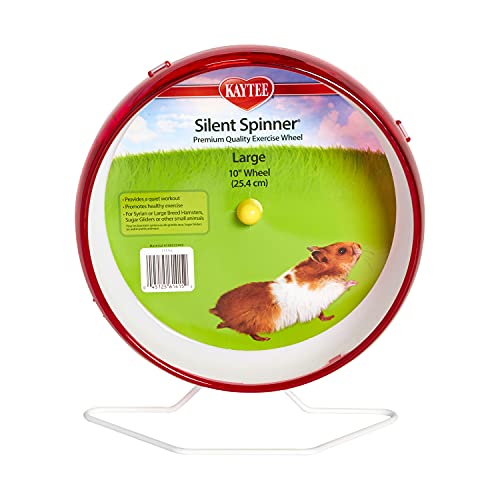
Kaytee Silent Spinner Exercise Wheel
A long-standing wheel design with an enclosed quiet mechanism, sold in sizes that need to be matched carefully against the specific hamster species being kept.
Frequently asked questions
What is the minimum wheel size recommended for a Syrian hamster?
Most small animal vets recommend at least eleven to twelve inches in diameter for an adult Syrian hamster, since anything smaller tends to force a visibly arched running posture.
Is an eight inch wheel big enough for a dwarf hamster?
Generally yes for most dwarf species like Roborovski or Campbell’s, though checking the individual hamster’s running posture on it is still the most reliable confirmation rather than relying on diameter alone.
Can a hamster outgrow a wheel that was fine as a baby?
Yes, young hamsters grow noticeably in their first weeks, so a wheel that fit comfortably at a young age may become too small once the hamster reaches its adult size, especially with Syrian hamsters.
Does a wire mesh wheel cause different problems than a solid one?
Yes, separate from spine curvature concerns, wire rungs create a risk of feet and legs slipping through gaps during running, which can cause cuts, sprains, or broken limbs regardless of whether the diameter itself is correctly sized.
How can I tell if my hamster’s current wheel is actually too small?
Watching closely while the hamster runs and checking whether its back curves upward to follow the wheel’s shape instead of staying flat and level is the clearest sign, more reliable than just checking the labeled size on the package.
Do all hamster species need roughly the same wheel size?
No, Syrian hamsters need notably larger wheels than dwarf species due to their larger body size, so species identification matters before choosing a wheel diameter.
Can spinal problems from a small wheel be reversed by switching to a bigger one later?
Switching to a properly sized wheel can stop further strain and may improve comfort going forward, but any structural spinal changes that have already developed are unlikely to fully reverse, which is why getting the size right from the start matters more than correcting it later.
Is it normal for a hamster to refuse to use a wheel at all?
Occasionally yes for various reasons including an uncomfortable fit, but persistent refusal from a hamster that is otherwise active is worth investigating, since discomfort from a poorly sized or unstable wheel is a common cause.
Does wheel material, like plastic versus metal, affect spine health too?
Not directly in the same way size does, though a flimsy or unstable wheel of any material that wobbles during use can indirectly affect running posture and comfort even if the diameter itself is adequate.
How many hours a night does a healthy hamster typically spend on its wheel?
It varies by individual, but many hamsters will run for several hours cumulatively across a night, which is exactly why getting the wheel size right matters more than it might for an animal using one only briefly.
Can a hamster use a wheel that is too big rather than too small?
A wheel larger than strictly necessary generally poses less risk than one that is too small, since an oversized wheel at worst is simply roomier, while an undersized one actively forces an unnatural running posture.
Do exercise balls serve as an alternative to a wheel for spine-safe exercise?
Exercise balls carry their own risks including overheating, poor ventilation, and a hamster being unable to see obstacles, and they do not solve a spine-curvature problem any better than a correctly sized wheel would, so they are not generally considered a superior substitute.
Is it worth measuring my hamster before buying a wheel?
Yes, a rough body length measurement from nose to base of tail, doubled for a comfortable running diameter, is a more reliable method than guessing from species name alone, since individual size varies even within the same species.
Can an elderly hamster still benefit from switching to a properly sized wheel?
Yes, reducing unnecessary spinal strain remains worthwhile at any age, even if an older hamster with existing stiffness may use the wheel less vigorously than it did when younger.
Does cage size interact with wheel size in terms of overall spine health?
Indirectly, since a cramped cage limits how large a wheel can fit at all, so ensuring adequate cage space is often a prerequisite for being able to properly size the wheel in the first place rather than a separate consideration.
The bottom line
Wheel size is one of the more overlooked basics of hamster care because a small wheel does not look obviously wrong sitting in a cage, and the damage from it builds slowly rather than showing up immediately. Matching the diameter to the actual species and body size in front of you is a small decision with a real, cumulative effect on comfort and spine health over the animal’s life.
Olivia Hartley
Olivia spent several years working at an animal shelter and a pet-supply retailer before joining the editorial team. She researches pet gear with an emphasis on safety, comfort and the fine print that owners often miss.