How Does a Dog’s Harness Fit Affect Breathing During Walks?
A correctly fitted harness should never restrict a dog’s breathing, because it spreads pressure across the chest and shoulders instead of the windpipe. Problems appear at both extremes: a harness that is too tight compresses the rib cage and limits how deeply a dog can breathe, while one that is too loose can ride up and settle against the throat during a hard pull, which puts the dog right back in collar-like territory the harness was meant to avoid.
Why harnesses exist in the first place
A collar concentrates every pound of pulling force onto a narrow band around the trachea and larynx. A harness exists specifically to move that load off the neck and spread it across the chest, shoulders and back instead, which is why vets routinely recommend harnesses for dogs that pull, cough, or have any known airway sensitivity. The tradeoff only works if the harness is actually sized and adjusted correctly for that individual dog.
What correct fit actually looks like
You should be able to slide two fingers flat under every strap without forcing it. The chest strap should sit a couple of inches below the throat, never pressing against it even when the dog looks down, and the girth strap behind the front legs should be snug but not compressing the rib cage. If you can see the harness pinching fur or skin at any point, it is too tight regardless of what size label is on it.
How a too-tight harness affects breathing
A harness cinched too tight restricts the outward movement of the rib cage during inhalation, which matters most during exertion when a dog needs to move more air, not less. This is a bigger deal for brachycephalic breeds like French Bulldogs, Pugs and Boston Terriers, whose airways are already narrowed by skull shape, since they have less breathing capacity to spare in the first place.
How a too-loose harness causes a different problem
A loose harness does not just slip around annoyingly, it can ride up the body under load. On a front-clip design in particular, a loose fit lets the chest strap travel upward toward the throat exactly when the dog lunges or pulls hardest, which is the one moment you most need the pressure to stay off the neck. Loose harnesses are a common reason dogs ‘suddenly’ start coughing on walks even though nothing about the harness changed.
Back-clip vs front-clip and where pressure actually lands
A back-clip harness keeps pulling force on the chest and shoulders no matter how hard the dog pulls, which is generally the gentlest option for a dog’s airway. A front-clip harness redirects the dog sideways when it pulls, which is useful for training, but it does concentrate more force near the chest and lower neck area during a hard pull, so fit precision matters more with this style.
Breeds and dogs where fit matters most
Brachycephalic breeds, small and toy breeds prone to tracheal collapse (Chihuahuas, Yorkies, Pomeranians), and senior dogs with reduced lung capacity all have less margin for error. For these dogs, a well-padded, wide-strap harness with a snug but not tight girth fit is usually a better everyday choice than a thin-strap harness that happens to be the right size on paper.

Ruffwear Front Range Dog Harness
A padded back-clip and front-clip harness with wide chest straps that spread pressure broadly instead of concentrating it in a thin line.
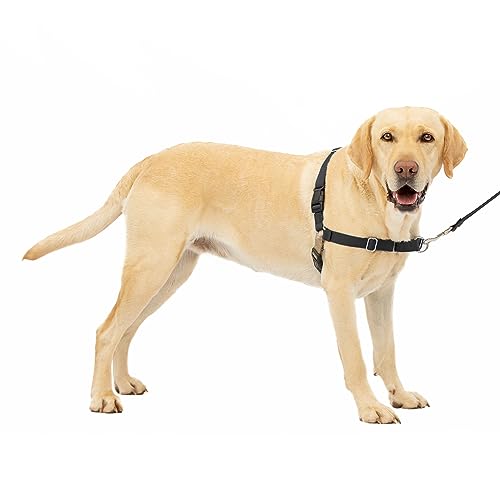
PetSafe Easy Walk Dog Harness
A front-clip harness built around a martingale-style loop under the front legs, designed specifically to redirect pulling without pressure reaching the throat.
Good to know
How do I know if my dog’s harness is too tight?
Check whether you can slide two fingers flat under every strap without forcing them in. If the fur or skin puckers around a strap, or your dog hesitates and resists putting it on, it is likely too tight.
Can a harness cause breathing problems the way a collar can?
Yes, if it fits badly. A tight harness restricts rib expansion and a loose one can ride up toward the throat during a hard pull, both of which reduce the breathing benefit the harness is supposed to provide.
Is a front-clip harness safer for breathing than a back-clip?
Not automatically. Front-clip harnesses are excellent training tools for pulling, but they redirect more force near the chest and lower neck during a hard pull, so precise fit matters more with this style than with a back-clip.
Do brachycephalic dogs need a specific harness design?
A wide, padded harness that avoids any pressure near the throat is generally the safest choice, since breeds like Pugs and French Bulldogs already have reduced airway capacity and less room for error from a poor fit.
Why does my dog cough or gag when wearing a harness?
This usually means the harness has shifted and is pressing somewhere it should not, often because it loosened over the walk or was sized slightly too large to begin with.
How tight should a harness be around the chest?
Snug enough that it cannot slide forward or sideways on the body, but loose enough that two fingers slide under the strap without resistance and the dog’s ribs can expand normally when breathing.
Can a harness actually slip up into a dog’s throat?
Yes, especially a loose front-clip harness during a hard lunge. The chest strap can travel upward along the body until it sits against the throat, which defeats the entire purpose of using a harness.
Does harness material affect how it sits on the chest?
Yes, wider and padded straps distribute pressure over more surface area than thin webbing, which generally feels less restrictive to the dog even at the same tension.
Will a harness help a dog with a collapsing trachea?
A properly fitted harness removes neck pressure entirely, which is exactly what vets recommend for dogs with tracheal collapse, but the harness still needs to be checked regularly since even a good design fails if it loosens.
How often should I recheck harness fit as a dog grows or loses weight?
Check it every few weeks for a growing puppy and anytime an adult dog’s weight shifts noticeably, since even a half inch of extra girth room changes how the harness behaves under pulling.
Is it normal for a dog to pant more in a harness than a collar?
A small amount of extra effort from the straps is normal, but heavy panting, wheezing or reluctance to move usually means the harness is restricting the dog more than it should.
Can a harness restrict a dog’s shoulder movement?
Yes, if the front strap sits too far back or too tight across the shoulder blades, it can shorten the dog’s natural stride, which is a separate issue from breathing but often gets fixed by the same refitting.
Do step-in harnesses fit differently than overhead harnesses?
Step-in designs tend to sit lower and can shift more during active movement, so they generally need more frequent fit checks than overhead harnesses that buckle at the neck and chest.
Should a harness be adjusted differently for a thick-coated dog?
Yes, a fit that looks correct over thick fur can be noticeably looser against the skin underneath, so it is worth checking fit by feel, not just by eye, on heavily coated breeds.
Can a wet harness change how it fits during a rainy walk?
Yes, some fabric webbing stretches slightly when soaked, which can loosen the fit enough that it is worth rechecking once the harness dries out again.
Does a heavily padded harness always breathe better than a thin strap one?
Not necessarily. Thick padding distributes pressure well but can trap heat against the chest in warm weather, so breathable mesh padding is often a better compromise than dense foam in hot climates.
Is it harmful to leave a harness on a dog all day?
Leaving a harness on for extended periods is not inherently dangerous if it fits correctly, but checking periodically for fur matting or pressure marks underneath the straps is still a good habit.
Our take
Breathing problems from a harness almost never come down to brand or price, they come down to fit drifting out of range in either direction. A harness checked and adjusted regularly, with the two-finger rule applied at the chest and girth straps, does the job it was designed for. One left loose for months, or cinched down once and forgotten, can end up pressing on exactly the airway it was bought to protect.
Olivia Hartley
Olivia spent several years working at an animal shelter and a pet-supply retailer before joining the editorial team. She researches pet gear with an emphasis on safety, comfort and the fine print that owners often miss.


