How Does a Brake Bleeder Kit Actually Remove Air From Brake Lines?
A brake bleeder kit removes air by creating a one-way path for brake fluid, and the trapped air bubbles mixed into it, to exit through the brake caliper’s bleeder valve while fresh fluid is pushed or drawn in to replace what left. Different kit types create that flow differently, some by pushing fluid from the master cylinder reservoir, others by pulling a vacuum at the bleeder valve itself, but the underlying goal is the same: move air contaminated fluid out and solid, air free fluid in.
Why air in brake lines is a real problem in the first place
Brake fluid is only effective because it does not compress noticeably under pressure, transmitting the force from the pedal directly to the caliper. Air bubbles mixed into that fluid do compress, so pressing the brake pedal partially just squeezes those air pockets smaller instead of moving fluid, which is why air in the lines produces a soft, spongy pedal feel instead of firm, immediate braking response.
How a vacuum bleeder kit works specifically
A vacuum bleeder attaches a hose to the bleeder valve on the caliper and uses a hand pump or compressed air to create suction, pulling fluid and any trapped air out through that valve and into a catch container. The vacuum draws fluid down from the reservoir to replace what is removed, continuing until the fluid coming out shows a steady stream with no visible bubbles.
How a pressure bleeder kit works differently
A pressure bleeder instead pressurizes the brake fluid reservoir at the top of the system, usually with a sealed cap and a hand or air driven pump, pushing fluid down through the lines and out through each bleeder valve as it is opened in sequence. This pushes air out ahead of the fluid rather than pulling it, and many mechanics prefer this method because it maintains more consistent pressure throughout the system during the process.
Why bleeding has to happen in a specific sequence on most cars
Most vehicles have a manufacturer specified bleeding order, typically starting with the wheel farthest from the master cylinder and working toward the closest, since this sequence most effectively pushes air out of the entire system rather than trapping pockets of it in sections already considered done.
Why a one-person bleeder kit solves an old two-person problem
Traditional manual bleeding required one person pumping the brake pedal while another opened and closed the bleeder valve at the correct moments to avoid drawing air back in. A one way check valve built into most modern bleeder kits allows fluid to flow out but prevents air from being sucked back into the line when the pedal is released, which is what lets a single person bleed brakes alone without the risk of reintroducing air.
How to tell when the air is actually fully out
The fluid exiting the bleeder valve should run as a clear, consistent stream with no visible bubbles for several seconds in a row, and pedal feel should return to firm and consistent rather than soft or sinking slowly to the floor, both of which are more reliable confirmation than just bleeding for a fixed amount of time.

Mityvac MV6830 Silverline Elite Brake Bleeder Kit
A vacuum style bleeder with a hand pump and a one way check valve, widely used for one-person brake bleeding without a second person pumping the pedal.
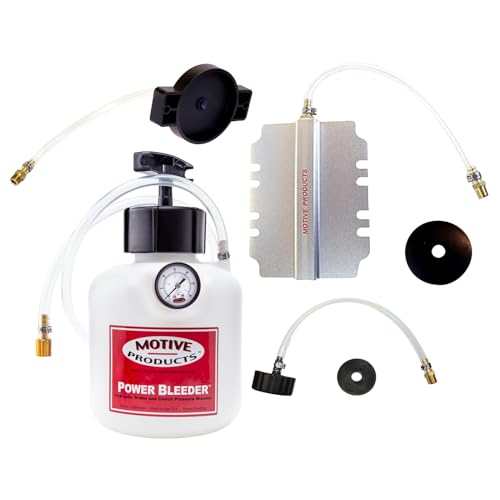
Motive Products Power Bleeder
A pressure bleeder that seals onto the brake fluid reservoir and pushes fluid through the system from the top, an approach some mechanics prefer over vacuum bleeding for consistent flow.
Common questions
Can you bleed brakes without any kit at all, just the pedal and a helper?
Yes, the traditional two-person method works by having one person pump and hold the brake pedal while another opens the bleeder valve to release fluid and air, then closes it before the pedal is released, repeating until no bubbles appear, though it requires careful timing to avoid drawing air back in.
How do you know which wheel to bleed first on a specific car?
Most manufacturers specify a bleeding sequence in the vehicle’s service manual, and the general rule across most vehicles is to start with the wheel farthest from the master cylinder and finish with the closest, though some systems with diagonal brake lines have a different specific order.
Is vacuum bleeding or pressure bleeding more reliable for getting all the air out?
Both methods are capable of fully removing air when done correctly, but pressure bleeding tends to maintain more consistent flow throughout the process, while vacuum bleeding can occasionally draw in tiny amounts of air around the valve threads if the seal is not tight, producing bubbles that look like trapped air but are not.
Why does the pedal still feel slightly soft even after bleeding thoroughly?
A pedal that stays soft after a thorough bleed often points to a problem beyond air, such as a worn master cylinder, a flexible brake hose expanding under pressure, or air trapped in a section the bleeding sequence did not fully clear, rather than simply needing more bleeding time.
Does old brake fluid need to be bled out even if there is no air problem?
Yes, brake fluid is hygroscopic, meaning it absorbs moisture from the air over time even without any air bubbles being present, and that absorbed moisture lowers the fluid’s boiling point and can contribute to corrosion inside the system, which is why fluid replacement is recommended on a schedule separate from any air problem.
Can bleeding brakes incorrectly actually introduce more air than was there before?
Yes, if the bleeder valve is opened while the vacuum or pressure source is not properly sealed, or if the reservoir runs dry during the process, it is possible to actually draw new air into the system, undoing progress rather than completing it.
How often should brake fluid be bled and replaced as routine maintenance?
Most manufacturers recommend flushing and replacing brake fluid roughly every two years regardless of mileage, since the moisture absorption and gradual degradation of the fluid happens on a time basis rather than purely a mileage basis.
Does a bleeder kit work the same on ABS-equipped vehicles?
Yes, a standard bleeder kit works the same way on ABS-equipped vehicles for the basic hydraulic lines, though some ABS systems require a specific bi-directional scan tool procedure to fully cycle the ABS module’s internal valves and remove air trapped inside it, which a basic bleeder kit alone cannot reach.
What does it mean if the fluid coming out during bleeding looks dark or dirty?
Dark or discolored fluid typically means the brake fluid has absorbed moisture and degraded over time or picked up contamination from worn internal seals, and seeing that during a bleed is a good reason to continue flushing until clean fluid runs through rather than stopping at the first sign of no bubbles.
Can you reuse brake fluid that was bled out, or does it need to be discarded?
Brake fluid that has been bled out and exposed to air, along with any contamination already in the lines, should generally be discarded rather than reused, since it has already absorbed moisture and lost some of the performance characteristics fresh fluid has.
Is it dangerous to let the master cylinder reservoir run dry during bleeding?
Yes, letting the reservoir run completely dry during bleeding draws air directly into the lines from the top of the system, which can undo the entire process and sometimes requires starting the bleed over from the beginning once that happens.
Do different brake fluid types, like DOT 3 versus DOT 4, affect the bleeding process itself?
The bleeding process itself works the same regardless of DOT fluid type, but different DOT fluid grades should never be mixed in significant amounts, so it matters to confirm which type the vehicle requires before topping off the reservoir during a bleed.
Why do some brake systems need a special procedure beyond basic bleeding, like bench bleeding a new master cylinder?
A new master cylinder often needs to be bench bled, meaning air is purged from it on a workbench before installation, since air trapped inside a dry new unit can be difficult to fully remove once it is already mounted and connected to the vehicle’s lines.
Can a bad bleeder valve itself prevent air from coming out properly even with a good kit?
Yes, a worn, corroded, or improperly seated bleeder valve can let air leak in around the threads during the process even with a good kit and correct technique, which is a common reason bleeding sometimes seems to never fully finish on an older vehicle.
Our take
The mechanism is simple once you see it: create flow in one direction through the valve, and air comes out with the old fluid regardless of whether that flow is pushed from the top or pulled from the bottom. Most frustration with bleeding comes from an incomplete seal or a skipped sequence step, not from the basic method being wrong.
Tony Russo
Tony trained as an automotive technician and spent years in service and parts retail before moving into writing. He focuses on garage tools, car care products and accessories from a hands-on maintenance perspective.


