Do Laser Measures Actually Beat a Tape Measure for Accuracy Indoors?
For most indoor jobs, yes, a quality laser measure is more accurate than a tape measure, typically holding within about 1/16 inch over distances where a hand held tape sags, bows, or gets misread at an awkward angle. The gap narrows on short, straight runs under about 10 feet, where a steel tape is already accurate enough and often faster to deploy.
How laser measures actually measure distance
A laser measure sends out a beam of light and calculates distance from how long it takes the reflection to return, or from a shift in the light’s phase, depending on the model. A tape measure instead physically spans the gap with a rigid or semi rigid blade, so its accuracy depends entirely on how straight and taut that blade stays across the distance.
Where tape measures still win
On short runs, outdoors in bright sunlight where a laser dot washes out, around curves or corners a beam cannot bend past, and anywhere a dead battery would stop work entirely, a plain steel tape has no real competition. It also needs zero setup and works the same in the rain.
Where laser measures pull ahead
Long interior spans, measuring alone without a second person to hold the far end, vertical ceiling height readings, and diagonal room measurements for flooring or carpet estimates are all situations where a laser measure saves real time and avoids the sag and parallax errors that creep into a long tape pull.
The accuracy numbers in practice
Typical consumer laser measures hold roughly plus or minus 1/16 inch out to 100 feet or more under normal indoor conditions. A tape measure can match that over a short run, but sag in a long unsupported span, plus the reading angle error from looking at a blade edge on, can easily push a tape’s real world error past what a laser would show on the same distance.
What actually causes laser measure errors
Most laser inaccuracy traces back to a dark or highly reflective target surface scattering the beam, an off axis angle to the target, a low battery affecting the sensor’s internal timing, or a reference edge that was not set correctly against the wall or corner before firing.
Combining both tools is usually the real answer
Most working contractors carry both rather than picking one. The tape comes out for quick layout marks and small checks where speed matters more than reach, and the laser comes out for big rooms, vertical drops, and anything where an extra set of hands is not available.

Bosch GLM 50 Cx Laser Distance Measure
A widely used Bluetooth enabled laser measure with a built in inclinometer, popular for indoor room and ceiling measurements.

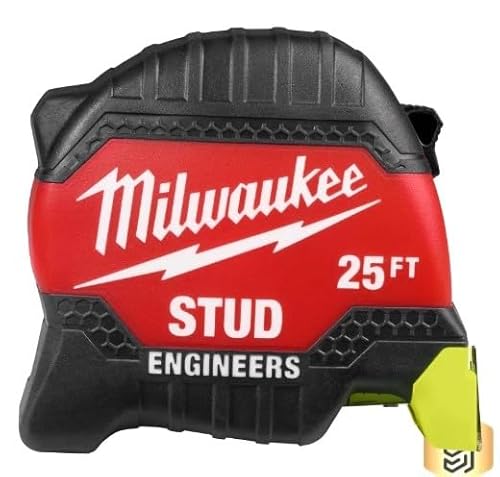
Milwaukee 25 ft. FASTBACK Tape Measure
A standard job site steel tape with a wide, stiff blade that resists bending over longer unsupported spans than a basic tape.
Frequently asked questions
How accurate is a typical laser measure compared to a steel tape?
Most consumer laser measures claim roughly plus or minus 1/16 inch, which is comparable to a tape measure over short distances and often more reliable over long or unsupported spans where a tape can sag or twist.
Can laser measures work outdoors in sunlight?
They can struggle, since bright ambient light washes out the visible laser dot and makes it hard to confirm the target point, though some models include a viewfinder or digital display specifically to help in strong light.
Does a laser measure need a flat wall to bounce off?
It needs a reasonably solid, non transparent surface at roughly the right angle. Glass, mirrors, and very dark or glossy surfaces can scatter or absorb the beam and produce an unreliable reading.
Why does my laser measure give different readings on dark surfaces?
Dark, matte surfaces absorb more of the laser light than light or reflective ones, which weakens the returned signal and can make the measurement less consistent, especially at longer distances.
Is a laser measure worth it for a single room remodel?
For one project, a mid range laser measure usually pays for itself in time saved on area and diagonal measurements alone, though a basic tape measure can still get the job done if budget is the deciding factor.
Can laser measures measure around corners?
No, since the beam travels in a straight line. Measuring around a corner still requires either two separate readings added together or a tape measure that can physically bend into the space.
Do laser measures need to be calibrated?
Most consumer models are factory calibrated and rarely drift, but it is good practice to check a known distance occasionally, and some professional models include a calibration check mode in their menu.
Why do professional contractors still carry a tape measure?
A tape needs no battery, works in bright sun, and is faster for quick marks like cutting a board to length, so most contractors use both tools for different parts of the same job rather than replacing one with the other.
How do laser measures calculate area and volume?
They store two or three individual length readings and multiply them automatically, which is faster and less error prone than manually multiplying tape measurements on paper, especially for odd shaped rooms.
Does temperature affect laser measure accuracy?
Extreme cold can shorten battery life and occasionally affect sensor response time, but normal indoor temperature swings have little practical effect on the measurement itself.
Can a laser measure replace a tape measure entirely for framing work?
Not fully, since framing often needs physical marks transferred directly onto lumber, which a tape does more directly than a laser reading that still has to be transcribed or marked separately.
Why does my laser measure’s dot look fuzzy at longer distances?
The beam naturally spreads slightly over distance, so the dot appears larger and softer the farther away the target is, which is normal and does not necessarily mean reduced accuracy.
Is Bluetooth connectivity on a laser measure actually useful?
For anyone sketching floor plans or logging multiple room dimensions, sending readings straight to a phone app saves real time over writing numbers down by hand, though it is not essential for simple one off measurements.
How long does a laser measure’s battery typically last?
Most models run for several thousand individual measurements on a single set of batteries under normal use, since the laser only fires briefly for each reading rather than staying on continuously.
Can laser measures measure height without a ladder?
Yes, pointing the laser straight up at a ceiling or ledge gives a height reading instantly, which is one of the more practical uses since climbing a ladder just to hold a tape at height is slower and less safe.
Do all laser measures include an angle or inclinometer function?
No, basic models only measure straight line distance, while mid range and higher models often add an inclinometer that can calculate height or indirect distances using angle and trigonometry.
Is a laser measure accurate for outdoor landscaping measurements?
In shaded or overcast conditions it works well, but direct midday sun can wash out the beam enough to make readings unreliable, so a tape or a laser with a digital viewfinder works better in that situation.
Can a laser measure be used to measure a diagonal for squaring a room?
Yes, this is a common use, since measuring both diagonals of a rectangular room and comparing them quickly reveals whether the walls are actually square without needing a long tape stretched corner to corner.
Do budget laser measures sacrifice much accuracy compared to premium ones?
Many budget models still hold reasonable accuracy for basic tasks, though premium models tend to offer more consistent readings at longer distances and better performance in tricky lighting.
Can laser measures be damaged by dropping them on a job site?
Yes, a hard drop can misalign the internal optics or damage the sensor, which is why many models include a protective rubber bumper housing for job site use.
Is it safe to point a laser measure at your eyes or someone else’s?
Most consumer laser measures use a low power Class 2 laser considered safe for brief incidental exposure, but deliberately staring into the beam is still discouraged as a basic precaution.
The bottom line
Neither tool fully retires the other. A laser measure is the better choice the moment a job involves long interior spans, ceiling heights, or working without a second pair of hands, while a tape measure stays the faster, more reliable pick for short, precise marks and anything done in direct sunlight.
Jake Monroe
Jake worked as a residential contractor for over a decade before shifting to full-time writing. He evaluates power tools, hand tools and workshop gear through the lens of someone who has actually used them on job sites, not just read the box.