Do Infrared Thermometers Actually Read Accurately on Shiny Metal Surfaces?
Shiny, reflective metal is one of the specific weak points for infrared thermometers. These devices measure thermal radiation, and highly polished or reflective metal has very low emissivity, meaning it radiates little of its own heat signature and instead reflects ambient infrared from its surroundings. That combination can produce a reading significantly lower than the metal’s actual temperature unless the device or user compensates for it.
What an infrared thermometer is actually measuring
It detects infrared radiation naturally emitted from a surface and converts that signal into a temperature using an assumed emissivity value. It is not directly sensing heat the way a contact probe does, it is inferring it from radiated energy.
Why shiny metal breaks that underlying assumption
Most infrared thermometers are factory-calibrated around an emissivity figure like 0.95, which works well for painted, organic, or matte surfaces. Polished or reflective bare metal often has an emissivity well below that, sometimes as low as 0.1 to 0.3, so the same radiated signal reads as a much lower apparent temperature than reality.
Why reflection adds a second source of error
Beyond low emissivity, a shiny surface also reflects infrared radiation from its surroundings much like a mirror reflects visible light, so a reading can pick up heat from a nearby person, light fixture, or piece of hot equipment instead of the metal itself.
What actually helps when measuring reflective metal
Some higher-end infrared thermometers allow manually adjusting the emissivity setting to better match bare metal, and a simple trick many technicians use is applying a strip of matte tape or paint to the metal surface and measuring that spot instead, since a non-reflective reference reads far more accurately.
Where this matters most in practice
This becomes a real issue when checking engine or exhaust components, bare cookware, or ductwork, where polished metal is common, while it is rarely a problem on painted, textured, or organic surfaces like food, skin, or most household materials where emissivity is already close to the device’s default calibration.

Etekcity Lasergrip 774 Infrared Thermometer
A widely used consumer infrared thermometer with a fixed default emissivity setting, representative of the limitation described above on bare metal.
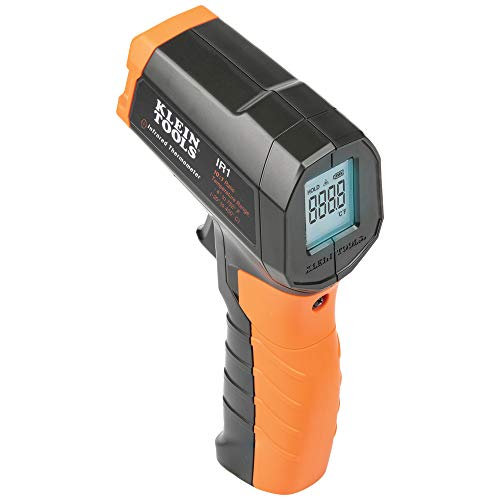
Klein Tools IR1 Infrared Thermometer
A thermometer commonly used by technicians for checking equipment and electrical components where reflective surfaces are routinely encountered.
Frequently asked questions
Why does my infrared thermometer show a cooler reading on stainless steel than it actually is?
Stainless steel’s naturally low emissivity causes the thermometer to under-read, since it radiates less of its own heat signature relative to the default emissivity the device assumes.
Can adjusting the emissivity setting fix inaccurate metal readings?
Yes, on thermometers that allow manual emissivity adjustment, setting it closer to the metal’s actual emissivity, often found in published reference tables, significantly improves accuracy.
Does taping or painting a spot on metal actually improve infrared readings?
Yes, a small patch of flat, non-reflective tape or paint gives the thermometer a surface with known, higher emissivity to read, which is a widely used trick among HVAC and automotive technicians.
Is a contact thermometer always more accurate than infrared on metal?
For bare reflective metal specifically, yes, a contact probe reads the actual surface temperature directly without the emissivity and reflection issues infrared devices face.
Why do infrared thermometers work fine on food but not on a metal grill grate?
Food and most organic surfaces have emissivity close to what the thermometer is calibrated for by default, while bare metal grates have much lower emissivity, causing the same device to behave very differently between the two surfaces.
Does distance between the thermometer and the surface affect accuracy?
Yes, infrared thermometers have a specific distance-to-spot ratio, and standing too far away can capture a larger area with mixed temperatures or more ambient reflection, which worsens accuracy further on an already tricky reflective surface.
Can polished aluminum give a very different reading than brushed aluminum?
Yes, surface finish changes emissivity significantly even on the same base metal, so a polished mirror-like finish reads less accurately than a matte brushed or anodized finish on otherwise identical aluminum.
Is there a type of infrared thermometer better suited for reflective metal?
Some professional models include adjustable emissivity and a narrower spot ratio specifically marketed for industrial and metalworking use, which handle reflective surfaces more reliably than basic fixed-emissivity consumer models.
Does rust or oxidation on metal change how accurately an infrared thermometer reads it?
Yes, oxidized or rusted metal typically has notably higher emissivity than the same metal polished and bare, which usually makes infrared readings more accurate on aged or oxidized surfaces.
Can reflections from a nearby hot object cause a false high reading on metal?
Yes, reflective metal can bounce infrared from a nearby heat source into the thermometer’s sensor, producing an inflated reading unrelated to the metal’s actual temperature.
Why do readings change slightly when I move the thermometer on the same metal spot?
Small changes in angle relative to a reflective surface change how much ambient infrared is being reflected into the sensor versus how much of the metal’s own weaker radiated signal is actually captured.
Does this reflective-surface issue also affect thermal cameras?
Yes, thermal cameras rely on the same emissivity principle, so they face the identical accuracy challenge on shiny metal, often shown as an oddly cool-looking area or visible reflected shapes of surrounding objects.
Does direct sunlight make metal readings even less reliable outdoors?
Yes, sunlight reflecting off shiny metal adds another strong infrared source the thermometer can pick up, compounding the existing reflection and emissivity problems.
Can wiping the metal surface clean improve reading accuracy?
Removing surface contaminants like oil or dust can help slightly, but it does not change the underlying emissivity issue caused by the metal itself being reflective.
Does a higher-end infrared thermometer always include adjustable emissivity?
Not always, some mid-range consumer models still use a fixed emissivity setting, so checking the specifications before buying matters if reflective metal readings are a regular need.
Is the laser sighting dot on an infrared thermometer related to the emissivity issue?
No, the laser dot is only there to help aim at the measurement spot, it plays no role in how the sensor interprets emissivity or reflection.
Can humidity or steam in the air affect infrared readings on metal?
Yes, moisture in the air between the thermometer and the surface can absorb or scatter some infrared radiation, adding another small source of error on top of the emissivity and reflection issues already present with metal.
Does the thermometer’s field of view matter when measuring a small metal part?
Yes, if the measured spot is smaller than the thermometer’s field of view at that distance, the reading blends in temperatures from surrounding surfaces, which compounds inaccuracy on an already tricky reflective target.
Can two different infrared thermometers give different readings on the same shiny metal spot?
Yes, differences in default emissivity assumptions, sensor quality, and spot size ratio between models can produce noticeably different readings on the same reflective surface.
Does the color of the metal itself, beyond shine, matter for infrared readings?
Not meaningfully, color affects visible light reflection rather than the infrared wavelengths these thermometers use, so two differently colored but equally polished metals typically still cause a similar degree of reading error.
Where this leaves you
Infrared thermometers are not malfunctioning when they struggle on shiny metal, they are behaving exactly as the underlying physics predicts given low emissivity and reflection. A contact probe or a quick matte-tape trick remains the practical fix whenever a bare polished surface actually needs to be measured accurately.
Jake Monroe
Jake worked as a residential contractor for over a decade before shifting to full-time writing. He evaluates power tools, hand tools and workshop gear through the lens of someone who has actually used them on job sites, not just read the box.