Do Grip Trainers Build Forearm Strength?
Yes, grip trainers build forearm strength, but the effect is specific to the muscles that close your hand. They load the flexors of the forearm, which is why heavy gripper work can add size and endurance to the lower arm. They do not meaningfully train wrist extension, rotation, or the brachioradialis, so a complete forearm program needs more than a gripper.
What grip trainers actually load
A grip trainer, whether it is a torsion-spring gripper or a squeezable handle, resists the closing of your fingers. That motion is driven mainly by the flexor digitorum profundus and superficialis, plus the flexor carpi radialis and ulnaris to stabilize the wrist. These muscles make up the bulk of the visible forearm on the palm side, so consistent training does produce measurable growth and strength gains there. The extensor muscles on the back of the forearm, which open the hand and lift the wrist, are barely involved unless the trainer has a return-spring design that actively resists opening.
The difference between crush, pinch, and support grip
Grip trainers almost always train crush grip: the hand closing against resistance. That is the same pattern used in a handshake or a stress ball squeeze. Pinch grip, where you hold an object between thumb and fingers, and support grip, where you hang from a bar or hold a heavy dumbbell, are separate qualities. A heavy-duty gripper will improve crush strength but will not automatically improve your dead hang time or your ability to hold a thick-handled kettlebell. Research on grip training generally shows that strength gains are highly specific to the joint angle and contraction type you practice, so a crush-focused tool leaves pinch and support grip mostly untrained.
How much forearm growth you can expect
Forearm size is limited by the same hypertrophy principles as any other muscle: progressive overload, adequate volume, and enough recovery. Grip trainers make overload easy to apply because you can move to a heavier spring or add reps. However, the total muscle mass involved in a single-hand squeeze is small, so the systemic growth stimulus is modest compared with compound lifts like deadlifts or rows. People who add dedicated grip work often see the most visible change in the flexor bundle near the wrist and in the brachioradialis if they also do heavy pulling. Expect a slow, steady change over months, not weeks.
Where grip trainers fall short
The biggest gap is wrist extension. Most forearm pain and imbalance comes from strong flexors paired with weak extensors, especially in people who type or use a mouse all day. A gripper does nothing for the extensor side. Wrist rotation, which involves the pronator teres and supinator, is also ignored. And because grippers are usually used one hand at a time in a seated position, they do not train the stabilizer muscles that keep the wrist neutral under a load, which is what carries over to lifting. A complete approach pairs gripper work with reverse wrist curls, pronation and supination drills, and loaded carries.
Who benefits most from grip trainers
People who already lift and want to break through a grip-limited plateau get the clearest benefit, because a stronger crush grip can improve deadlift lockout and row endurance. Rock climbers and boulderers use grippers to build finger flexor endurance, though hangboard work is more specific. People recovering from a hand or wrist injury should not self-prescribe a gripper without guidance, since loading a healing tendon with a heavy spring can aggravate the problem. For general fitness, a gripper is a convenient accessory, not a replacement for heavy pulling.
How to program grip trainers without overdoing it
Treat gripper work like any other strength exercise: two to three sessions per week, three to five sets of five to fifteen reps, with at least one rest day between hard sessions. Tendons in the hand and forearm adapt more slowly than muscle, so start lighter than you think you need and increase resistance only when the current level feels controlled for all sets. Stop a set when your form breaks down or your fingers start to tremble, not when you reach a rep target. Pair gripper work with extensor training, such as rubber band finger extensions, to keep the joint balanced.
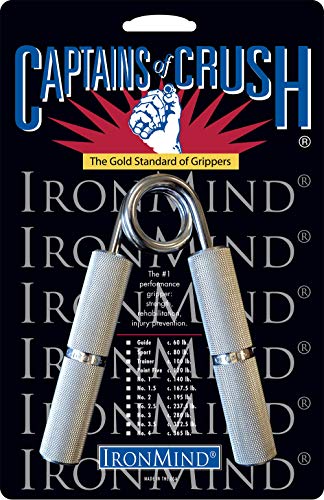
Captains of Crush Gripper
A knurled aluminum-handled torsion-spring gripper sold in graduated resistance levels, widely used for crush grip training.

TheraBand Hand Exerciser
A set of progressive resistance hand bands that train both closing and opening of the hand, useful for balanced flexor and extensor work.
Questions worth asking
Do grip trainers build forearm strength?
Yes, they build strength in the flexor muscles that close the hand, which are a major part of the forearm. They do not train the extensors on the back of the forearm or wrist rotation, so they are only one piece of a complete forearm program.
How long does it take to see forearm growth from grip trainers?
Most people notice strength gains in four to six weeks and visible size changes in three to six months, depending on training frequency, starting strength, and overall nutrition. Tendons adapt more slowly than muscle, so patience matters.
Can grip trainers make your forearms bigger?
They can add size to the flexor bundle, especially if you progressively increase resistance. The effect is modest compared with heavy compound pulling, because the total muscle mass involved in a hand squeeze is small.
Do grip trainers help with deadlifts?
They can help if your deadlift is limited by grip endurance, but the carryover is limited because deadlift grip is a support grip, while most grippers train crush grip. Heavy holds and farmer carries are more specific.
Are grip trainers bad for your wrists?
Not inherently, but heavy gripper work without extensor training can create an imbalance that contributes to wrist pain. Start light, progress slowly, and include reverse wrist curls or finger extensions.
Should you train grip every day?
No. Like any strength training, grip work needs recovery. Two to three hard sessions per week is enough for most people, with lighter mobility or extensor work on other days.
What is the difference between a gripper and a hand grip strengthener?
Both resist hand closing, but grippers usually use a torsion spring with adjustable or graduated resistance, while many hand grip strengtheners use compression springs or squeezable material. The training effect is similar, though grippers tend to allow heavier loading.
Can grip trainers improve rock climbing performance?
They can improve finger flexor endurance, but climbing demands finger strength at specific joint angles and on small holds. Hangboard training is more specific, and grippers are best used as a supplement.
Do grip trainers work the brachioradialis?
Only minimally. The brachioradialis is involved in elbow flexion with a neutral grip, so exercises like hammer curls and reverse curls target it more directly than a gripper does.
Is it better to use a gripper with high reps or low reps?
Both have a place. Low reps with heavier resistance build maximal strength, while higher reps build endurance. A mix, such as one heavy day and one higher-rep day per week, covers both.
Can grip trainers cause elbow pain?
They can if you progress too quickly or use a very heavy gripper without adequate warm-up. The flexor tendons cross the elbow, so overload can irritate them. Reduce resistance and volume if pain appears.
Do you need to train both hands with a grip trainer?
Yes, for balance and to avoid asymmetries. Even if you only need grip strength in one hand for a sport, training both sides helps maintain symmetry and reduces injury risk.
Will grip trainers help with everyday tasks like opening jars?
Yes, improved crush grip makes tasks that require closing the hand against resistance easier, including opening jars, carrying bags, and turning tools.
Can you use grip trainers if you have carpal tunnel syndrome?
Only with medical clearance. Gripping can aggravate carpal tunnel symptoms in some people, while others tolerate light exercise. A doctor or physical therapist should guide that decision.
Do grip trainers replace forearm exercises like wrist curls?
No. Wrist curls train the flexors through a larger range of motion, and reverse wrist curls train the extensors. Grippers are a useful addition, not a replacement.
How do you choose the right resistance for a grip trainer?
Start with a level you can close for five to eight controlled reps with each hand. If you cannot close it fully or your form breaks down, go lighter. Increase resistance only when you can complete all sets with good control.
Do grip trainers help with forearm endurance for sports like tennis or golf?
They can improve flexor endurance, which may help with racquet or club control, but sport-specific training and extensor work are also important to prevent imbalance.
Is it normal for your forearms to be sore after using a grip trainer?
Yes, mild soreness in the flexors is normal for a day or two after a new stimulus. Sharp pain, numbness, or pain that lasts more than a few days is a sign to back off and possibly consult a professional.
Where this leaves you
Grip trainers are a legitimate tool for building crush grip and adding some size to the flexor side of the forearm, but they are not a complete forearm solution. Use them consistently, progress slowly, and pair them with extensor and wrist rotation work to keep the joint balanced and the strength usable.
Derek Holt
Derek has a background coaching recreational and amateur athletes and has worked the sales floor at specialty fitness retailers. He focuses on equipment durability, ergonomics and realistic use cases rather than marketing claims.