Do Dead Blow Hammers Actually Reduce Rebound Better?
Yes, dead blow hammers genuinely reduce rebound far better than a solid steel or rubber mallet, and the effect is real physics rather than marketing language. The sand, steel shot, or similar loose filling inside the hollow head absorbs and dissipates impact energy internally instead of letting it bounce the head back, which is exactly what a solid-head hammer cannot do since all of its impact energy has nowhere to go but back into rebound.
Why a solid hammer head rebounds in the first place
When a solid hammer head strikes a surface, most of the kinetic energy that is not transferred into the workpiece has to go somewhere, and in a rigid, mostly elastic material that energy sends the head bouncing back toward the user. This is normal physics for any dense solid striking a surface, not a flaw specific to any one hammer brand.
How the loose internal filling changes that outcome
Inside a dead blow hammer, the sand or steel shot is free to shift and collide with itself and the inner cavity walls on impact, converting a large portion of that rebound energy into internal friction and heat instead of sending it back out through the head. This is the same basic principle behind a dead blow mechanism in other impact tools, not unique to hammers.
Why this matters more for precision and control work
Reduced rebound means a single, controlled strike actually stays a single strike instead of bouncing and risking a second unintended contact with the workpiece, which matters a lot when setting bearings, aligning parts, or working near a finished surface where a bounced second hit could cause damage or marring.
Does the type of filling material make a measurable difference?
Steel shot generally deadens rebound slightly better than sand because of its higher density and more efficient energy absorption per strike, though both materials clearly outperform a solid head of the same overall weight in rebound testing and real-world feel.
Why dead blow hammers still have real limitations
The same internal filling that kills rebound also means the hammer delivers somewhat less peak transferred force per swing compared to a solid steel hammer of equal weight, since some energy is absorbed internally rather than transferred fully into the workpiece. For heavy demolition or driving large stakes, that tradeoff can mean more swings needed to accomplish the same task.
How this compares to a rubber mallet’s rebound behavior
A rubber mallet does reduce rebound somewhat through the material’s elasticity, but not nearly as effectively as a true dead blow design, since rubber still returns a meaningful portion of stored energy rather than dissipating it internally the way loose shot or sand does.

Estwing Dead Blow Hammer
A widely used dead blow hammer with a steel-shot-filled polyurethane head, commonly chosen for automotive and mechanical work where controlled, low-rebound strikes matter.
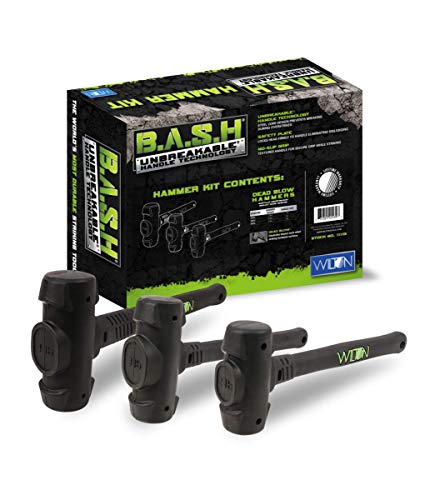
Wilton 11626 B.A.S.H Dead Blow Hammer
A heavier-duty dead blow hammer built for shop and mechanical use, known for noticeably reduced bounce-back compared to a standard rubber mallet of similar weight.
Questions worth asking
What is actually inside a dead blow hammer that stops the rebound?
Most dead blow heads contain loose sand or small steel shot inside a sealed cavity, and that loose material’s internal movement on impact absorbs energy that would otherwise bounce the head back.
Is a steel shot dead blow hammer better than a sand-filled one?
Steel shot generally deadens rebound slightly more effectively due to its higher density, though both perform noticeably better than a solid head of comparable weight.
Can a dead blow hammer damage a surface less than a regular hammer?
Yes, both because the outer head material is usually a softer polyurethane or rubber, and because the reduced rebound means less chance of an uncontrolled second impact.
Do dead blow hammers lose their effectiveness over time?
If the internal filling settles unevenly or the head cracks and loses filling, the dead blow effect can diminish, which is why cracked or visibly damaged dead blow hammers should be retired.
Why would someone choose a regular hammer over a dead blow for some tasks?
For tasks needing maximum force transfer per swing, like driving large stakes or heavy demolition, a solid steel hammer delivers more usable impact force than a dead blow of the same weight.
Is a dead blow hammer safer to use than a standard hammer?
The reduced rebound does lower the risk of an uncontrolled bounce striking the user’s hand or arm, which many mechanics and technicians consider a meaningful safety advantage during close precision work.
Do dead blow hammers work well for striking chisels?
They are generally not the first choice for striking chisels, since some rebound-free hammers trade off peak transferred force, making a standard mallet or hammer better suited to repeated chisel strikes needing consistent force.
Can you repair a dead blow hammer if the head cracks?
Most dead blow heads are not designed to be opened and resealed reliably, so a cracked head typically means replacing the hammer rather than attempting a repair.
Is there a weight range where dead blow hammers work best?
Lighter to mid-weight dead blow hammers, roughly one to three pounds, are most common for mechanical and automotive work, while heavier dead blow mallets exist for alignment and installation tasks needing more force with control.
Do dead blow hammers make less noise than solid hammers?
Yes, the dampened impact and softer outer material typically produce a noticeably quieter strike compared to a steel-faced hammer hitting the same surface.
Can dead blow hammers be used on metal surfaces without marring them?
Many dead blow heads use a non-marring polyurethane or similar polymer shell specifically so they can strike finished metal or painted surfaces without leaving marks, unlike a bare steel hammer face.
Why do mechanics commonly prefer dead blow hammers for bearing work?
The combination of reduced rebound and a non-marring head makes dead blow hammers well suited to seating bearings and similar precision parts where a bounced second hit could misalign the piece.
Is a heavier dead blow hammer always better for reducing rebound?
Not necessarily, since rebound reduction depends more on the internal filling design than overall weight, though a heavier dead blow does deliver more absolute force per controlled strike.
Do temperature extremes affect how well a dead blow hammer performs?
Very cold temperatures can make the outer polyurethane shell slightly more brittle and less compliant, though the internal filling’s rebound-dampening effect itself is not significantly temperature-sensitive.
Can you tell a dead blow hammer’s filling has shifted or settled by sound?
Yes, shaking a dead blow hammer and listening for the characteristic shifting sound of loose shot or sand is a simple way to confirm the filling is still intact and has not clumped or leaked.
Do dead blow hammers require any special maintenance compared to a regular hammer?
Not much, since the sealed head needs no lubrication or adjustment, though keeping the outer polyurethane shell clean of solvents or petroleum products helps avoid the premature softening or cracking that can eventually let the internal filling escape.
Is a dead blow hammer a reasonable all-purpose choice for a home toolbox?
Yes, for most household and light automotive tasks a mid-size dead blow hammer covers a wide range of jobs safely, though a standard claw hammer is still worth keeping on hand for driving and pulling nails, which a dead blow head is not designed for.
Can a dead blow hammer be used to strike another metal tool, like a punch or chisel handle?
It can for light tapping, but the softer polyurethane face and the energy-absorbing design mean less force transfers into the punch compared to a steel hammer, so for driving a punch with real authority a standard hammer is generally the better choice.
Where this leaves you
The dead blow design is one of the rare cases where the marketing claim matches the actual physics cleanly. The tradeoff is honest too, you give up some peak force for a cleaner, safer, single strike, which is exactly the right trade for precision work and the wrong one for heavy demolition.
Jake Monroe
Jake worked as a residential contractor for over a decade before shifting to full-time writing. He evaluates power tools, hand tools and workshop gear through the lens of someone who has actually used them on job sites, not just read the box.