Digital Truck Battery Chargers for AGM and 24V Rigs
NOCO’s GENIUS10 fits most single-battery trucks: 10 amps, AGM and lithium profiles, plus a force mode for flat packs. Running 24V or paired batteries? Pick the NOCO GENIUS PRO 25 instead. Keep a Schumacher SC1281 in the bay for its 100 amp engine start.
Buy the NOCO GENIUS10 if your truck runs one 12V battery and you want the charger to read state of charge before picking a rate. Ten amps recovers a flat battery overnight, though it will not crank an engine on a work morning. Fleet yards and 24V rigs need more current than it can supply.
Truck batteries are awkward because they are often AGM, frequently paired, and sometimes wired in series for 24V. We compared published amperage, supported chemistries, engine start figures and the presence of repair or desulfation modes across seven digital units. Owner reports settled the close calls, especially around batteries that fall below the voltage a charger can detect.
The best picks, ranked
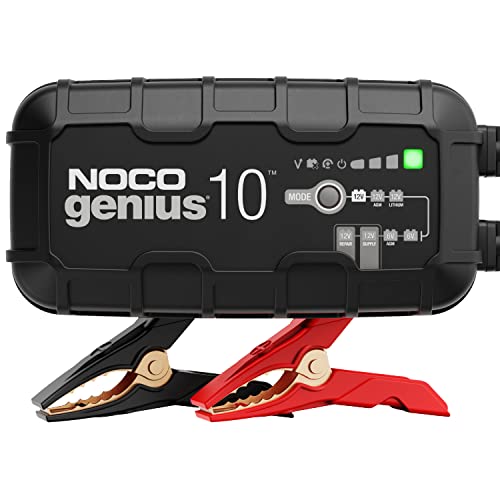
NOCO GENIUS10 Smart Battery Charger
Ten amps at 6V or 12V covers most single-battery pickups, with separate profiles for wet, AGM, EFB and lithium packs. An integrated thermal sensor trims output in summer heat and raises it below freezing. Force mode pushes current into a battery reading too low for a normal charger to detect.
Pros
- Force mode wakes batteries other chargers ignore
- Thermal sensing matches charge rate to ambient temperature
- Small enough to live in the truck toolbox
Cons
- Ten amps is slow for a paired battery setup
- No engine start burst

NOCO GENIUS PRO 25 Battery Charger
Support for 6V, 12V and 24V in one box answers series-wired trucks and winch batteries without a second charger. Twenty five amps returns a large group 31 battery to full inside a working shift. A diagnostic screen reports state of health, so you learn whether a battery deserves another winter.
Pros
- Handles the 24V systems most consumer chargers skip
- Twenty five amps refills a large battery within a shift
- Health readout flags a weak cell before it strands you
Cons
- Heavier and bulkier than a basic maintainer
- More charger than one small starter battery needs

Schumacher SC1281 Automatic Battery Charger and Engine Starter
Boost charging at 30 amps sits alongside a 100 amp engine start burst, so a dead work truck moves the same morning. Its digital panel reads out battery voltage and charge percentage instead of a single status light. Wheels and a steel case suit a garage bay rather than a truck bed.
Pros
- Cranks a flat truck without a second vehicle
- Thirty amp boost cuts recovery time to under an hour
- Numeric readout replaces guesswork on state of charge
Cons
- Steel case is too bulky to carry to a job
- Clamp leads are short for a unit this size

DEWALT DXAEC80 Battery Charger
Built around repeated daily use, this one charges at 3, 20 or 30 amps and cranks with an 80 amp start. An alternator check reads charging system output, separating a tired battery from a failing alternator. Heavy clamps bite past the corrosion that builds on work truck terminals.
Pros
- Alternator test isolates a charging system fault
- Clamps grip corroded truck terminals firmly
- Takes back-to-back charges without thermal shutdown
Cons
- No 24V support for series wired rigs
- Cooling fan is audible in a closed garage

CTEK MXS 5.0 Battery Charger
Eight charging stages finish in a float maintenance cycle rather than a constant trickle, so a parked truck keeps its battery healthy for months. Output stops at 4.3 amps, a storage rate rather than a recovery rate. Recond mode stirs stratified electrolyte in a flooded battery that sat flat too long.
Pros
- Safe to leave connected through a full winter layup
- Recond stage recovers stratified flooded batteries
- IP65 sealing tolerates a damp unheated garage
Cons
- At 4.3 amps a full recharge takes a day or more
- No engine start capability

Battery Tender 5 Amp Battery Charger and Maintainer
Five amps brings a battery up, then the charger drops to float on its own, which suits a plow rig or a second truck between jobs. Lead acid and lithium modes switch on the front panel. Alligator clips and a ring terminal harness both ship in the box, so you can hard-wire it under the hood.
Pros
- Ring harness charges without opening the hood
- Automatic float prevents overcharging during storage
- Selectable lithium mode covers newer truck batteries
Cons
- Five amps is slow on a deeply discharged battery
- LED status lights instead of a numeric display

Ampeak 12V 10A Smart Battery Charger
Ten amps at 12V and an LCD showing live voltage and current cover routine top-ups with nothing extra. Standard, AGM and repair modes handle the chemistries in most older trucks. Long term durability is the open question, and there is no lithium profile.
Pros
- Ten amps from an entry level unit
- LCD shows live voltage and current draw
- Three buttons, no menu to learn
Cons
- No lithium charging mode
- Housing feels lighter than NOCO or CTEK builds
How they compare
| # | Model | Output | Best for | Score | Price |
|---|---|---|---|---|---|
| 1 | NOCO GENIUS10 Smart Battery Charger | 10 A at 6V and 12V | Best overall | 9.4 | Check price |
| 2 | NOCO GENIUS PRO 25 Battery Charger | 25 A | Best for 24V systems | 9.2 | Check price |
| 3 | Schumacher SC1281 Automatic Battery Charger and Engine Starter | 2 A maintain, 6 A, 30 A boost | Best for jump starting | 9.0 | Check price |
| 4 | DEWALT DXAEC80 Battery Charger | 3 A maintain, 20 A, 30 A | Best for shop and fleet use | 8.8 | Check price |
| 5 | CTEK MXS 5.0 Battery Charger | 4.3 A at 12V | Best for winter storage | 8.6 | Check price |
| 6 | Battery Tender 5 Amp Battery Charger and Maintainer | 5 A at 12V | Best value | 8.4 | Check price |
| 7 | Ampeak 12V 10A Smart Battery Charger | Up to 10 A at 12V | Best budget | 8.0 | Check price |
Before you buy
How many amps do you need for a truck battery? Match the charge rate to battery capacity first. A common working rule sets the rate near ten percent of the amp hour rating, so a 100 Ah battery pairs with 10 amps. Faster rates, such as the 25 amps from the GENIUS PRO 25, shorten the wait but run the battery warmer. Anything under 5 amps belongs in the storage category, not the recovery category. Group 31 batteries and dual setups push you toward 20 amps or more.
Matching the charger to AGM, EFB or lithium Chemistry decides the voltage profile, not the brand. AGM absorbs at a slightly higher voltage than flooded lead acid, so a plain flooded setting leaves it short over months. Start-stop pickups carrying EFB batteries want their own profile as well. Lithium packs must never see a desulfation pulse, which rules out any charger without a lithium switch. Both NOCO units and the Battery Tender let you select chemistry, which is why newer trucks suit them.
Best chargers for 24V and dual battery trucks Heavy trucks and many diesels carry two batteries. Wired in series they read 24V, and only a 24V unit such as the GENIUS PRO 25 can charge them still connected. Parallel pairs stay at 12V but double the capacity, so expect roughly twice the charging time. Disconnecting one battery is the workaround when your charger tops out at 12V. Read the terminal wiring before you clip anything on.
When engine start beats charging Charging rebuilds capacity over hours at a controlled rate. Engine start delivers a short high current burst so the starter turns immediately. Schumacher’s SC1281 supplies 100 amps for that job, and the DEWALT DXAEC80 supplies 80. Use the burst sparingly, since repeated attempts heat the starter and stress an already weak battery. Any truck needing a boost every week needs a new battery, not a bigger charger.
Common questions
What amp charger is best for a truck battery?
Ten amps suits most single 12V truck batteries and recovers a flat one overnight. Move to 20 or 30 amps if you need the vehicle back within the hour or run paired batteries. Treat anything under 5 amps as a maintainer.
Can a smart charger revive a completely dead battery?
Sometimes. Force or repair modes, like the one on the NOCO GENIUS10, push current into a battery reading too low for detection. Recovery fails once a cell shorts, which shows up as a battery that will not hold voltage after charging.
How long does it take to charge a flat truck battery?
Divide the amp hours you need by the charge rate, then add about twenty percent for the absorption stage. A 100 Ah battery at 10 amps therefore needs roughly twelve hours from empty. Twenty five amps cuts that to a long afternoon.
Do I need a 24V charger for my truck?
Only when the electrical system itself runs at 24V, common on heavy commercial vehicles and equipment. Two 12V batteries wired in series produce 24V. Check the terminals before assuming, since parallel pairs stay at 12V.
Is it safe to leave a battery charger connected all winter?
With a modern automatic unit, yes. CTEK’s MXS 5.0 and the Battery Tender both switch to a maintenance stage once full instead of charging continuously. Older manual transformer chargers can boil off electrolyte and should never be left unattended.
What is the difference between a battery charger and a jump starter?
A charger restores capacity over hours at a regulated rate. Jump starting supplies a brief high current so the engine cranks, then hands the job to the alternator. Schumacher’s SC1281 does both from one housing.
Do these chargers work with AGM truck batteries?
Every pick here includes an AGM setting, the Ampeak included. AGM needs a slightly higher absorption voltage than flooded lead acid. Leaving the charger on the wrong profile shortens battery life gradually rather than immediately.
Why does my truck battery keep going flat?
Short trips, a parasitic drain from aftermarket lights or radios, and a failing alternator cause most cases. Running the alternator check on the DEWALT DXAEC80 rules out the charging system in a minute. Batteries past four or five years are often simply worn out.
NOCO GENIUS10 vs CTEK MXS 5.0: which is better?
Choose the GENIUS10 for faster recovery, 6V support and its force mode. Choose the MXS 5.0 for long layups, since the eight-stage program and recond mode target vehicles that sit. Owners with two trucks often keep one of each.
Are digital chargers worth it over old manual ones?
Yes for anything modern. Microprocessor units taper voltage, switch to float and read state of charge, which a manual transformer charger cannot do. That protection matters most with AGM and lithium, where overcharging is expensive.
Our take
For a single-battery truck, buy the NOCO GENIUS10: it wakes deeply drained batteries and adjusts its rate to the weather, which covers the two failures most owners actually hit. Series-wired 24V trucks and dual battery rigs should go straight to the NOCO GENIUS PRO 25. Anyone who has ever needed a truck running in five minutes should add a Schumacher SC1281 to the garage.
Tony Russo
Tony trained as an automotive technician and spent years in service and parts retail before moving into writing. He focuses on garage tools, car care products and accessories from a hands-on maintenance perspective.


