Zigbee Hubs Compared: Local Control vs Cloud Apps
Aeotec Smart Home Hub suits most households, carrying Zigbee 3.0 and Z-Wave Plus behind the well documented SmartThings app. Hubitat Elevation C-8 Pro fits anyone who wants rules running on the hub with no cloud account. Aqara Hub M3 earns its place where Matter bridging and infrared control both matter.
Aeotec Smart Home Hub is the sensible default for a first Zigbee mesh of sensors, bulbs and locks. A Z-Wave Plus radio rides along in the same box, and the SmartThings app pairs thousands of device models with little fuss. Cloud dependence is the weak point, since certain routines stall when broadband drops. Hubitat Elevation C-8 Pro answers that by keeping every automation on the device.
Hub shopping confuses people because Zigbee 3.0, Thread and Matter often share one enclosure without doing the same job. We compared published radio specs, antenna design, local automation support and official compatibility lists. Owner reports on mesh range and repeater behaviour shaped the order. Hubs with stalled firmware were excluded.
What to look for
What to look for in a Zigbee hub Radios come first, because they decide which accessories ever pair. Any Zigbee 3.0 coordinator covers current bulbs, buttons and contact sensors. Adding Z-Wave opens up locks and older window sensors that never shipped in Zigbee form. Wired options deserve a second look. An Ethernet port takes Wi-Fi congestion out of the equation, and Power over Ethernet cuts a cable behind a wall panel. Every platform publishes a device compatibility list, so read yours before filling a cart with sensors.
Zigbee, Thread and Matter are not the same thing Both Zigbee and Thread are low power mesh radios, yet they never speak to each other directly. Zigbee accessories join a Zigbee coordinator; Thread accessories need a Thread border router. Matter sits above both as an application layer, describing how a lock or lamp reports itself to any controller. Bridging closes the gap, which is exactly the job Aqara Hub M3 does. A Matter logo on the box guarantees nothing about the Zigbee sensors already on your shelf.
Local rules versus cloud automations Cloud logic fails during outages and slows when servers are busy. Hubitat Elevation C-8 Pro processes its rules on the hub, so motion still triggers a light with the modem unplugged. SmartThings and Alexa keep part of the logic remote, buying easier onboarding and native voice control. Response time is what owners notice day to day, often a fraction of a second against one or two seconds. Door locks, heating and security scenes are the places to insist on local execution.
Matching a hub to your home size and ecosystem Large or two storey houses benefit from external antennas and mains powered repeaters, which is why the Hubitat C-8 Pro and the SONOFF dongle both expose an antenna connector. Apartments rarely need that reach, so a compact Aqara Hub M2 covers a floor comfortably. Apple Home owners should shortlist hubs that bridge into HomeKit rather than units built around Alexa alone. Renters who cannot cut into a wall should pass on Echo Hub and pick a shelf unit. Anyone already running Home Assistant gets more from a coordinator stick than from a second app.
Our top picks
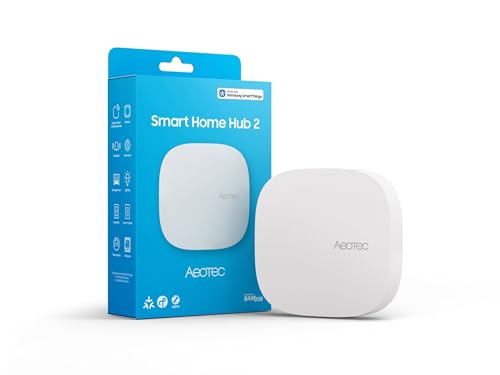
Aeotec Smart Home Hub (SmartThings Hub v3)
Aeotec builds the former SmartThings V3 hardware, so Zigbee 3.0 and Z-Wave Plus still share one enclosure. Ethernet or Wi-Fi carries the uplink, and the SmartThings app onboards thousands of certified models. Some routine types execute on Samsung servers, which means a broadband drop can stall them.
Pros
- Two mesh radios in a single box
- Compatibility list runs unusually long
- Acts as a Matter controller through SmartThings
Cons
- Several routine types depend on the cloud
- Thread accessories need a separate border router

Hubitat Elevation C-8 Pro
Rules run on the hub, so a motion sensor still switches a lamp with the modem unplugged. External antennas feed the Zigbee 3.0 and Z-Wave 800 series radios, which helps in wide or two storey floor plans. Rule Machine offers conditional depth app first platforms rarely match, at the cost of a steeper first week.
Pros
- Automations survive an internet outage
- Detachable antennas can be upgraded
- Conditional logic nests several layers deep
Cons
- Setup rewards patience and documentation
- Voice assistant links take extra configuration

Aqara Hub M3
M3 exists to bridge, exposing Zigbee 3.0 sensors to Matter controllers such as Apple Home and Alexa. A Thread border router sits beside the Zigbee radio, and Power over Ethernet reduces the uplink to one cable. Its 360 degree infrared blaster takes over older air conditioners and televisions.
Pros
- Zigbee sensors appear inside Matter homes
- Infrared blaster retires old remotes
- PoE removes the second power cable
Cons
- Strongest results come with other Aqara gear
- No Z-Wave radio inside

Amazon Echo Hub
An 8 inch touch panel fronts Zigbee, Thread and Matter radios. Mounted over a standard electrical box, it becomes a wall dashboard for locks, cameras and scenes. Alexa routines take minutes to build, though they execute on Amazon servers. Speaker output stays thin, so plan a separate speaker for music.
Pros
- One panel drives scenes and camera feeds
- Zigbee and Thread share the same device
- Sits flush over a standard wall box
Cons
- Routines rely on Amazon servers
- Built in speaker stays quiet

Homey Pro (Early 2023)
Six radio technologies stack inside one aluminium puck: Zigbee 3.0, Z-Wave Plus, Thread, Matter, Bluetooth and infrared. Legacy 433 MHz and 868 MHz support revives older alarm sensors and garage remotes. Flows run locally and chain conditions across brands that normally ignore each other. Fewer owners also means fewer troubleshooting threads to lean on.
Pros
- Covers nearly every home radio protocol
- Flow engine executes on the device
- Old remotes and alarm sensors keep working
Cons
- Community is smaller than SmartThings
- Ethernet arrives through a separate adapter

SONOFF Zigbee 3.0 USB Dongle Plus (ZBDongle-P)
This is a coordinator stick rather than a standalone hub, so it needs a host running Home Assistant or Zigbee2MQTT. A Texas Instruments CC2652P chip and a 2 dBi external antenna deliver mesh performance well beyond the size. Owners can reflash firmware, which keeps the stack current for years. Nothing works until the host software is set up.
Pros
- Lowest barrier into an open Zigbee mesh
- External antenna lifts usable range
- Firmware can be reflashed by the owner
Cons
- A host computer is mandatory
- No app or interface of its own

Aqara Hub M2
Up to 128 Zigbee 3.0 child devices can join M2, which also packs an infrared blaster and a siren. Ethernet or Wi-Fi handles the uplink, and paired sensors bridge into Apple Home, Alexa and Google Home. Matter bridging arrived through a firmware update. Thread accessories still require a separate border router.
Pros
- Large sensor count on one coordinator
- Siren covers basic alarm duty
- Bridges to all three voice platforms
Cons
- No Thread radio on board
- Infrared needs clear line of sight
How they stack up
| # | Model | Radios | Best for | Score | Price |
|---|---|---|---|---|---|
| 1 | Aeotec Smart Home Hub (SmartThings Hub v3) | Zigbee 3.0 and Z-Wave Plus | Best overall | 9.4 | Check price |
| 2 | Hubitat Elevation C-8 Pro | Zigbee 3.0 and Z-Wave 800 series | Best for local control | 9.2 | Check price |
| 3 | Aqara Hub M3 | Zigbee 3.0, Thread, Wi-Fi, Bluetooth | Best for Matter bridging | 9.0 | Check price |
| 4 | Amazon Echo Hub | 8 inch touchscreen | Best for Alexa households | 8.8 | Check price |
| 5 | Homey Pro (Early 2023) | Zigbee 3.0, Z-Wave Plus, Thread, Matter | Best for mixed protocol homes | 8.6 | Check price |
| 6 | SONOFF Zigbee 3.0 USB Dongle Plus (ZBDongle-P) | Texas Instruments CC2652P | Best budget | 8.4 | Check price |
| 7 | Aqara Hub M2 | Up to 128 child devices | Best value | 8.2 | Check price |
Common questions
Do I need a Zigbee hub if I already own an Echo?
Certain Echo models carry a Zigbee radio, including Echo Hub and Echo Show 10. Those handle basic bulbs and plugs. A dedicated hub adds wider device support, local rules and readable logs.
What range does a Zigbee hub cover indoors?
Plan on roughly 10 to 20 metres from the coordinator, less through brick, concrete or foil backed insulation. Every mains powered Zigbee device repeats traffic, so each plug extends the mesh further out.
Can a Zigbee hub work without internet?
Hubitat and Homey Pro keep automations running with the line down. SmartThings and Alexa based hubs lose part of their logic. Remote app access stops on every platform during an outage.
Which Zigbee hub works with Apple Home?
Aqara Hub M3 and Aqara Hub M2 both bridge Zigbee sensors into Apple Home. Homey Pro exposes devices through Matter. Hubitat relies on a community integration for HomeKit.
Is Zigbee better than Z-Wave for a first smart home?
Zigbee accessories are more plentiful and easier to source locally. Z-Wave runs on a less crowded sub gigahertz band, which helps in dense apartment blocks. Dual radio hubs such as the Aeotec unit sidestep the choice.
How many devices can one Zigbee hub handle?
Aqara Hub M2 lists 128 child devices. Hubitat and SmartThings cope with several hundred, though mesh stability matters more than the headline figure. Add mains powered repeaters as counts climb.
Do Zigbee bulbs act as repeaters?
Mains powered bulbs generally do repeat traffic. Older units from a few brands repeat badly and drop messages from other makers. Smart plugs make steadier repeaters for a mixed brand mesh.
Can you run two Zigbee hubs in the same house?
Yes, and migrations usually involve exactly that. Put each coordinator on a different Zigbee channel so they stop competing. Any single device joins one coordinator at a time.
What is the difference between a Zigbee hub and a Zigbee dongle?
A hub ships with its own app, storage and automation engine. Dongles such as the SONOFF ZBDongle-P only provide the radio, leaving Home Assistant or Zigbee2MQTT to supply the brains.
Does a Zigbee hub need to sit near the router?
Only if it uses Wi-Fi for the uplink. Ethernet models can move to the centre of the floor plan, which usually beats a corner cabinet. Keep several feet between the hub and the router, since 2.4 GHz Wi-Fi overlaps Zigbee channels.
Our pick
Aeotec Smart Home Hub is the buy for most homes, covering Zigbee and Z-Wave with the least configuration and the broadest device list. Choose Hubitat Elevation C-8 Pro when offline reliability and rule depth outweigh a gentle setup. Apple Home owners who mainly want existing Zigbee sensors visible to Matter controllers should take the Aqara Hub M3 instead.
Marcus Chen
Marcus covered consumer electronics for enthusiast tech publications for six years before joining ChoiceCrest. He specializes in translating manufacturer spec sheets into plain-language buying advice, with a focus on audio, computing accessories and smart-home gear.


