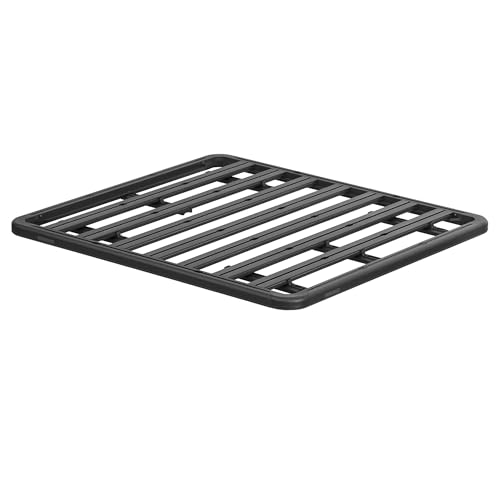
How to Match a No-Drill Roof Rack to Your Car
Thule’s WingBar Evo fits the widest range of roof types through one Evo Clamp system. Raised-rail SUVs get a tighter fit from Yakima’s JetStream on SkyLine towers. Bare-roof vehicles without rails do better with Rhino-Rack’s Vortex 2500, which clamps to the door jamb instead of drilling into the roof.
Thule’s WingBar Evo adapts to more roof types than any rack here, since its Evo Clamp feet swap between fixed points, raised rails and flush rails without a second kit. Raised-rail owners on a tighter budget often do better with Yakima’s JetStream instead, since Evo Clamp hardware costs more than single-purpose rail feet.
Searches for wireless roof racks almost always mean tool-free, no-drilling installation, not an actual wireless product, since crossbars carry no electronics. We compared mounting hardware, load ratings and roof-type fit across current Thule, Yakima, Rhino-Rack, RockyMounts, ROLA, INNO and VDP listings, weighing owner feedback on install time and wind noise.
Our top picks

Thule WingBar Evo Load Bars
Evo Clamp feet click onto fixed mounting points, raised rails, flush rails or factory tracks without drilling. A BoxBeam aluminum structure supports 220 pounds of capacity, while SmartSlides length markers speed up alignment. WindDiffuser ridges cut noise at highway speed, and SwingBlade end caps open the T-track for mounting accessories.
Pros
- Evo Clamp feet adapt to four roof types without swapping hardware
- 220 lb capacity covers cargo boxes, bike trays and kayak carriers
- WindDiffuser ridges keep highway noise lower than round bars
Cons
- Costs more than single-purpose rail or fixed-point systems
- Feet are sold separately from bars, so buyers must match the right kit

Yakima JetStream Crossbars with SkyLine Towers
SkyLine towers drop onto a vehicle’s landing pad and close in one motion, skipping tools entirely. A three-click torque wrench in the box locks the JetStream bar to the tower without over-tightening. Teardrop-shaped JetFlow profiling and built-in WindRidge trim cut noise compared with round bars.
Pros
- Tool-free tower installation with a built-in torque-limiting wrench
- SkyLine towers fit raised rails, fixed points and track systems
- Teardrop profile cuts wind noise versus round crossbars
Cons
- Dynamic load rating trails Thule’s WingBar Evo by 55 lbs
- Towers sell separately, adding a second purchase before install

Rhino-Rack Vortex 2500 Roof Rack System
Vortex 2500 legs clamp directly to door jamb edges, built for roofs with no rails or fixed points to grab. Molded glass-reinforced nylon pads hug the roof contour instead of relying on drilled holes. A key-locking RCH leg design deters theft while keeping the wing-shaped aluminum bar’s wind resistance low.
Pros
- No drilling or permanent modification needed on bare roofs
- Key-locking legs deter theft of the entire rack
- Nylon pads spread clamp pressure without denting roof edges
Cons
- 165 lb capacity trails Thule’s WingBar Evo by 55 lbs
- Door jamb clamps need periodic rechecking for tightness
RockyMounts Ouray Crossbars with Flagstaff Towers
Flagstaff towers pair only with RockyMounts’ own Ouray bar, and all mounting hardware ships in the box, so no separate tools are needed. Anodized aluminum walls run about 20 percent thicker than many rival bars, adding strength for bike, kayak and cargo box mounts. Stainless steel straps from most third-party racks clamp directly onto the bar’s tapered profile.
Pros
- Thick-wall aluminum adds strength for accessory-heavy loads
- Compatible with square, round and aero-mount bike or kayak racks
- Anodized finish resists corrosion better than painted steel
Cons
- Ouray bars mount only to RockyMounts’ own tower system
- 165 lb rating matches rather than exceeds most rivals here

ROLA R6005 FPE Series Extreme Cross Bar Roof Rack
Support legs on each 53 inch bar slide inside underside channels, letting owners match leg spacing to their vehicle’s fixed mounting points. Extruded aluminum construction keeps drag and wind noise down compared with bolt-on steel racks. A T-slot along the top accepts channel-mounted carriers and most universal accessory clamps.
Pros
- Slide-adjustable legs fit a range of fixed-point spacings on one bar
- Extruded aluminum construction cuts weight versus steel racks
- T-slot accepts channel-mounted accessories without extra brackets
Cons
- Limited to vehicles with factory fixed mounting points, not bare roofs
- Rubber T-slot insert can loosen after repeated accessory swaps

INNO XS201 Aero Base Stays with XB100 Aero Bar
Base stays sit 2 7/8 inches tall, among the lowest profiles available for flush-roof mounting. A built-in torque knob tightens each stay to the roof edge by hand and stops once it reaches correct clamp force. Locks and keys ship with the stays, and the short stack height keeps wind noise low at highway speed.
Pros
- Low 2 7/8 inch stay height reduces drag and wind noise
- Torque knob prevents over-tightening without a separate tool
- Locking hardware included at this price point
Cons
- Only fits smooth, flush roofs, not raised rails or rain gutters
- Aero bar and mounting hooks sell as separate add-ons
VDP L120 Aluminum Roof Rack Rails
VDP’s L120 clamps onto a vehicle’s existing raised roof rails, arriving pre-assembled with two 120 cm bars and four mounting feet. A sliding guide channel along each bar lets roof boxes and U-bracket accessories reposition without extra hardware. Integrated locks secure the bars to the rails against casual theft.
Pros
- Lower cost than most aluminum aero-bar systems in this group
- Pre-assembled bars need only clamping to the rails, no assembly
- Integrated locks secure bars without a separate cable lock
Cons
- Requires existing raised rails; won’t fit bare or fixed-point roofs
- Round bar profile carries more wind noise than aero-shaped bars
How to choose
What Tool-Free Actually Means on a Roof Rack Clamp-on roof racks skip permanent drilling by gripping a vehicle’s existing rails, factory points or door jambs instead. Most kits still ship with a wrench or torque tool in the box, even when the listing says tool-free installation. That included tool usually just tightens a clamp, not a fastener driven into sheet metal. Removing the whole rack later leaves no holes behind, unlike older drilled crossbar systems.
Matching Mounting Feet to Your Roof Type Raised side rails sit above the roofline and accept clamp-on feet like Yakima’s SkyLine tower or VDP’s L120. Flush rails sit level with the roof and need a different foot, since a raised-rail clamp won’t grip them. Bare roofs with no rails at all require door jamb clamps, the approach Rhino-Rack’s Vortex 2500 and INNO’s XS201 both use. Fixed mounting points, small factory studs under trim caps, work with adjustable-leg systems such as ROLA’s FPE Series Extreme.
Load Capacity and Crossbar Shape by Cargo Type Aero-shaped bars like the WingBar Evo and JetStream cut wind noise and fuel drag versus round tubes. Round bars, like VDP’s L120, cost less but generate more whistle at highway speed. Cargo boxes and loaded bike trays benefit from the 220 lb rating on Thule’s WingBar Evo. Kayaks and single bikes stay well within the 165 lb rating shared by most other systems here.
Accessory Compatibility, Locks and Factory Crossbar Replacement Bike and kayak carriers made by Thule, Yakima or RockyMounts generally clamp onto any square, round or aero crossbar regardless of brand. T-slot systems, found on the WingBar Evo and FPE Series Extreme, accept channel-mounted accessories without extra brackets. Owners replacing worn factory crossbars should confirm their vehicle’s roof type first, since a rail-only rack won’t fit a bare-roof SUV. Locking legs or integrated bar locks matter most for vehicles parked outdoors overnight.
Side by side
| # | Model | Material | Best for | Score | Price |
|---|---|---|---|---|---|
| 1 | Thule WingBar Evo Load Bars | Aluminum (BoxBeam construction) | Best Overall | 9.4 | Check price |
| 2 | Yakima JetStream Crossbars with SkyLine Towers | Aluminum (JetFlow teardrop profile) | Best for Raised Factory Side Rails | 9.2 | Check price |
| 3 | Rhino-Rack Vortex 2500 Roof Rack System | Aluminum bars, glass-reinforced nylon legs | Best for Bare Roofs Without Rails | 9.0 | Check price |
| 4 | RockyMounts Ouray Crossbars with Flagstaff Towers | Anodized aluminum, thick-wall construction | Best for Bike and Cargo Accessory Mounting | 8.8 | Check price |
| 5 | ROLA R6005 FPE Series Extreme Cross Bar Roof Rack | Extruded aluminum alloy | Best for Factory Fixed Mounting Points | 8.5 | Check price |
| 6 | INNO XS201 Aero Base Stays with XB100 Aero Bar | Aluminum aero bar, reinforced base stays | Best Aerodynamic Fit for Smooth Roofs | 8.2 | Check price |
| 7 | VDP L120 Aluminum Roof Rack Rails | Aluminum, round tube bars | Best Budget Pick | 8.0 | Check price |
Frequently asked questions
What do people actually mean by a wireless roof rack?
Roof racks carry no electronics or wiring, so the search almost always means tool-free, no-drilling installation. Clamp-on crossbar systems like these fit that description without any wireless component involved.
How do tool-free roof racks attach without drilling?
They clamp onto existing raised rails, flush rails, fixed mounting points or door jambs using spring-loaded or torque-limited feet. Most kits include a wrench or knob for tightening, but none require drilling into the roof.
Which roof rack works best for raised factory side rails?
Yakima’s JetStream on SkyLine towers and VDP’s L120 both clamp directly onto raised rails. Yakima’s tool-free tower costs more but supports a wider range of Yakima accessories.
Can I install a roof rack on a car with no rails at all?
Yes, bare-roof systems like Rhino-Rack’s Vortex 2500 and INNO’s XS201 clamp to the door jamb edge instead of a rail. Confirm your roof is smooth and flush before ordering either one.
What’s the difference between aero, round and square crossbars?
Aero bars taper to reduce wind noise and drag at highway speed, while round and square bars trade quiet running for lower cost. Square bars also accept the widest range of older, clamp-style bike and cargo accessories.
Is a locking roof rack worth it for theft prevention?
Integrated locks on VDP’s L120 and Rhino-Rack’s key-locking RCH legs stop casual theft of the whole rack, not just the cargo. Vehicles parked outdoors overnight benefit most from this feature.
Yakima JetStream vs Thule WingBar Evo, which fits more roof types?
Thule’s WingBar Evo covers fixed points, raised rails, flush rails and tracks with one Evo Clamp system. Yakima’s JetStream needs a specific tower, SkyLine or otherwise, matched to each roof type.
How much weight can a clamp-on roof rack safely carry?
Most systems here cap out between 165 and 220 lbs, but your vehicle’s owner manual may set a lower roof limit. Always follow whichever number is smaller, the rack’s rating or the vehicle’s.
How long does installing a clamp-on roof rack take?
Tool-free towers like Yakima’s SkyLine or Thule’s Evo Clamp typically go on in under 30 minutes per side once the correct feet are matched to the roof. Slide-adjustable systems like ROLA’s FPE Series Extreme take a bit longer, since leg spacing needs setting first.
Our pick
Thule’s WingBar Evo remains the strongest pick for most drivers, since its Evo Clamp feet adapt to fixed points, raised rails and flush rails without buying a second kit. Owners with raised factory side rails and a tighter budget should choose Yakima’s JetStream on SkyLine towers instead, which costs less than switching Evo Clamp feet later. Drivers with a bare roof and no rails at all get a better fit from Rhino-Rack’s Vortex 2500, which clamps to the door jamb rather than a rail that isn’t there.
Tony Russo
Tony trained as an automotive technician and spent years in service and parts retail before moving into writing. He focuses on garage tools, car care products and accessories from a hands-on maintenance perspective.