Wireless Digital Battery Chargers That Actually Deliver
For most drivers, the NOCO Genius 5 stands out as the best wireless digital battery charger because it combines a smart digital display with robust multi-battery support and a proven track record. Its main advantage is the ability to automatically detect 6V and 12V batteries and deliver a precise charging profile without manual settings. The main limitation is that it does not include a carrying case, which some owners find inconvenient for storage.
A dead battery is a hassle, but a smart charger can prevent it. Wireless digital battery chargers simplify maintenance by automatically adjusting voltage and current. They also provide clear feedback through digital displays, so you know exactly what is happening.
This roundup covers seven top-rated models from trusted brands. Whether you need a compact unit for occasional use or a heavy-duty charger for multiple vehicles, there is an option here. We highlight strengths and weaknesses to help you choose wisely.
What we recommend
NOCO Genius 5
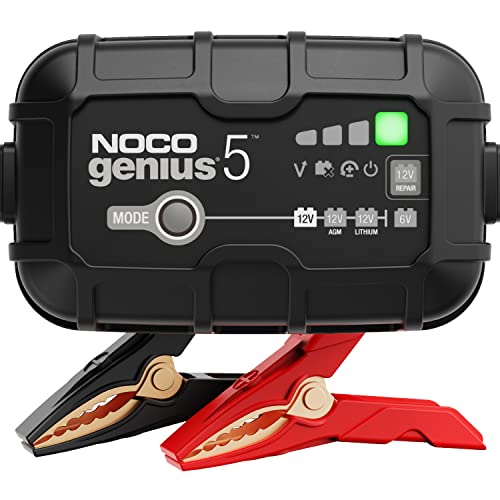
The NOCO Genius 5 is a 5-amp smart charger that works with 6V and 12V lead-acid and lithium batteries. It features a backlit digital display that shows charging status and battery health. Its automatic voltage detection and multi-stage charging make it a versatile choice for cars, motorcycles, and boats.
Pros
- Automatic voltage detection
- Works with lithium batteries
- Clear digital display
Cons
- No carry case included
- Cables are relatively short

Battery Tender Plus 021-0128
The Battery Tender Plus is a 1.25-amp charger that is ideal for maintaining batteries during storage. It uses a four-step charging program and has a digital status indicator. While it lacks a full digital screen, its LED lights clearly communicate charging stages.
Pros
- Compact and affordable
- Maintains battery without overcharging
- Trusted brand
Cons
- Low amperage slows charging
- No display for voltage

Schumacher SC1281
The Schumacher SC1281 is a 15-amp charger with a large digital display and a 40-amp engine start mode. It supports 6V and 12V batteries, including AGM and gel. Its robust design and high output make it suitable for larger vehicles and frequent charging.
Pros
- High charge rate
- Engine start mode
- Large easy-to-read display
Cons
- Bulky and heavy
- More expensive

CTEK MXS 5.0
The CTEK MXS 5.0 is a 5-amp charger that offers a patented automatic reconditioning mode to revive deeply discharged batteries. It features a digital display and a range of programs for different battery types. Its rugged design is built for workshop use.
Pros
- Reconditioning mode
- Weather-resistant housing
- Multiple charging programs
Cons
- No carrying handle
- Cables may be short for some users
Black+Decker BM3B
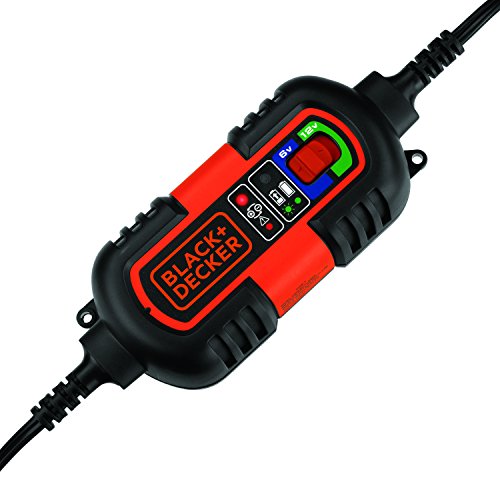
The Black+Decker BM3B is a 3-amp charger that is compact and easy to store. It includes a digital display and a built-in battery clamp that connects directly to the battery. It is designed for 12V lead-acid batteries and offers simple plug-and-play operation.
Pros
- Very compact
- Easy to use
- Integrated clamps
Cons
- Not for large batteries
- Limited features

NOCO Genius 1
The NOCO Genius 1 is a 1-amp charger that is perfect for small batteries like those in motorcycles, ATVs, and lawn mowers. It is fully automatic and features a digital display that shows charging status. Its tiny footprint makes it easy to keep on a shelf or in a tool bag.
Pros
- Ultra-compact
- Works with lithium batteries
- Automatic charging
Cons
- Very low amperage
- Not for large batteries

Optimate 4
The Optimate 4 is a 4-amp charger that specializes in maintaining batteries over long periods. It uses a patented desulfation mode to recover sulfated batteries. The digital display provides clear status updates, and its weatherproof case makes it suitable for outdoor use.
Pros
- Desulfation mode
- Weatherproof
- Great for seasonal storage
Cons
- Not as powerful as some competitors
- Price is higher for the amperage
The lineup, side by side
| # | Model | Output | Best for | Score | Price |
|---|---|---|---|---|---|
| 1 | NOCO Genius 5 | 5 amps | Best overall for most vehicles | 9.4 | Check price |
| 2 | Battery Tender Plus 021-0128 | 1.25 amps | Best for simple maintenance charging | 8.8 | Check price |
| 3 | Schumacher SC1281 | 15 amps | Best for heavy-duty use with multiple battery types | 9.2 | Check price |
| 4 | CTEK MXS 5.0 | 5 amps | Best for advanced battery diagnostics | 9.0 | Check price |
| 5 | Black+Decker BM3B | 3 amps | Best for portability and convenience | 8.5 | Check price |
| 6 | NOCO Genius 1 | 1 amp | Best for motorcycles and small batteries | 8.7 | Check price |
| 7 | Optimate 4 | 4 amps | Best for maintaining batteries in storage | 8.9 | Check price |
What matters most
Questions worth asking
What does ‘wireless’ mean in a battery charger?
It means the charger itself has a built-in digital control unit, so you do not need an external display or separate module. It connects directly to the battery.
Can I leave a wireless digital battery charger connected all the time?
Yes, most smart chargers are designed for maintenance and can be left connected indefinitely. They automatically switch to float mode when the battery is full.
What is the difference between a trickle charger and a smart charger?
A trickle charger provides a constant low current, which can overcharge if left on too long. A smart charger monitors the battery and adjusts current, so it is safe to leave connected.
Will these chargers work with AGM or gel batteries?
Many models support AGM and gel batteries, but you must check the specifications. Look for explicit compatibility or selectable modes.
How long does it take to charge a car battery with a 5-amp charger?
Typically, a 5-amp charger can charge a standard 50Ah battery in about 10 to 12 hours from a deeply discharged state. Smaller batteries take less time.
Are wireless digital battery chargers safe for modern vehicles with sensitive electronics?
Yes, most are spark-proof and have reverse polarity protection. However, it is wise to disconnect the battery before charging if you are concerned about electronic systems.
Can I use a charger with a lithium battery?
Only if the charger explicitly states lithium compatibility. Lithium batteries require different charging profiles, so using the wrong charger can be dangerous.
What is the difference between a battery maintainer and a battery charger?
A maintainer delivers a low current to keep a battery topped off. A charger can deliver higher current to recharge a depleted battery. Some devices do both.
Do I need to remove the battery from the vehicle to charge it?
No, you can charge it in place, but ensure the area is well-ventilated and the charger is placed on a stable surface away from the battery.
What is the warranty on these chargers?
Most brands offer a one to three-year limited warranty. Check the product listing for specific warranty details.
The bottom line
If you need a reliable all-around charger, go with the NOCO Genius 5. It offers the best balance of power, compatibility, and safety. For heavy-duty use, the Schumacher SC1281 is a strong alternative. For those with small batteries or tight budgets, the Battery Tender Plus is a solid, inexpensive choice.
Tony Russo
Tony trained as an automotive technician and spent years in service and parts retail before moving into writing. He focuses on garage tools, car care products and accessories from a hands-on maintenance perspective.