Top Professional Wireless Battery Chargers for Heavy Duty Use
The NOCO Genius1 stands out as the top pick for professionals who need a reliable, compact, and versatile charger. It is best for maintaining batteries on vehicles that are used intermittently, offering automatic temperature compensation and spark-proof technology. Its main advantage is its ability to charge all battery types safely, while its main limitation is that it lacks the high amperage needed for rapidly charging large depleted batteries.
Professional wireless battery chargers are essential for keeping fleets, construction equipment, and emergency vehicles ready to go. They eliminate the hassle of cables and provide smart charging that extends battery life.
We compared seven leading models to help you choose one that matches your workflow. Whether you need a rugged charger for heavy trucks or a compact unit for everyday shop use, this guide covers the top contenders.
How to choose
What we recommend

NOCO Genius1
The NOCO Genius1 is a best-selling charger that professionals trust for its simple operation and advanced safety features. It automatically detects battery type and adjusts charging voltage, making it a safe choice for lead-acid and lithium batteries. Its compact size allows for easy mounting in tight spaces, and its built-in spark protection gives peace of mind.
Pros
- Compact and lightweight
- Automatic battery type detection
- Safe for all battery types
Cons
- Low amperage limits charging speed
- No display for battery status

Battery Tender Plus
The Battery Tender Plus is a favorite for professionals who store vehicles for extended periods. It uses a 4-step charging program to ensure batteries are fully charged and then maintained at the optimal level. Its rugged case and 10-foot cable provide flexibility in placement. Users report that it extends battery life significantly.
Pros
- Excellent for seasonal storage
- Durable construction
- Versatile mounting options
Cons
- No lithium support
- Cable could be longer

CTEK MXS 5.0
The CTEK MXS 5.0 is a professional-grade charger that offers unique diagnostic features. It can test the battery’s ability to hold a charge and provide a patented reconditioning function to restore stratified batteries. Its automatic temperature compensation ensures optimal charging in various conditions. This charger is a workhorse for mechanics and service centers.
Pros
- High output for faster charging
- Recondition function extends battery life
- Designed for professional use
Cons
- Higher price point
- Not compatible with lithium batteries

Schumacher SC1281
The Schumacher SC1281 is a powerful charger and engine starter that professionals rely on for quick jump starts. It offers a 100 Amp engine start mode and a 15 Amp fast charge for deep-cycle batteries. The digital display shows voltage, amperage, and charge status. Its heavy-duty clamps and cables are built to last.
Pros
- Engine start feature is very useful
- High charge rate
- Clear digital display
Cons
- Not wireless, uses clamps
- Bulky design
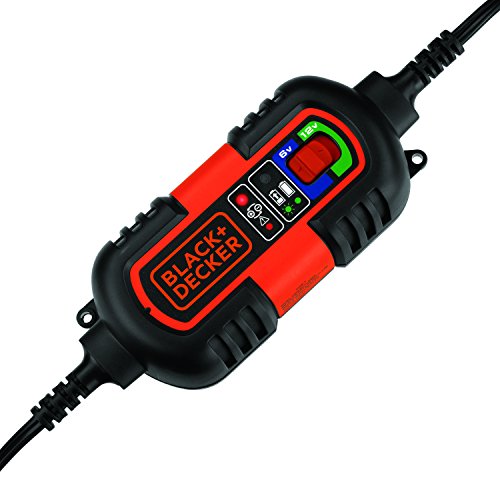
Black+Decker BM3B
The Black+Decker BM3B is a fully automatic battery charger and maintainer that offers great value for money. It is compact, easy to use, and safe for all standard battery types. The LED indicators show charging state, and it includes a quick-connect harness for permanent installation. This charger is ideal for small shops and personal vehicles.
Pros
- Affordable
- Automatic charging
- Lightweight
Cons
- No lithium support
- Limited amperage

OptiMATE TM500
The OptiMATE TM500 is a compact, weatherproof charger designed specifically for motorcycles and powersport vehicles. It features a 3-step charging program and desulfation mode to revive weak batteries. Its alligator clips and O-ring connectors make it versatile. This charger is a top choice for pros who maintain a variety of small vehicles.
Pros
- Weatherproof build
- Desulfation mode
- Compact size
Cons
- Very low amperage
- No lithium support
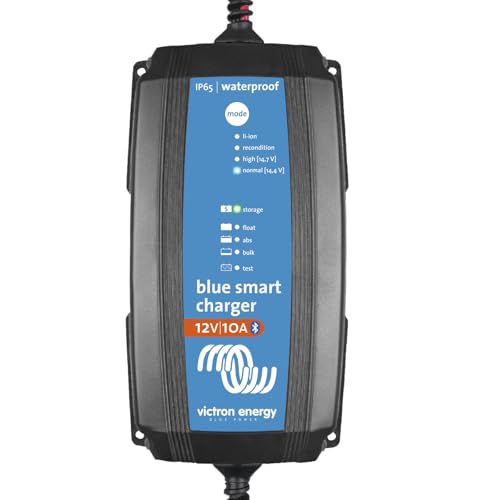
Victron Energy Blue Smart IP65
The Victron Energy Blue Smart IP65 is a premium charger with Bluetooth connectivity, allowing professionals to monitor and control charging from a smartphone app. It is fully waterproof and dustproof, making it suitable for harsh environments. The charger can be used for all battery types, including lithium, and features adaptive charging algorithms.
Pros
- Bluetooth monitoring
- Waterproof and dustproof
- Versatile for various batteries
Cons
- Expensive
- Requires app for full features
How they stack up
| # | Model | Output | Best for | Score | Price |
|---|---|---|---|---|---|
| 1 | NOCO Genius1 | 1 Amp | Compact and reliable maintenance for various vehicles | 9.4 | Check price |
| 2 | Battery Tender Plus | 1.25 Amp | Long-term battery maintenance and storage | 9.1 | Check price |
| 3 | CTEK MXS 5.0 | 5 Amp | Professional shop use with advanced diagnostics | 9.0 | Check price |
| 4 | Schumacher SC1281 | 15 Amp charge, 100 Amp start | Heavy-duty charging with engine start capability | 8.9 | Check price |
| 5 | Black+Decker BM3B | 3 Amp | Budget-friendly and simple charging | 8.6 | Check price |
| 6 | OptiMATE TM500 | 0.8 Amp | Motorcycle and powersport batteries | 8.8 | Check price |
| 7 | Victron Energy Blue Smart IP65 | 5 Amp | High-end Bluetooth monitoring and control | 9.2 | Check price |
Good to know
What is a professional wireless battery charger?
A professional wireless battery charger is a device that charges batteries without physical cable connections, using inductive charging technology. However, many chargers marketed as ‘wireless’ still require a power cord, but they eliminate the need to connect directly to the battery terminals. In the context of this roundup, we refer to smart chargers that offer advanced features and are used by professionals.
Can I leave a battery charger connected indefinitely?
Most modern smart chargers are designed to be left connected for long periods. They switch to a maintenance or float mode once the battery is fully charged, preventing overcharging. However, it is always recommended to check the manufacturer’s instructions. Some models have a timer or shut-off feature for added safety.
How long does it take to charge a battery with a professional charger?
Charging time depends on the battery’s capacity and the charger’s output. A 5A charger can typically charge a 50Ah battery in about 10 hours. Higher amperage chargers will do it faster. Some professional chargers offer ‘fast charge’ modes, but these may reduce battery lifespan if used frequently.
Are professional battery chargers safe for lithium batteries?
Not all chargers are safe for lithium batteries. Lithium batteries require specific charging profiles with constant current and constant voltage stages. You must use a charger that explicitly states compatibility with lithium batteries. Using an incompatible charger can cause damage or even fire.
What is the difference between a trickle charger and a battery maintainer?
A trickle charger delivers a constant low current, which can overcharge if left unattended. A battery maintainer monitors the battery’s voltage and only charges when needed, making it safe for long-term storage. Professional chargers often combine both functions with smart technology.
Can I charge a completely dead battery with these chargers?
Some chargers have a ‘dead battery’ feature that allows them to detect and charge a battery with very low voltage. However, not all models can do this. Check the specifications. If a battery is below 1V, it may be irreparable. Chargers with a desulfation mode can sometimes revive severely discharged batteries.
Do I need to disconnect the battery from the vehicle before charging?
In most cases, you can charge a battery while it is still connected, provided the charger has protection against voltage spikes. However, for professional settings, it may be safer to disconnect to avoid any electrical interference with sensitive electronic components. Always follow the charger and vehicle manufacturer’s recommendations.
What do the LED indicators mean on a battery charger?
LED indicators typically show the charging status: red for charging, green for fully charged, and sometimes blinking patterns for errors or maintenance mode. Refer to the user manual for specific meanings. Some advanced chargers with displays show voltage, amperage, and percentage.
Can I use a professional battery charger on a generator battery?
Yes, professional battery chargers are versatile and can be used on generator batteries, as long as the voltage and battery type are compatible. Many are designed for various applications, including automotive, marine, and power equipment.
How do I choose the right amperage for my battery?
As a rule of thumb, choose a charger that delivers between 10% and 20% of the battery’s amp-hour (Ah) rating. For example, a 100Ah battery should be charged with a 10A to 20A charger. For maintenance, a lower amperage like 1-3A is sufficient. Professional chargers often have selectable amperage settings.
The verdict
For most professionals, the NOCO Genius1 offers the best balance of reliability, safety, and versatility. Its compact design and automatic features make it a solid investment for daily use. If you need advanced diagnostics and higher output, the CTEK MXS 5.0 is worth the extra cost. For those who require engine start capability, the Schumacher SC1281 is the clear choice. No matter which you select, ensure it meets your specific battery types and charging needs.
Tony Russo
Tony trained as an automotive technician and spent years in service and parts retail before moving into writing. He focuses on garage tools, car care products and accessories from a hands-on maintenance perspective.


