Lever, Twist-On, or Sealed: Picking the Right Wire Connector
WAGO 221-412 LEVER-NUTS lead for reusable, tool-free splicing across mixed wire types. Gardner Bender WingGard 13-086 wins on value in bulk quantities. Ideal 30-076 76B wire nuts stay the cheapest reliable pick for small repairs, based on listed AWG range, voltage rating, and owner feedback.
A wire connector has to match the conductor gauge, count, and voltage of the splice, not just the brand on the box. Lever-style connectors like WAGO’s LEVER-NUTS open and close by hand, so they suit remodels where a joint might need to come apart again. Twist-on caps from Ideal and Gardner Bender still dominate new-construction work because they cost less per splice and thread onto conductors with a simple twist.
Choosing gets harder once location enters the picture, since outdoor, low-voltage, and vibration-prone wiring each demand a different seal or contact method. We compared listed AWG ranges, voltage and UL ratings, pack sizes, and owner feedback on installation ease across lever, twist-on, waterproof, IDC, and heat-shrink styles.
The shortlist, ranked

WAGO 221-412 LEVER-NUTS Compact Splicing Connector
Flip-up levers grip solid, stranded, and fine-stranded conductors from 24 to 12 AWG without a crimp tool. Clear polycarbonate housing lets you check that each wire seats fully before closing the lever. Rated 600V and 32A, it suits both new circuits and remodel splices that might get reopened later.
Pros
- Opens and reopens without cutting the splice apart
- Clear housing confirms wire insertion depth
- Accepts solid, stranded, and fine-stranded wire in one connector
Cons
- Higher per-connector cost than twist-on wire nuts
- Larger body can crowd shallow electrical boxes

Gardner Bender WingGard 13-086 Twist-On Wire Connector
A tapered square-wire spring inside this twist-on cap grips 22 to 6 AWG conductors without pre-twisting the wires. Off-center knurled wings add leverage during installation, according to the listing. Five hundred connectors per box push the per-splice cost down for contractors running multiple circuits.
Pros
- Large 500-count box lowers cost per splice
- Square-wire spring adapts to mixed wire gauges
- Flame-retardant shell holds up to 105C
Cons
- Not reusable once twisted onto conductors
- No moisture seal for outdoor splices

Ideal 30-076 Wire-Nut 76B Twist-On Connector
Electricians have relied on the 76B for decades, thanks to a fixed square-wire spring that grips two 14 AWG up to four 12 AWG conductors. It carries a 600V rating inside a 105C-rated shell. A 100-count jar keeps upfront spending low for repairs and small jobs.
Pros
- Low cost per jar for occasional repairs
- No pre-twisting needed before capping conductors
- Stocked at nearly every hardware store
Cons
- Smaller cap limits large wire bundles
- Permanent once seated, unlike lever connectors
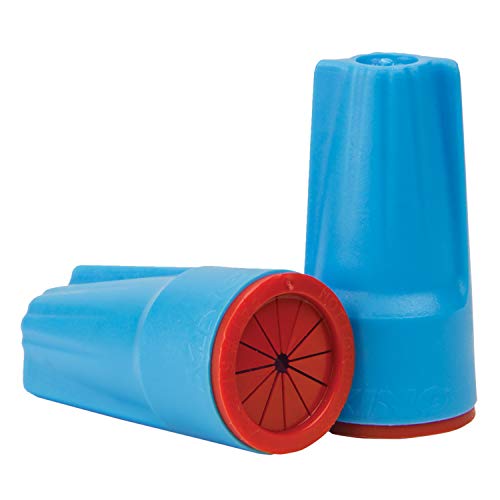
King Innovation 62225 DryConn Outdoor Electrical Wire Connector
DryConn pairs a standard twist-on wire nut with an outer cap filled with silicone gel. Sealant surrounds the splice once the cap snaps over 22 to 8 AWG conductors, blocking moisture and corrosion. Listed to UL 486D for wet locations, it turns up in landscape lighting and irrigation control wiring according to the listing.
Pros
- Silicone gel seals the splice from water and corrosion
- Two-step cap-over-nut design resists pull-apart
- UL 486D listing covers direct outdoor exposure
Cons
- Bulkier than a plain wire nut in a tight box
- Smaller 20-count bag raises cost per splice

3M Scotchlok UR2-JAR500 IDC Butt Connector
Insulation-displacement contacts pierce wire insulation, so stripping conductors before splicing isn’t necessary. Gel fill inside the shell resists moisture on 19 to 26 AWG runs. Telecom lines, alarm wiring, and thermostat circuits are common uses, though a dedicated crimp tool is required for proper seating.
Pros
- Skips wire stripping before crimping
- Gel fill resists moisture intrusion
- 500-count jar suits high-volume low-voltage jobs
Cons
- Not rated for standard 120 or 240V branch circuits
- Requires a dedicated crimp tool to seat properly

Wirefy 180 PCS Heat Shrink Butt Connectors Kit
Heat activates the adhesive lining in this butt connector kit, sealing the splice once a heat gun passes over it. Coverage spans 22 to 10 AWG, with red, blue, and yellow sizes color-coded to gauge. Owners report the crimp-plus-shrink combo holds up on boats and vehicles exposed to constant vibration.
Pros
- Adhesive lining creates a sealed, waterproof splice
- Color-coded sizes speed up gauge matching
- Crimp and heat-shrink combo resists vibration loosening
Cons
- Needs a heat gun to activate the seal
- Not tool-free for quick reopening like a lever connector

Morris Products 23476 P6-Type Screw-On Wire Connector
Sign and fixture circuits that exceed standard branch-circuit voltage call for this screw-on connector, rated up to 1000V. It handles combinations from three 18 AWG up to three 10 AWG conductors. A thick red thermoplastic shell resists cracking under heavy torque during installation.
Pros
- Rated to 1000V for fixture and sign circuits
- Thick thermoplastic shell resists cracking
- Wide wire combination range covers mixed gauges
Cons
- Overkill rating for typical 120V household splices
- Less common on store shelves than standard wire nuts
What matters most
How Are Wire Connectors Rated and Sized? Every wire connector lists a minimum and maximum AWG range alongside a voltage rating, typically 300V or 600V for household circuits. UL 486A and 486B cover standard twist-on and lever connectors, while UL 486D applies to sealed, wet-location designs. Matching that AWG range to the actual conductor count matters more than brand loyalty. A connector rated for two 12 AWG wires may not grip three of the same gauge safely.
Lever Connectors vs Twist-On Wire Nuts: Which Fits Your Job? Spring-loaded arms inside lever connectors like the WAGO 221-412 clamp conductors without twisting them together. Twist-on wire nuts, including the Ideal 76B and Gardner Bender WingGard, rely on a tapered spring inside a screw-shaped shell instead. Reopening a lever connector for troubleshooting costs nothing extra, since the arm simply lifts back up. Bulk boxes make twist-on caps cheaper per splice, though removing one usually means cutting the wires apart.
Which Wire Connector Works Best Outdoors or in Wet Locations? Standard indoor connectors aren’t built to handle rain, irrigation water, or buried soil contact. Sealed options such as the King Innovation DryConn surround the splice with silicone gel after the cap snaps closed. Look for a UL 486D listing before installing anything in a landscape lighting junction box or exposed fixture. Direct burial splices need a connector specifically rated for that use, not just a generic waterproof label.
What Connector Fits Low-Voltage, Automotive, or Fixture Wiring? Thermostats, alarms, and telecom lines often pair with small IDC connectors like the 3M Scotchlok UR2, which pierce insulation instead of requiring stripped wire. Vibration-prone automotive and marine wiring benefits from heat-shrink butt splices such as the Wirefy kit, since adhesive lining seals against moisture. Fixture and sign circuits can exceed standard 300V ratings, which is where a 1000V-rated screw-on connector like the Morris 23476 fits. Matching connector category to circuit type avoids both under-rating and unnecessary overspending.
How they stack up
| # | Model | Connector Type | Best for | Score | Price |
|---|---|---|---|---|---|
| 1 | WAGO 221-412 LEVER-NUTS Compact Splicing Connector | 2-conductor lever, tool-free | Best overall | 9.4 | Check price |
| 2 | Gardner Bender WingGard 13-086 Twist-On Wire Connector | Twist-on wire nut | Best value | 9.1 | Check price |
| 3 | Ideal 30-076 Wire-Nut 76B Twist-On Connector | Twist-on wire nut | Best budget | 8.8 | Check price |
| 4 | King Innovation 62225 DryConn Outdoor Electrical Wire Connector | Twist-on with waterproof gel cap | Best for outdoor and wet-location splices | 8.5 | Check price |
| 5 | 3M Scotchlok UR2-JAR500 IDC Butt Connector | IDC gel-filled butt splice | Best for low-voltage and telecom splicing | 8.3 | Check price |
| 6 | Wirefy 180 PCS Heat Shrink Butt Connectors Kit | Heat shrink butt splice | Best for automotive and marine wiring | 8.1 | Check price |
| 7 | Morris Products 23476 P6-Type Screw-On Wire Connector | Screw-on wire connector | Best for high-voltage fixture and sign wiring | 8.0 | Check price |
Common questions
What is the difference between a lever wire connector and a wire nut?
Lever connectors clamp conductors with a spring-loaded arm that opens and closes by hand, no twisting required. Traditional wire nuts use a screw-shaped shell with an internal spring threaded onto twisted conductors. Levers can be reopened for reuse, while wire nuts typically get cut apart during removal.
Are wire nuts still allowed by code?
Standard twist-on and lever connectors remain accepted under the National Electrical Code when installed within their listed voltage and AWG range. Local inspectors sometimes add extra requirements, so checking local amendments is worthwhile before a rough-in inspection. UL 486A, 486B, and 486D listings signal that a connector meets recognized safety standards.
Can you reuse a twist-on wire connector?
Standard twist-on wire nuts are built for a one-time connection and usually get destroyed during removal. Lever-style connectors such as the WAGO 221-412 reopen and reuse on a different set of conductors instead. Frequent reconfiguration favors a lever design over a twist-on cap.
What size wire connector do I need for 12 AWG wire?
General-purpose connectors like the Ideal 76B and Gardner Bender WingGard cover 12 AWG comfortably within their listed range. Checking the minimum and maximum wire count printed on the packaging still matters before buying. A connector below its rated capacity may not grip the conductor firmly enough.
Are wire connectors waterproof?
Most wire connectors aren’t waterproof unless specifically listed for wet locations under UL 486D. Sealed designs like the King Innovation DryConn fill the cap with silicone gel to block moisture after twisting. Standard indoor twist-on or lever connectors belong inside a dry junction box or fixture.
How many wires can fit in one wire connector?
Capacity depends on the model, with small connectors handling two or three 18 AWG wires and larger ones accepting combinations up to 10 AWG or thicker. Packaging usually states the exact minimum and maximum wire combinations allowed. Exceeding that rated count risks a loose connection that can overheat.
WAGO lever nuts vs wire nuts, which is better?
WAGO lever nuts allow tool-free, reusable splicing and suit connections that might need reopening later. Traditional wire nuts from brands like Ideal cost less per connector and remain familiar to most electricians for permanent splices. Budget, reuse needs, and personal preference decide which one fits a given job.
Do wire connectors work for outdoor lighting?
Standard wire connectors aren’t suited for outdoor lighting unless the fixture housing itself blocks moisture completely. Exposed outdoor junctions call for a sealed connector like King Innovation DryConn or another UL 486D-listed design. Irrigation and landscape lighting installers commonly choose gel-filled connectors for that reason.
What is the best wire connector for automotive wiring?
Heat-shrink butt connectors, such as the Wirefy kit, suit automotive and marine wiring because adhesive-lined tubing seals against vibration and moisture. Crimping first, then heating the tubing, locks the splice in place. Standard twist-on wire nuts aren’t designed to withstand constant vehicle vibration.
Can low-voltage wiring use the same connectors as household circuits?
Low-voltage runs for thermostats, alarms, and telecom lines typically use smaller IDC connectors like the 3M Scotchlok UR2 instead of standard wire nuts. IDC connectors pierce insulation without stripping, which speeds up high-volume low-voltage work. Standard 600V twist-on or lever connectors work fine on low-voltage circuits too, though their larger size can be less practical.
Our take
WAGO 221-412 LEVER-NUTS remain the easiest reusable choice for household rewiring and remodel splices across mixed wire types. Budget-conscious or bulk jobs favor the Gardner Bender WingGard or Ideal 76B twist-on connectors instead. Outdoor, low-voltage, and automotive splices call for the sealed, IDC, or heat-shrink designs built for those specific conditions.
Jake Monroe
Jake worked as a residential contractor for over a decade before shifting to full-time writing. He evaluates power tools, hand tools and workshop gear through the lens of someone who has actually used them on job sites, not just read the box.


