How to Choose a Welding Jacket for Your Weld Process
Heavy MIG and stick welders get the most protection from the Lincoln Electric K2986 leather jacket. TIG welders benefit from the slimmer Tillman 3281 cowhide cut. Most home shops do well with the Black Stallion JF1465 FR cotton jacket, which balances breathability against spark exposure without leather’s bulk.
Sparks that reach skin through a thin jacket defeat the entire purpose of wearing one. Weld process, ambient heat, and time spent at the bench should drive the material choice, not price alone.
Leather blocks slag better but traps heat, while FR cotton breathes yet wears faster near heavy spatter. We compared listed materials, closures, and sizing across seven Amazon jackets, weighing manufacturer specs against owner feedback, to sort which suits which job.
Our top picks

Black Stallion JF1465 FR Cotton Welding Jacket
This 9 oz FR cotton jacket suits light to medium MIG and stick jobs without overheating the wearer. A snap front closure and two chest pockets keep tools within reach. Owners report it holds flame resistance through repeated washes.
Pros
- Breathes better than leather in warm shops
- Machine washable per listing care instructions
- Lightweight enough for all-day wear
Cons
- Less slag resistance than leather
- Not rated for heavy overhead welding

Lincoln Electric Leather Welding Jacket K2986
Full grain leather on this jacket blocks spatter and radiant heat during high-amperage stick and MIG passes. Kevlar-stitched seams resist burn-through where thread normally fails first. Snap closures at the collar and cuffs seal out falling slag.
Pros
- Strong resistance to slag and spatter
- Kevlar seams outlast standard stitching
- Reinforced shoulders support overhead work
Cons
- Heavier and warmer than FR cotton
- Needs a break-in period before the leather softens

Tillman 3281 Top Grain Cowhide Welding Jacket
A slimmer cut from top grain cowhide suits close TIG work where dexterity matters most. Foam-padded shoulders reduce fatigue during long overhead sessions. A two-piece back panel allows more shoulder movement than boxier leather jackets.
Pros
- Closer fit aids fine TIG control
- Padded shoulders ease overhead fatigue
- Cowhide resists small spatter well
Cons
- Less coverage than longer leather coats
- Sizing runs slightly small per buyer reports
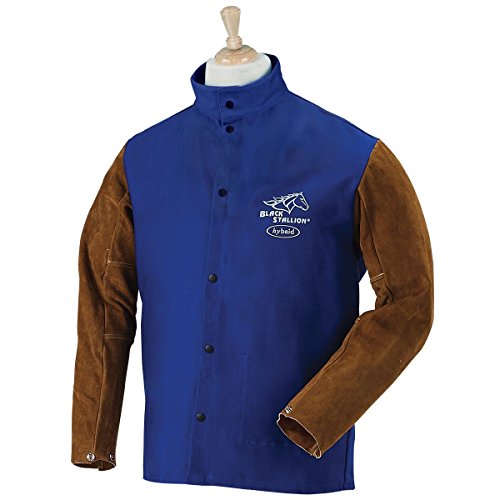
Revco Black Stallion Split Leather Welding Jacket
Split cowhide on this jacket delivers most of top grain’s spark resistance at a lower cost. A blue denim FR back panel trims weight and cost without sacrificing front coverage, where sparks hit most. Snap front and elastic cuffs keep debris out.
Pros
- Costs less than full leather jackets
- Denim back panel improves airflow
- Covers shop MIG work adequately
Cons
- Split leather wears faster than top grain
- Back panel offers less slag protection

QeeLink Flame Resistant Welding Jacket
Hobbyists and light-duty shop use get a low-cost flame resistant cotton option here. Reflective trim adds visibility in dim garages and workshops. An adjustable waist strap tightens the fit to cut loose fabric near the torch.
Pros
- Most affordable option in this lineup
- Reflective trim aids garage visibility
- Adjustable waist improves fit
Cons
- Not built for heavy stick or overhead welding
- Thinner fabric than dedicated FR brands
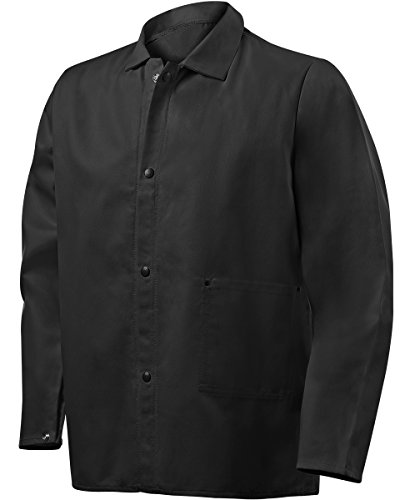
Steiner Weld-Cool FR Cotton Welding Jacket
Weld-Cool fabric blends FR cotton with a mesh-lined back to cut heat buildup in summer shops. Vented underarms move air without exposing skin to spatter. Lighter weight than leather makes long shifts in warm bays more tolerable.
Pros
- Noticeably cooler than leather in summer
- Mesh back panel improves airflow
- Meets NFPA 2112 flame resistance rating
Cons
- Less abrasion resistance than leather
- Not ideal for heavy overhead slag

Rapicca Leather Welding Jacket XL Tall
Extended sleeve and body length on this jacket suit welders who find standard cuts too short at the wrist and waist. Split cowhide up front resists spatter, while adjustable cuffs seal the extra sleeve length. Reinforced elbows add durability for repetitive bending.
Pros
- Longer sleeves and torso fit bigger frames
- Adjustable cuffs prevent gaps at the wrist
- Reinforced elbows hold up to repeated flexing
Cons
- Runs large for average height welders
- Bulkier fit limits close TIG work
Side by side
| # | Model | Material | Best for | Score | Price |
|---|---|---|---|---|---|
| 1 | Black Stallion JF1465 FR Cotton Welding Jacket | 9 oz FR cotton | Best overall | 9.4 | Check price |
| 2 | Lincoln Electric Leather Welding Jacket K2986 | Full grain leather | Best for heavy MIG and stick welding | 9.1 | Check price |
| 3 | Tillman 3281 Top Grain Cowhide Welding Jacket | Top grain cowhide | Best for TIG welding | 8.8 | Check price |
| 4 | Revco Black Stallion Split Leather Welding Jacket | Split leather front, FR cotton back | Best value | 8.5 | Check price |
| 5 | QeeLink Flame Resistant Welding Jacket | FR cotton blend | Best budget | 8.2 | Check price |
| 6 | Steiner Weld-Cool FR Cotton Welding Jacket | FR cotton with mesh back panel | Best for hot climates | 8.6 | Check price |
| 7 | Rapicca Leather Welding Jacket XL Tall | Split cowhide leather | Best for tall and big builds | 8.0 | Check price |
What matters most
Leather vs FR cotton welding jacket: which protects better? Leather resists slag, sparks, and radiant heat better than FR cotton, since it does not ignite and sheds molten metal on contact. FR cotton breathes better and suits lighter MIG, grinding, or intermittent welding, where heat buildup is the bigger complaint. Full grain leather costs more but lasts longer under heavy spatter. Split leather trims cost by using a lower layer of hide, trading durability for a lighter price.
What welding jacket is best for MIG vs TIG vs stick? Stick and heavy MIG welding throw more spatter and slag, so leather with reinforced seams handles that exposure best. TIG welding involves finer movement and less spatter, so a slimmer cowhide jacket like the Tillman 3281 allows better dexterity. High-amperage stick welding benefits from Kevlar-stitched seams that resist burn-through longer than cotton thread. Jacket weight should match amperage and process, not personal preference alone.
How should a welding jacket fit? A properly fitted jacket sits close enough to avoid loose fabric near the torch, yet loose enough for shoulder and arm movement. Sleeves should reach the wrist even with arms raised, since gaps let sparks in during overhead work. Taller welders often need extended sizing, like the Rapicca XL Tall, to avoid short sleeves. Snap or button fronts seal better against falling slag than a zipper, which can jam with debris.
Do welding jackets need a flame resistance certification? NFPA 2112 is the standard most FR cotton welding jackets reference for flame resistant garments in industrial settings. Leather jackets are inherently flame resistant due to the material itself and typically skip that certification labeling. Checking the Amazon listing for stated compliance confirms a jacket meets a recognized standard rather than marketing language alone. Safety programs at some employers require documented certification for compliance records.
Questions worth asking
Is leather or FR cotton better for welding jackets?
Leather offers stronger resistance to slag and sparks, while FR cotton breathes better and suits lighter welding tasks in warmer shops.
Can you wear a welding jacket for overhead welding?
Yes, though reinforced shoulders and full sleeve coverage matter most, as in the Lincoln Electric K2986, since falling slag is a bigger risk overhead.
What is the best welding jacket for TIG welding?
The Tillman 3281 top grain cowhide jacket fits closer to the body, which helps with the fine control TIG welding requires.
Are FR cotton welding jackets machine washable?
Many FR cotton jackets, including the Black Stallion JF1465, list machine washable care instructions, though checking the garment tag confirms it.
What size welding jacket should a tall person buy?
Extended or tall sizing, such as the Rapicca XL Tall, gets longer sleeves and torso length without excess bulk elsewhere.
Do welding jackets need NFPA 2112 certification?
FR cotton jackets often reference NFPA 2112 compliance on the listing, while leather jackets rely on the material’s natural flame resistance instead.
Is split leather as durable as top grain leather for welding?
Split leather resists spatter reasonably well but wears faster than top grain leather under heavy or repeated exposure.
What welding jacket works best in hot weather?
Vented options like the Steiner Weld-Cool jacket use mesh back panels to cut heat buildup during long shifts in warm shops.
The bottom line
Match the jacket to the weld process first, then to comfort. Leather suits heavy MIG, stick, and overhead work, while FR cotton fits lighter tasks and hotter shops. The Black Stallion JF1465 offers the widest balance of protection and comfort for most home and shop welders.
Jake Monroe
Jake worked as a residential contractor for over a decade before shifting to full-time writing. He evaluates power tools, hand tools and workshop gear through the lens of someone who has actually used them on job sites, not just read the box.