What Watercolor Set Should Beginners Actually Buy?
Winsor & Newton’s Cotman Sketchers Pocket Box leads for consistent student-grade pigment in a travel case. The Sakura Koi Pocket Field Box is the value pick with a built-in brush. Painters ready to mix their own colors should look at the Daniel Smith Essentials set.
Winsor & Newton’s Cotman Sketchers Pocket Box tops this list because it delivers steady, well-behaved student-grade pigment in a case small enough to actually carry. Sakura’s Koi Pocket Field Box is the value choice thanks to a built-in water brush, and the Daniel Smith Essentials set suits painters who want artist-grade pigment to mix themselves.
Pan count is the least meaningful number on the box, since a 24-pan student set with filler-heavy binder can produce muddier results than six well-chosen artist paints. Lightfastness, single-pigment versus blended formulas, and usable mixing area matter more. We compared published pigment and lightfastness data against what painters report about rewetting and behavior on paper.
What we recommend

Winsor & Newton Cotman Watercolour Sketchers Pocket Box
Twelve half pans distill Winsor & Newton’s student line into a metal box with a built-in mixing lid and small brush. Paint rewets cleanly and behaves predictably, which matters most while learning. Pigment load sits below the artist-grade Professional line, so deep darks need extra layers.
Pros
- Predictable, well-behaved paint for learning
- Rewets cleanly after drying
- Genuinely pocketable metal case
Cons
- Lower pigment load than artist grade
- Included brush is functional rather than good

Sakura Koi Water Colors Pocket Field Sketch Box
A refillable water brush ships inside the case, removing the need for a separate water pot on outdoor sketching trips. Colors lean bright and rewet fast rather than subtle. Lightfastness varies across the range, so treat these as sketchbook paints rather than pieces meant to hang in daylight.
Pros
- Water brush makes outdoor sketching easy
- Bright colors that rewet very quickly
- Fold-out palette gives decent mixing space
Cons
- Lightfastness varies across the range
- Plastic case is less durable than metal boxes

Daniel Smith Essentials Introductory Watercolor Set
Six tubes cover warm and cool versions of each primary, chosen as a mixing set that reaches a wide gamut cleanly. Pigment concentration far exceeds student paint, so darks arrive in one pass. No palette ships in the box, and tubes need squeezing and drying before they suit travel.
Pros
- High pigment concentration with clean mixes
- Six colors mix a surprisingly wide range
- Strong lightfastness across the selection
Cons
- No palette or case included
- Requires understanding of color mixing

Arteza Watercolor Premium Set
A wide spread of ready-mixed colors lets beginners experiment without worrying about wasting expensive paint. That breadth helps before you learn to mix your own shades. Many colors are pigment blends rather than single pigments, so mixing two of them can turn muddy faster than mixing pure primaries.
Pros
- Large colour selection for the price
- Good for experimenting without cost anxiety
- Storage case included
Cons
- Many colours are pigment blends that muddy when mixed
- Lightfastness information is limited

Van Gogh Watercolour Pocket Box
Royal Talens positions this line between student and artist grade, and colors lift and layer more cleanly than basic student paint. The pocket box includes a mixing lid and travel brush. It costs noticeably more than Cotman or Koi, a point where some beginners are better served buying better paper instead.
Pros
- Cleaner lifting and layering than basic student paint
- Good lightfastness for the price bracket
- Compact metal travel box
Cons
- Costs meaningfully more than entry student sets
- Small mixing area in the lid
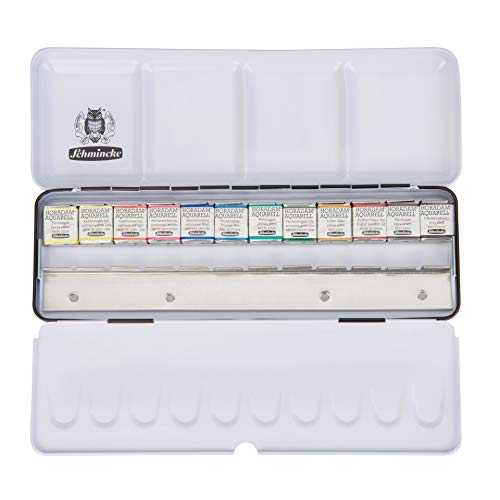
Schmincke Horadam Aquarell Metal Set
High pigment concentration and a honey-based binder put Schmincke’s Horadam line among the finest watercolor sold. Colors granulate and flow in ways student paint cannot reproduce. The price makes little sense for a first set, and its qualities go to waste on cheap paper.
Pros
- Exceptional pigment concentration and flow
- Rewets easily even after long storage
- Strong lightfastness throughout
Cons
- Expensive, not a sensible first set
- Needs good paper to show its qualities

Prang Oval 16 Watercolor Set
Decades in classrooms have made Prang the standard, since it rewets instantly and washes out of clothing without drama. Oval pans are large enough for small hands to load a brush without precision. Colors are bright but weakly pigmented and dry noticeably lighter than they look wet.
Pros
- Very inexpensive for the pan count
- Rewets instantly with no soaking
- Washes out of clothes easily
Cons
- Weak pigment that dries much lighter
- Not suitable for work you want to keep
Compared at a glance
| # | Model | Format | Best for | Score | Price |
|---|---|---|---|---|---|
| 1 | Winsor & Newton Cotman Watercolour Sketchers Pocket Box | 12 half pans | Best overall | 9.4 | Check price |
| 2 | Sakura Koi Water Colors Pocket Field Sketch Box | 12, 24 or 30 pans by version | Best value | 9.2 | Check price |
| 3 | Daniel Smith Essentials Introductory Watercolor Set | 6 tubes | Best pigment quality | 9.0 | Check price |
| 4 | Arteza Watercolor Premium Set | Pans or tubes by version | Best large palette | 8.8 | Check price |
| 5 | Van Gogh Watercolour Pocket Box | 12 half pans | Best step up from student grade | 8.6 | Check price |
| 6 | Schmincke Horadam Aquarell Metal Set | Half pans in a metal box | Best premium | 8.3 | Check price |
| 7 | Prang Oval 16 Watercolor Set | 16 oval pans | Best for classrooms and kids | 8.0 | Check price |
What to look for
Why is pan count the least useful number on the box? A 24-pan student set looks generous next to a 6-tube artist set, yet the six tubes often produce better paintings. Pigment concentration determines how dark you can go and how clean a mix stays. Single-pigment paints mix predictably, while blends of three pigments mixed together rapidly turn grey. Check pigment codes on the packaging when the manufacturer publishes them.
Pans or tubes: which format suits your painting? Pans stay compact, rewet on demand, and suit sketchbooks and outdoor work, though loading a strong dark from a hard pan takes patience. Tubes deliver concentrated paint immediately, ideal for large washes and deep values, at the cost of squeezing fresh paint each session. Many painters keep a tube palette at home and a pan box in a bag.
Does lightfastness matter for a set you’ll frame? Watercolor is the most fragile medium in daylight, and fugitive pigments visibly fade within a few years on a sunny wall. Artist-grade paints publish lightfastness ratings on a scale from excellent to fugitive. Student and classroom sets often skip this entirely, a fair trade for practice work and a poor one for anything you plan to hang.
Is better paper more important than a better paint set? Choosing between nicer paint and nicer paper, buy the paper. Cheap wood-pulp paper buckles, absorbs unevenly, and won’t let you lift or blend, making any paint look weak. A 140-pound cotton sheet transforms the same student set. Start on decent cotton paper, then upgrade pigments once technique outgrows the paper.
Common questions
What is the difference between student and artist grade watercolor?
Artist grade carries a higher pigment-to-binder ratio, uses more single-pigment formulas, and publishes lightfastness ratings. Student grade adds fillers to cut cost, which is why the same color looks chalkier and needs more layers to reach a dark value.
How many colors does a beginner really need?
Six is enough, covering a warm and cool version of each primary. That combination mixes almost anything and teaches color relationships faster than picking a ready-made shade from a tray of 24.
Are pans or tubes better for a first set?
Pans suit portability and quick sketching; tubes suit strong washes and large work. Beginners usually get on better with pans, since there is nothing to squeeze, waste, or dry out.
Why do my watercolor paintings look muddy?
Usually too many pigments mixed at once, or a wash overworked while it dries. Mixing two multi-pigment paints together compounds the problem. Fewer, purer colors and letting each layer dry fully solve most of it.
Do watercolor paints expire?
Pans last effectively forever if kept dry and simply need soaking to rewet. Tubes can dry hard or separate over years, though dried tube paint can be squeezed into a pan and used that way.
What paper works best with a watercolor set?
At least 140-pound weight, and cotton over wood pulp if the budget allows. Cold press is the versatile default. Thin sketchbook paper buckles and blocks blending regardless of paint quality.
Can you mix watercolor brands in one palette?
Yes, freely. Binder chemistry is broadly similar across manufacturers, so paints mix without issue. Many painters build a personal palette from several brands, chosen by individual color rather than complete sets.
Is a water brush worth using instead of a regular brush?
For sketching away from a desk, very much so, since it removes the water pot from the equation. Studio work favors a conventional brush, which holds more water and gives better control over edges.
The verdict
Winsor & Newton’s Cotman Sketchers Pocket Box is the set to start with, since the paint behaves predictably while you learn and the case keeps it usable. Outdoor sketchers get more practical value from the Sakura Koi Pocket Field Box and its built-in water brush. Painters ready to mix their own colors should skip large trays and buy the Daniel Smith Essentials set alongside good cotton paper.
Jake Monroe
Jake worked as a residential contractor for over a decade before shifting to full-time writing. He evaluates power tools, hand tools and workshop gear through the lens of someone who has actually used them on job sites, not just read the box.


