Water Leak Detectors That Actually Reach the Basement
The YoLink Smart Water Leak Sensor leads, since its long range radio still reports from basements where Wi-Fi drops out. The Govee Water Leak Detector wins on value for covering several rooms at once. The Moen Flo Smart Water Monitor and Shutoff earns the shutoff pick, since it closes the main valve on its own.
The YoLink Smart Water Leak Sensor tops this list because its long range radio still reports from basement corners and crawl spaces where Wi-Fi sensors go silent. The Govee Water Leak Detector wins on value for covering several risk points in one multipack. The Moen Flo Smart Water Monitor and Shutoff is the upgrade pick for anyone who wants the water shut off automatically instead of just an alert on a phone.
Leak detectors look interchangeable on a listing page, yet failures happen in predictable spots. A sensor under a basement laundry sink often sits at the weak edge of Wi-Fi coverage. An alarm that only sounds locally does nothing in an empty house, and a puddle spreading away from a small sensor foot never reaches the contacts. We compared radio technology and range, whether a hub is required, sensing reach through probes or cables, freeze detection, battery life, and what happens when a network drops. Owner feedback and published specifications both point to placement and range mattering more than raw sensitivity, so those weighed heavily here.
The shortlist, ranked

YoLink Smart Water Leak Sensor
YoLink runs on a low frequency LoRa radio instead of Wi-Fi. That signal reaches sump pits, garages, and basement corners where phone-based sensors go quiet. A local siren sounds first, then the app and a text message follow through the required hub. Pair it with a YoLink valve controller and it can shut the water off on its own.
Pros
- Reaches basements and outbuildings other sensors miss
- Can trigger an automatic valve shutoff via a YoLink controller
- Battery lasts multiple years between changes
Cons
- Requires the hub before any sensor works
- Fewer accessories than mainstream Wi-Fi brands
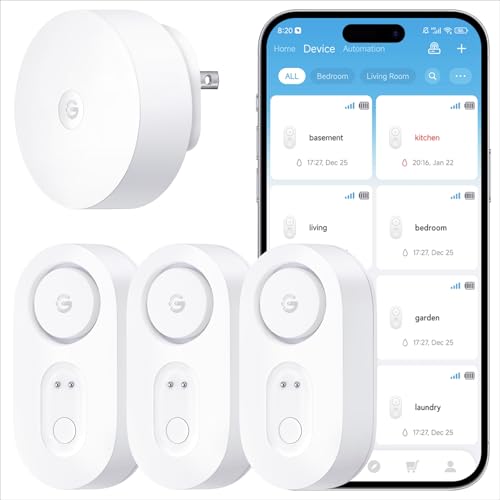
Govee Water Leak Detector
Govee sells this sensor in multipacks built for covering five or six rooms at once. Its onboard siren is loud enough to hear through a closed door. App alerts route through the required Govee gateway. Each unit senses only where it touches, so placement at the lowest point of a spill matters most.
Pros
- Cheapest way to cover many rooms in a multipack
- Siren carries through walls and closed doors
- App setup takes only a few minutes
Cons
- Gateway needed before phone alerts work
- Small sensing foot demands careful placement

Moen Flo Smart Water Monitor and Shutoff
Flo installs directly on the main supply line rather than sitting on a floor. It watches flow and pressure patterns, catching a slow pipe leak long before a puddle forms. When flow looks abnormal, the valve closes on its own, even with nobody home. Installation is a plumbing job, which rules it out for most renters.
Pros
- Catches hidden leaks inside walls and underground pipes
- Closes the main valve automatically without user action
- Tracks water usage trends over time in the app
Cons
- Needs professional plumbing installation on the main line
- Some monitoring features require a paid plan

Aqara Water Leak Sensor
Aqara’s sensor is small enough to slide behind a toilet or under a dishwasher toe kick. It communicates over Zigbee through an Aqara hub rather than connecting to Wi-Fi directly. Its IP67 body tolerates a drenching, and it works with Apple Home, Alexa, and Google Assistant. Triggering a smart valve or lights elsewhere in the house is the real draw here.
Pros
- Compact size fits gaps larger sensors cannot reach
- Triggers smart home automations across three major platforms
- IP67 rating tolerates direct water contact
Cons
- Has no meaningful siren of its own
- Needs the Aqara hub to function at all

Ring Alarm Flood and Freeze Sensor
This sensor only makes sense alongside an existing Ring Alarm base station. Pairing takes under a minute, and alerts land in the same app already used for the alarm system. It detects both standing water and dropping temperature, flagging freeze risk before a pipe bursts. Outside the Ring ecosystem, it has no way to alert anyone.
Pros
- Adds flood coverage to a Ring Alarm system in minutes
- Detects freeze risk alongside water
- Battery replacement is needed only every few years
Cons
- Useless without an existing Ring Alarm base station
- No independent siren built into the sensor
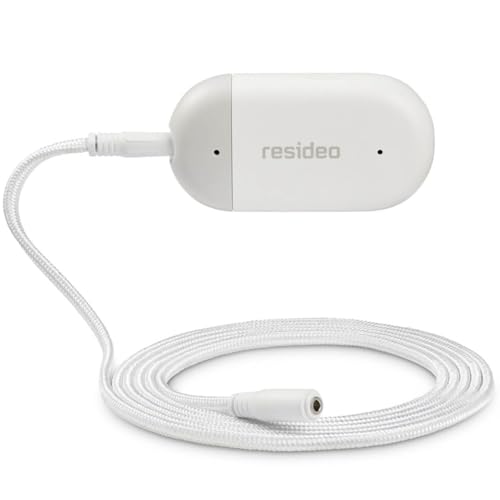
Honeywell Home Lyric Wi-Fi Water Leak and Freeze Detector
The Lyric connects straight to Wi-Fi, skipping any hub purchase. It ships with an extendable sensing cable that runs along a wall base or wraps around a water heater. That cable senses a whole line rather than one point, catching water that spreads sideways. Reliance on Wi-Fi means it belongs somewhere signal stays strong.
Pros
- Sensing cable covers a line instead of a single point
- No hub required beyond a home Wi-Fi network
- Reports humidity and freeze risk alongside leaks
Cons
- Weak Wi-Fi in basements limits where it can go
- Bulkier setup than the compact point sensors here

Zircon Leak Alert
Zircon keeps things simple: a single battery alarm that shrieks when its contacts touch water. There is no app, no hub, and no account to set up. Drop it under a utility sink or inside a shed and it works immediately. Its one limitation is obvious: nobody hears the alarm if the house is empty.
Pros
- Works with no network, hub, or account needed
- Setup takes seconds, just place it and go
- Costs little enough to deploy at several spots
Cons
- Sends no remote notification of any kind
- Provides no protection when nobody is home to hear it
How they stack up
| # | Model | Radio | Best for | Score | Price |
|---|---|---|---|---|---|
| 1 | YoLink Smart Water Leak Sensor | LoRa long range | Best overall | 9.4 | Check price |
| 2 | Govee Water Leak Detector | Multipack options | Best value | 9.2 | Check price |
| 3 | Moen Flo Smart Water Monitor and Shutoff | Inline flow monitor with valve | Best for automatic shutoff | 9.0 | Check price |
| 4 | Aqara Water Leak Sensor | Zigbee via Aqara hub | Best for smart home automations | 8.8 | Check price |
| 5 | Ring Alarm Flood and Freeze Sensor | Ring Alarm base station | Best for Ring Alarm owners | 8.6 | Check price |
| 6 | Honeywell Home Lyric Wi-Fi Water Leak and Freeze Detector | Wi-Fi, no hub | Best sensing reach | 8.3 | Check price |
| 7 | Zircon Leak Alert | Standalone audible alarm | Best budget | 8.0 | Check price |
What to look for
What kinds of leak detectors are out there? Three basic designs cover most homes. Point sensors detect water touching two contacts on their base, working well directly under a supply line. Cable sensors extend that same detection along a run, watching a water heater pan or a wall base as a line instead of a spot. Flow monitors, like the Moen Flo, sit on the main supply and flag abnormal usage, catching leaks inside walls that a floor sensor would never see. Combining a flow monitor with a few point sensors covers the most ground.
Wi-Fi, Zigbee, or long range radio: which connection holds up? Basements and crawl spaces often have the weakest wireless signal in a house, which is exactly where leaks happen most. Long range radio designs like YoLink and mesh protocols like Zigbee tend to keep a connection where Wi-Fi drops. Before buying a Wi-Fi model, check signal strength on a phone standing where the sensor will sit. Marginal bars mean a hub based system or a mesh extender is worth the extra step.
Do you need a loud siren, app alerts, or both? A local siren only helps when someone is home to hear it, and leaks often do the most damage while a house sits empty. Push notifications solve that gap, while text or call escalation covers a silenced phone. The strongest setups combine both a siren and remote alerting. Anyone away from home often, including frequent travelers, should prioritize remote alerts and consider automatic shutoff over siren volume alone.
Where should sensors go first, and how many does a house need? Start with the appliances that fail most often instead of spreading sensors evenly. Water heaters, washing machine hoses, dishwashers, under sink shutoffs, refrigerator ice lines, sump pits, and any pipe in an unheated space account for most real claims. Place each sensor at the lowest point where water would actually collect, not against the appliance itself. Five or six sensors typically cover a standard home, with freeze detection worth adding anywhere pipes run through uninsulated areas.
Common questions
Do water leak detectors need Wi-Fi to work?
Standalone alarms like the Zircon Leak Alert need nothing at all, but only sound locally. Smart sensors need either Wi-Fi or a hub for remote alerts. Hub based systems using long range radio or Zigbee generally hold a connection better in basements than direct Wi-Fi sensors.
Can a leak detector shut off my water automatically?
Only if it controls a valve. The Moen Flo Smart Water Monitor and Shutoff includes one on the main line. Sensor systems such as YoLink can also trigger a separate motorized valve controller. Basic sensors alert you and stop there, leaving the shutoff to you.
How long do leak detector batteries last?
Most sensors run a year or more on replaceable cells. Long range radio models often last several years since the radio wakes only briefly to check in. Cold locations shorten battery life faster than warm ones. Choose a model that reports low battery status in its app, since a silent dead sensor gives false confidence.
Will a leak detector catch water leaking inside a wall?
Point sensors will not, since nothing reaches them until damage already shows. Flow monitors on the main supply are built for that job, flagging continuous small usage that should not be happening. Owners report this is the main reason to pair a flow monitor with floor sensors.
How many leak sensors does an average house need?
Five or six sensors cover the common failure points in a typical home. Priority spots include the water heater, washing machine, dishwasher, kitchen sink cabinet, main bathroom, and any sump or utility area. Multipacks like Govee’s make that affordable. Add more only for specific known risks, such as an aging supply line.
Do leak detectors still work during a power outage?
The sensors themselves run on batteries and keep working through an outage. Hubs and routers usually do not, so remote alerts stop even though a local siren still sounds. Put the hub and router on a small uninterruptible power supply if outage coverage matters to you.
Is freeze detection worth paying extra for?
In any climate with a real winter, yes. Burst pipes cause far larger losses than a slow drip ever does. A low temperature alert gives time to act before a pipe fails. The Ring Alarm Flood and Freeze Sensor and the Honeywell Home Lyric both include freeze detection at no extra step.
Where is the best place to put a sensor near a water heater?
Set a point sensor flat on the drip pan floor, where water pools first. A cable style sensor, like the one included with the Honeywell Home Lyric, covers more of the pan’s perimeter than a single contact point. Either placement beats leaving the water heater unmonitored.
Is a smart hub sensor better than a standalone alarm?
It depends on whether anyone is usually home. A standalone alarm like the Zircon Leak Alert needs no account and works instantly, but it stays silent to an empty house. Hub based sensors from YoLink or Aqara add remote alerts and automation, at the cost of a hub purchase and setup.
The bottom line
For coverage that reports reliably from a basement or crawl space, the YoLink Smart Water Leak Sensor remains the strongest pick in this group. The Govee Water Leak Detector covers several rooms affordably when Wi-Fi signal stays strong. When the goal is stopping damage rather than just hearing about it, add the Moen Flo Smart Water Monitor and Shutoff on the main supply.
Jake Monroe
Jake worked as a residential contractor for over a decade before shifting to full-time writing. He evaluates power tools, hand tools and workshop gear through the lens of someone who has actually used them on job sites, not just read the box.


