Walking Pad Treadmills for Desks, Flats and Runs
KingSmith WalkingPad A1 Pro takes the top spot, folding in half to slide under a sofa between shifts. LifeSpan TR1200-DT3 suits six hour desk days with its 2.25 horsepower continuous duty motor. UREVO 2 in 1 Under Desk Treadmill adds a folding handrail and jogging speeds for less.
KingSmith WalkingPad A1 Pro fits most home offices, because folding in half is what keeps a pad in use instead of in a closet. Top speed reaches 3.72 mph, enough for brisk walking and nothing beyond it. Its 220 pound limit and compact motor rule out heavier users and all day walkers.
Every walking pad looks like a belt in a flat box. Real differences hide in motor duty rating, belt width and deck height. A pad rated for occasional use overheats across a six hour workday, and a 5 inch deck can push a fixed desk out of ergonomic range. We compared published speed ranges, motor ratings, belt dimensions, weight limits and folded size. Owner reports on belt drift, motor noise and first year failures broke the ties.
What we recommend

KingSmith WalkingPad A1 Pro
Folding in half roughly halves storage length, which decides whether a pad stays in daily use. Speed runs 0.5 to 3.72 mph through a remote or the KS Fit app. Maximum user weight stops at 220 pounds, so larger walkers should step up to a sturdier frame.
Pros
- Halves its length for under sofa storage
- Slim deck clears most standing desks
- App logs steps, distance and time
Cons
- 220 pound ceiling excludes heavier users
- No handrail, so jogging is off the table

LifeSpan TR1200-DT3
A 2.25 horsepower continuous duty motor separates this from folding pads designed for short sessions. Belt area measures about 20 by 50 inches, which leaves room for a natural stride. Capacity reaches 350 pounds, the highest figure in this group.
Pros
- Rated for hours of continuous running
- Widest belt here at about 20 inches
- 350 pound capacity leads the group
Cons
- No folding, so it lives under the desk
- Wired console eats desk surface

UREVO 2 in 1 Under Desk Treadmill
Raising the handrail converts this from desk pad to treadmill, with run mode reaching 7.6 mph. Folded flat, it slides under a bed between sessions. Weight capacity of 265 pounds lands between the slim pads and the office units.
Pros
- One machine covers walking and jogging
- Handrail folds flat for desk mode
- Costs less than a pad plus a treadmill
Cons
- Heavier to reposition than a bare pad
- Belt is narrower than a full size treadmill

Sperax Walking Pad Treadmill
Entry level buyers still get a 2.25 horsepower motor and a 4 mph ceiling, which covers most desk walking. Finish trails the premium pads, particularly around the rear tensioning bolts. Owners describe it as a few hours a day machine rather than a full shift one.
Pros
- Cheapest route into desk walking
- 4 mph beats several slim pads here
- Transport wheels ease repositioning
Cons
- Belt needs periodic retensioning
- Not built for continuous all day duty
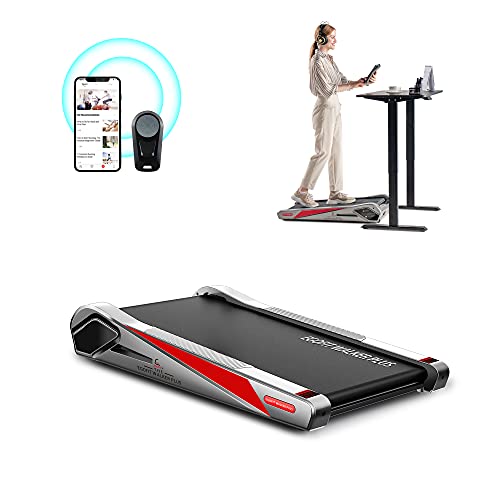
Egofit Walker Pro
Deck length is deliberately short, which lets this tuck under low desks and into studio flats where longer pads jam. A fixed incline near 5 degrees raises effort without raising speed. Top speed of about 3.1 mph keeps it to steady walking.
Pros
- Smallest footprint of the seven
- Fixed incline adds effort at low speed
- Low deck protects desk ergonomics
Cons
- Short belt cramps strides over six feet tall
- Slowest top speed in this group

GOPLUS 2 in 1 Folding Treadmill
Handrail up mode reaches 7.5 mph for running, while flat mode handles desk walking, so a walker and a runner share one unit. Bluetooth audio and app tracking come built in. Folded thickness exceeds the slimmest pads, which rules out under sofa storage.
Pros
- Serves a walker and a runner in one house
- Handrail steadies you at running speed
- App logs sessions for each user
Cons
- Thicker when folded than slim walking pads
- Speaker quality is basic

THERUN Under Desk Treadmill
Noise decides the purchase in flats and on video calls, and owners consistently describe this belt as quiet at walking pace. Multi layer shock absorbing deck softens impact travelling through the knees. Speed stops at 3.8 mph, so runners belong on a dual mode machine.
Pros
- Quiet enough for calls at walking pace
- Cushioned deck eases joint impact
- Stores upright against a wall
Cons
- Walking speeds only, no run mode
- No handrail for balance support
What to look for
What to look for in a walking pad Motor rating tells you how long a pad can run, and continuous duty figures mean far more than peak horsepower claims. Belt width sets stride comfort, with anything under 16 inches feeling tight for taller walkers. Deck height matters at a fixed desk, since a 5 inch deck can lift you past a comfortable typing position. Compare maximum user weight against your own with margin, because sustained loading near the limit shortens motor life. Folding only helps when the folded size fits the gap you actually have at home.
Walking pad vs treadmill: which one fits your goal Walking pads trade speed and cushioning for a deck you can put away. Most stop between 3.7 and 4 mph, which covers brisk walking and excludes running. Full treadmills bring incline, wider belts, longer decks and motors built for daily miles, at the cost of a permanent footprint. Dual mode machines with a folding handrail sit in between and suit a household split between walking and jogging. Step count during work points to a pad; training for a race points to a treadmill.
Setting one up under a standing desk Measure desk height first, then add the deck height of the pad you are considering. Elbows near 90 degrees is the target, and a tall deck breaks that for anyone below average height. Belt width of 16 inches or more prevents the drift that creeps in when your eyes stay on the monitor. Start around 1.5 to 2 mph for typing, since accuracy falls off noticeably above that. Route the power cable clear of the walking path and lay a mat underneath to protect flooring.
Noise, flooring and apartment living Footfall, not motor hum, is what a neighbour below actually hears. Multi layer cushioned decks absorb part of that thud before it reaches the joists. A rubber mat cuts vibration transfer and saves hardwood from the pad feet. Thick pile carpet is the common mistake, because it blocks ventilation underneath and invites overheating. Keep the pad on hard flooring or a firm mat, and vacuum beneath it monthly so dust stays out of the motor housing.
How they compare
| # | Model | Speed range | Best for | Score | Price |
|---|---|---|---|---|---|
| 1 | KingSmith WalkingPad A1 Pro | 0.5 to 3.72 mph | Best overall | 9.3 | Check price |
| 2 | LifeSpan TR1200-DT3 | 0.4 to 4.0 mph | Best for all day desk use | 9.1 | Check price |
| 3 | UREVO 2 in 1 Under Desk Treadmill | Up to 7.6 mph in run mode | Best value | 8.9 | Check price |
| 4 | Sperax Walking Pad Treadmill | 0.6 to 4.0 mph | Best budget | 8.7 | Check price |
| 5 | Egofit Walker Pro | 0.6 to 3.1 mph | Best for small apartments | 8.5 | Check price |
| 6 | GOPLUS 2 in 1 Folding Treadmill | Up to 7.5 mph in run mode | Best for shared households | 8.2 | Check price |
| 7 | THERUN Under Desk Treadmill | 0.6 to 3.8 mph | Best for quiet operation | 8.0 | Check price |
Common questions
How fast can you type while walking on a treadmill pad?
Most people stay accurate up to about 2 mph. Spreadsheet work and precise clicking suffer above that. Calls, reading and video meetings handle faster speeds comfortably.
Can you run on a walking pad treadmill?
Dedicated pads cap near 4 mph and have no handrail, which makes running unsafe. Dual mode machines with a folding handrail reach 7.5 mph or more. Choose a 2 in 1 if anyone in the house wants to jog.
Are walking pads good for weight loss?
They add several thousand steps a day without booking gym time, which lifts daily energy expenditure. Total activity and diet still decide the outcome. A fixed incline raises effort at the same speed.
How much weight can a walking pad hold?
Slim folding pads typically state 220 pounds. Mid range models list 265 pounds, and office grade desk treadmills reach 350. Staying well under the stated limit extends motor life.
Do walking pads work on carpet?
Thin low pile carpet is workable. Thick pile blocks airflow beneath the deck and risks overheating the motor. A hard mat under the pad solves ventilation and protects the floor at once.
Is a walking pad loud enough to disturb neighbours?
Motor noise stays modest at walking speed. Footfall vibration is what travels through a floor to the flat below. A rubber mat, a cushioned deck and soft soled shoes together cut most of it.
Which walking pad is best for a tall person?
Look for a belt around 20 inches wide and 50 inches long, such as the LifeSpan TR1200-DT3. Short compact decks force a clipped stride. Deck height counts too, since a taller deck raises your working position.
What is the best walking pad for a small apartment?
Egofit Walker Pro has the shortest deck here and slides into a studio with no dedicated room. KingSmith WalkingPad A1 Pro folds in half if you need the floor back each evening. Measure the storage gap before the walking space.
How do you stop the belt drifting to one side?
Uneven tension at the rear roller bolts causes most drift. Adjust in quarter turns with the supplied hex key while the belt runs slowly. Recheck after the first few weeks, since new belts settle.
Is a walking pad worth it if you already have a gym membership?
Gym sessions build fitness, while a pad attacks the sedentary hours between them. Desk workers gain more from steps spread across the day than from one extra cardio session. Skip it if your job already keeps you on your feet.
The verdict
KingSmith WalkingPad A1 Pro is the pick for a typical home office, because a pad that folds in half keeps getting used. Walking most of the workday changes that answer to the LifeSpan TR1200-DT3, whose continuous duty motor and 350 pound capacity are built for the load. Households with a runner should take the UREVO 2 in 1 instead, since one machine then covers both jobs.
Derek Holt
Derek has a background coaching recreational and amateur athletes and has worked the sales floor at specialty fitness retailers. He focuses on equipment durability, ergonomics and realistic use cases rather than marketing claims.


