Ceramic Grills Worth the Investment Without Overpaying
The Vision Grills Classic B Series Kamado offers the strongest balance of ceramic insulation and price for most backyard cooks. Buyers wanting a premium long-term investment should choose the Kamado Joe Classic III instead, while anyone on a tighter budget fits better with the Char-Griller Akorn’s steel-insulated design.
The Vision Grills Classic B Series Kamado leads this list because its thick ceramic walls hold heat as well as pricier competitors while costing noticeably less. Its main limitation is a smaller accessory ecosystem than Kamado Joe, which matters for buyers wanting add-ons like rotisseries or expansion racks. The rest of this list covers premium, budget and specialty options for different grilling priorities.
We compared listed cooking area, insulation construction and included accessories across each grill rather than cooking on them ourselves.
What we recommend
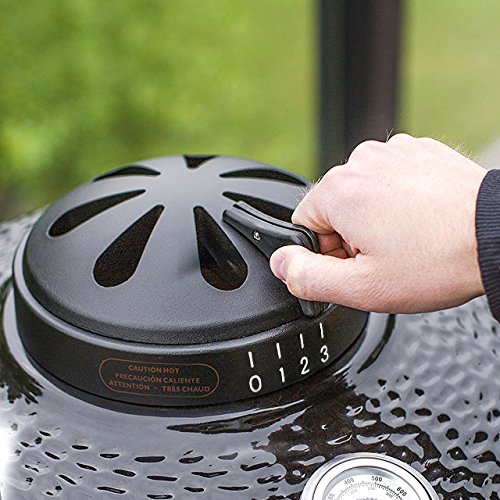
Vision Grills Classic B Series Kamado
Thick ceramic walls retain heat efficiently, holding steady temperatures for long low and slow cooks without constant fuel adjustment. A built in thermometer and ash drawer simplify temperature monitoring and cleanup compared to basic kamado designs. Vision Grills prices this model below Kamado Joe and Big Green Egg while matching similar cooking area and ceramic thickness.
Pros
- Ceramic thickness matches pricier competitors at a lower cost
- Built in thermometer simplifies temperature monitoring
- Ash drawer makes cleanup easier than basic kamado designs
Cons
- Smaller accessory ecosystem than Kamado Joe
- Fewer third-party expansion parts available

Kamado Joe Classic III
A divide and conquer cooking system lets buyers grill at two different heat zones simultaneously, a feature most ceramic grills on this list lack. Kamado Joe’s air lift hinge makes the heavy ceramic lid easier to open than standard hinges. The brand has built one of the largest accessory ecosystems in the kamado grill category.
Pros
- Divide and conquer system allows two heat zones at once
- Air lift hinge reduces effort needed to open the heavy lid
- Largest accessory ecosystem among kamado grills on this list
Cons
- Costs notably more than Vision Grills or Char-Griller
- Heavier overall weight makes repositioning difficult

Big Green Egg Large
Big Green Egg’s ceramic shell has a long track record of holding up to years of outdoor exposure without cracking under normal use. The brand’s name recognition keeps used units holding value better than lesser known kamado brands. Big Green Egg sells its Large size as the most popular size in its lineup for home backyard use.
Pros
- Strong brand recognition supports better resale value
- Long track record of ceramic durability over years of use
- Popular size fits most backyard cooking needs
Cons
- Smaller cooking area than Vision Grills or Kamado Joe
- Accessories often cost more than competing brands

Pit Boss K24 Ceramic Charcoal Kamado
A larger 24 inch cooking surface fits more food at once than the standard sizes offered by Big Green Egg’s Large model. Pit Boss includes a cart style base with the K24, adding storage and mobility not standard on every kamado grill. The brand positions this model toward buyers cooking for larger groups regularly.
Pros
- Larger cooking surface suits bigger groups and gatherings
- Included cart base adds mobility and storage
- Competitive price for the included cooking area
Cons
- Bulkier footprint takes up more patio space
- Less established accessory ecosystem than Kamado Joe
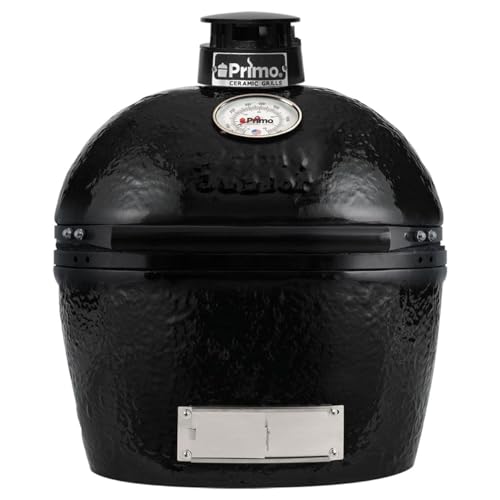
Primo Oval Junior Ceramic Grill
An oval shaped cooking grate fits both direct grilling and indirect smoking zones side by side, a layout different from the round grates on most other grills here. The Junior size suits smaller patios or households cooking smaller portions. Primo has built its oval shape as a distinguishing feature across its entire ceramic grill lineup.
Pros
- Oval grate allows direct and indirect zones side by side
- Compact footprint suits smaller patios or balconies
- Distinct shape sets it apart from standard round kamado grills
Cons
- Smaller cooking area limits it for larger gatherings
- Fewer accessory options than larger, more established brands

Char-Griller Akorn Kamado Kooker
A double walled steel shell, rather than ceramic, replicates kamado-style heat retention at a notably lower price point. Char-Griller markets the Akorn specifically as an entry point into kamado-style cooking before stepping up to true ceramic models. Its lighter steel build also makes it easier to move than any ceramic grill on this list.
Pros
- Costs significantly less than any ceramic grill on this list
- Lighter steel build makes it easier to move around
- Insulated steel still retains heat reasonably well for the price
Cons
- Steel does not retain heat as evenly as true ceramic
- Less long-term durability than ceramic shells

Coyote Asado Ceramic Cooker
Coyote designs the Asado specifically for built in outdoor kitchen installations, unlike the freestanding carts used by most other grills here. A front mounted damper and ash drawer improve airflow control and cleanup access in a built in setup. Coyote’s broader outdoor kitchen product line informs this model’s integration focused design.
Pros
- Designed specifically for built in outdoor kitchen installation
- Front mounted damper improves airflow access in tight setups
- Matches the broader Coyote outdoor kitchen product line
Cons
- Less practical for buyers wanting a freestanding, movable grill
- Installation requirements add cost beyond the unit itself
Side by side
| # | Model | Cooking Area | Best for | Score | Price |
|---|---|---|---|---|---|
| 1 | Vision Grills Classic B Series Kamado | Around 452 square inches | Best Overall Value | 9.0 | Check price |
| 2 | Kamado Joe Classic III | Around 452 square inches | Best Premium Pick | 9.2 | Check price |
| 3 | Big Green Egg Large | Around 262 square inches | Best for Resale and Longevity | 9.0 | Check price |
| 4 | Pit Boss K24 Ceramic Charcoal Kamado | Around 453 square inches | Best for Larger Cooking Area | 8.6 | Check price |
| 5 | Primo Oval Junior Ceramic Grill | Around 210 square inches | Best for Smaller Spaces | 8.5 | Check price |
| 6 | Char-Griller Akorn Kamado Kooker | Around 314 square inches | Best Budget Pick | 8.3 | Check price |
| 7 | Coyote Asado Ceramic Cooker | Around 300 square inches | Best for Built-In Outdoor Kitchens | 8.6 | Check price |
How to pick the right one
What to look for in a ceramic grill Cooking area determines how much food fits at once, ranging from compact options for small households to larger surfaces for groups. Insulation material affects heat retention, with true ceramic holding steady temperatures longer than insulated steel alternatives. Included accessories like carts, ash drawers and built in thermometers add convenience without needing separate purchases. Mobility matters too, since heavier ceramic grills move less easily than lighter steel options.
Premium brands versus value-focused alternatives Kamado Joe and Big Green Egg both carry strong brand recognition and accessory support, but at a higher price than Vision Grills. Vision Grills matches similar ceramic thickness and cooking area at a lower cost, making it the stronger value pick for most backyard cooks. Buyers prioritizing brand resale value or the widest accessory selection should still lean toward Kamado Joe or Big Green Egg.
Larger capacity versus compact sizing The Pit Boss K24 offers one of the largest cooking surfaces on this list, suited to cooking for bigger groups regularly. The Primo Oval Junior instead targets smaller households or limited patio space with its compact oval design. Matching grill size to typical group size avoids buying more capacity than actually needed.
Budget steel alternatives and built-in installations The Char-Griller Akorn swaps ceramic for insulated steel, cutting cost significantly while still offering kamado-style heat retention. The Coyote Asado instead targets buyers planning a permanent built in outdoor kitchen rather than a freestanding grill. Neither suits every buyer, but both address specific needs the mainstream ceramic grills above do not.
Frequently asked questions
What makes a ceramic grill different from a standard charcoal grill?
Ceramic grills, like Vision Grills and Kamado Joe, use thick ceramic walls to retain heat far more consistently than thin metal charcoal grills.
Which ceramic grill offers the best value for the price?
The Vision Grills Classic B Series Kamado matches similar ceramic thickness and cooking area to pricier brands at a lower cost.
Is the Char-Griller Akorn a true ceramic grill?
No, it uses an insulated double-walled steel shell instead of ceramic, which replicates some heat retention benefits at a lower price and lighter weight.
Which ceramic grill has the largest cooking area on this list?
The Pit Boss K24 Ceramic Charcoal Kamado offers one of the largest cooking surfaces among the grills compared here.
Do ceramic grills hold their value for resale?
Big Green Egg holds resale value particularly well due to its strong brand recognition and long track record.
What is the divide and conquer system on the Kamado Joe?
It is a cooking rack system that allows two different heat zones at once, letting buyers grill and sear on the same cook.
Is the Primo Oval Junior suitable for a small patio?
Yes, its compact oval design and smaller cooking area suit smaller patios or balconies better than larger kamado grills.
Can the Coyote Asado be used as a freestanding grill?
It is designed specifically for built in outdoor kitchen installation, so it works best as part of a permanent setup rather than freestanding.
Which ceramic grill is easiest to move around a backyard?
Among the ceramic options, the smaller Primo Oval Junior is easier to move than larger grills, though the steel-built Char-Griller Akorn is lighter still.
The verdict
For most backyard cooks who want genuine ceramic performance without overpaying, the Vision Grills Classic B Series Kamado is the strongest overall value pick. Buyers who want the broadest accessory ecosystem and strongest resale value should choose the Kamado Joe Classic III instead, since its established ecosystem justifies the higher cost. Anyone on a tighter budget should skip ceramic entirely and go with the Char-Griller Akorn’s insulated steel design.
Dana Whitfield
Dana spent eight years buying and merchandising for a regional kitchenware retailer before moving into editorial work. She has handled thousands of SKUs across cookware, small appliances and kitchen organization, and focuses on the practical differences that matter once a product is actually in daily use.