Which Home Treadmill Actually Holds Up to Daily Running
NordicTrack Commercial 1750 suits most households that want incline training and a large touchscreen in one machine. Sole F80 holds up best under heavy daily mileage thanks to its stronger motor and cushioned deck. Horizon Fitness 7.0 AT offers similar incline range at a lower price for buyers watching their budget.
NordicTrack Commercial 1750 earns the top spot here for combining a 3.75 continuous horsepower motor with a 14 inch touchscreen that handles live incline adjustments during a workout. Sole F80 trades some of that screen size for a stronger motor and a longer warranty, which matters more to someone running five days a week. Horizon Fitness 7.0 AT keeps a similar incline range at a noticeably lower price, though its display stays basic.
A treadmill that feels smooth during a showroom walk can still strain under a 45 minute run six days a week, so motor rating and deck cushioning matter more than screen size for frequent runners. We compared published motor horsepower, deck cushioning systems, incline and decline range, and stated weight capacity across seven models before narrowing this list.
How to pick the right one
What to check before buying a treadmill Motor power, measured in continuous horsepower, decides how well a treadmill handles sustained running rather than just walking. Deck cushioning affects joint impact over long sessions, and weight capacity should sit well above the heaviest regular user. Folding design and footprint matter most once the treadmill needs to share space with other furniture.
Best for small apartments and shared rooms ProForm’s Carbon TL folds into one of the smallest footprints here thanks to its SpaceSaver vertical design, while XTERRA’s TRX3500 folds just as compactly at a lower price. Both suit walkers and light joggers more than daily distance runners, since their motors are rated lighter duty.
Best for serious daily runners Sole’s F80 and NordicTrack’s Commercial 1750 both pair stronger motors with higher weight capacities built for daily mileage rather than occasional use. Deck cushioning on the F80 specifically targets reduced joint strain, which matters more as weekly running volume increases.
Budget options and simple no frills machines Schwinn’s 810 and XTERRA’s TRX3500 skip touchscreens and app subscriptions entirely, which keeps upfront and ongoing costs lower. Horizon’s 7.0 AT sits between budget and premium, matching the incline range of pricier machines without their screen technology.
The shortlist, ranked

NordicTrack Commercial 1750 Treadmill
A 3.75 continuous horsepower motor drives a 60 by 22 inch belt built for both walking and running paces. The 14 inch HD touchscreen tilts and adjusts incline automatically during guided workouts. Decline reaches minus 3 percent, which most treadmills in this price range skip entirely.
Pros
- Automatic incline and decline during guided workouts
- Large touchscreen doubles as a training display
- Belt size comfortably fits taller runners
Cons
- Full workout library needs an ongoing subscription
- Footprint is larger than most folding treadmills

Sole F80 Treadmill
Sole built the F80 around a 4.0 continuous horsepower motor and a cushioned deck designed to absorb impact during daily running sessions. A 400 pound weight capacity exceeds most home treadmills in this price range. The frame folds for storage, though its weight makes moving it a two person job.
Pros
- Stronger motor rated for frequent daily running
- Cushioned deck reduces joint impact over long sessions
- Highest weight capacity in this lineup
Cons
- Folding frame is heavy to move once collapsed
- Display is simpler than NordicTrack’s touchscreen

Horizon Fitness 7.0 AT Treadmill
Horizon pairs a 3.0 continuous horsepower motor with an incline range that climbs to 15 percent, matching far more expensive machines on paper. Bluetooth speakers and a tablet holder cover the basics without a large built in screen. Folding hinges let the deck stand upright against a wall.
Pros
- Incline range matches pricier treadmills
- Lower cost than NordicTrack or Sole at similar incline
- Folds upright for easier storage
Cons
- Motor is lighter duty than Sole’s F80
- No built in touchscreen for guided workouts

Bowflex Treadmill 22
A 22 inch touchscreen rotates roughly 180 degrees so it can face a floor workout area when not in use for running. The JRNY app adjusts incline and speed automatically during guided sessions based on stated fitness level. A 3.5 continuous horsepower motor keeps pace with most interval training.
Pros
- Rotating screen doubles for off treadmill workouts
- JRNY app adjusts pace automatically during sessions
- Motor handles interval style training well
Cons
- Full JRNY library requires an ongoing subscription
- Belt is narrower than Sole or NordicTrack options

ProForm Carbon TL Treadmill
ProForm’s SpaceSaver design folds the deck vertically and locks it in place, shrinking the footprint for apartments or shared rooms. A 2.5 continuous horsepower motor suits walking and light jogging rather than fast interval sprints. A built in tablet holder covers basic entertainment needs.
Pros
- Smallest folded footprint in this lineup
- Price sits below most incline capable treadmills
- Tablet holder works for entertainment during walks
Cons
- Motor struggles with sustained faster running paces
- Belt length feels short for taller runners
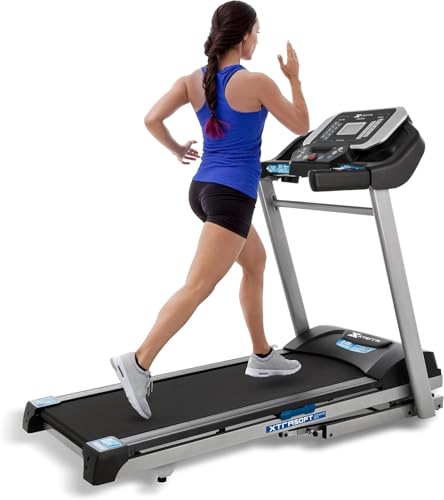
XTERRA TRX3500 Treadmill
XTERRA keeps the TRX3500 simple, with a 2.5 continuous horsepower motor and a basic LCD console rather than a touchscreen. Incline adjusts manually up to 10 percent, enough for light hill training without the cost of app connected machines. Folding hinges fit it into closets or under beds.
Pros
- Lowest cost entry point in this comparison
- Folds compactly for closet or under bed storage
- Simple console needs no subscription to use
Cons
- Motor is underpowered for serious daily running
- Incline adjusts manually rather than automatically

Schwinn 810 Treadmill
Schwinn’s 810 focuses on reliable basics, pairing a 2.5 continuous horsepower motor with Bluetooth speakers and a simple LCD display. There is no incline motor, so grade changes require manually propping the deck. It suits walkers and light joggers who want a straightforward machine.
Pros
- Straightforward console with no subscription needed
- Bluetooth speakers cover music without extra gear
- Reasonable price for a basic daily walking treadmill
Cons
- No motorized incline for hill style training
- Motor is not built for faster sustained running
How they stack up
| # | Model | Motor | Best for | Score | Price |
|---|---|---|---|---|---|
| 1 | NordicTrack Commercial 1750 Treadmill | 3.75 CHP continuous duty | Best overall | 9.4 | Check price |
| 2 | Sole F80 Treadmill | 4.0 CHP continuous duty | Best for heavy daily use | 9.2 | Check price |
| 3 | Horizon Fitness 7.0 AT Treadmill | 3.0 CHP continuous duty | Best value for incline training | 8.9 | Check price |
| 4 | Bowflex Treadmill 22 | 3.5 CHP continuous duty | Best interactive screen | 8.7 | Check price |
| 5 | ProForm Carbon TL Treadmill | 2.5 CHP continuous duty | Best compact foldable | 8.4 | Check price |
| 6 | XTERRA TRX3500 Treadmill | 2.5 CHP continuous duty | Best budget | 8.1 | Check price |
| 7 | Schwinn 810 Treadmill | 2.5 CHP continuous duty | Best simple no frills option | 8.0 | Check price |
Common questions
What horsepower do I need in a treadmill for running?
Look for at least 3.0 continuous horsepower for regular running, and closer to 4.0 CHP like Sole’s F80 if running happens most days of the week.
Are folding treadmills as sturdy as non folding ones?
Quality folding treadmills like the Commercial 1750 or F80 use the same motor and deck as non folding versions, with the hinge adding storage convenience rather than reducing stability.
How much weight capacity should a treadmill have?
Choose a capacity comfortably above the heaviest regular user, since running closer to the rated maximum wears the motor and deck faster over time.
Do treadmills need a subscription to use the incline features?
Automatic incline on app connected models like the Commercial 1750 or Bowflex Treadmill 22 typically needs a subscription for guided programs, though manual incline controls usually work without one.
What incline range is useful for hill training?
A range up to 10 to 15 percent, found on Horizon’s 7.0 AT and Sole’s F80, covers most hill simulation needs without requiring a decline feature.
Is decline on a treadmill worth having?
Decline mainly benefits runners training for downhill races or rehabbing certain injuries. Most home users get by fine with incline only, like Horizon or XTERRA offer.
How much floor space does a home treadmill need?
Plan for roughly 7 to 8 feet of length including clearance behind the belt, even on folding models like ProForm’s Carbon TL once unfolded for use.
Can a budget treadmill handle running or only walking?
Budget models like the TRX3500 or Schwinn 810 are rated for light jogging but their motors are not built for sustained fast running the way Sole’s F80 is.
How long should a home treadmill motor last?
A treadmill with a 3.0 CHP or higher motor and regular maintenance, like belt lubrication, commonly runs for several years of consistent household use.
Our take
NordicTrack’s Commercial 1750 remains the strongest all around pick for most households, pairing a capable motor with incline and decline in one touchscreen package. Runners putting in daily mileage should choose Sole’s F80 instead for its stronger motor and higher weight capacity, and anyone short on space or budget gets the most practical fit from Horizon’s 7.0 AT or XTERRA’s TRX3500.
Derek Holt
Derek has a background coaching recreational and amateur athletes and has worked the sales floor at specialty fitness retailers. He focuses on equipment durability, ergonomics and realistic use cases rather than marketing claims.
You might also need

A Golf Mat That Holds Up to Daily Practice Swings

Which Kick Scooter Holds Up Best for Daily Commutes?
Do Exercise Bikes Actually Pay Off for Home Workouts?